Tag: Belgium

Team Melli changes the American-based camp to Mexico.

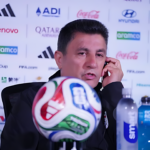
The Iranian national team will move its World Cup base camp to Mexico, according to a statement from Iran’s soccer federation president, Medhi Taj. The shift in location comes amid the ongoing war with the U.S. and related security concerns.

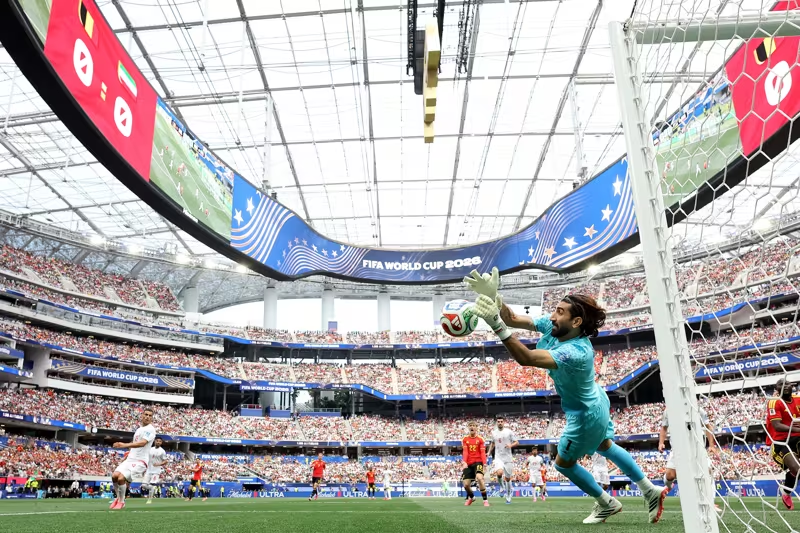
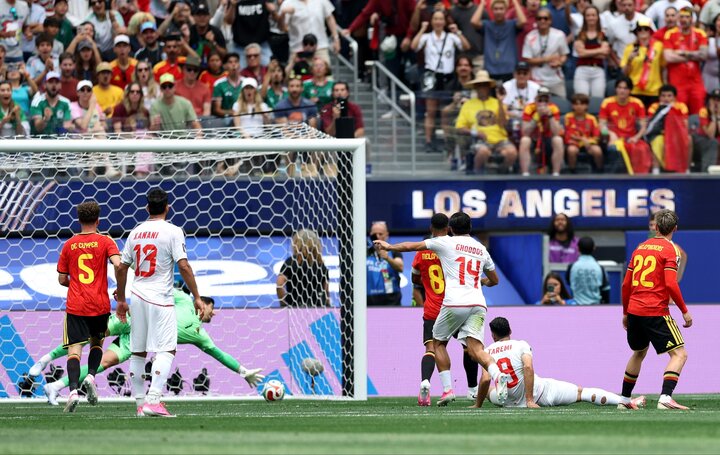
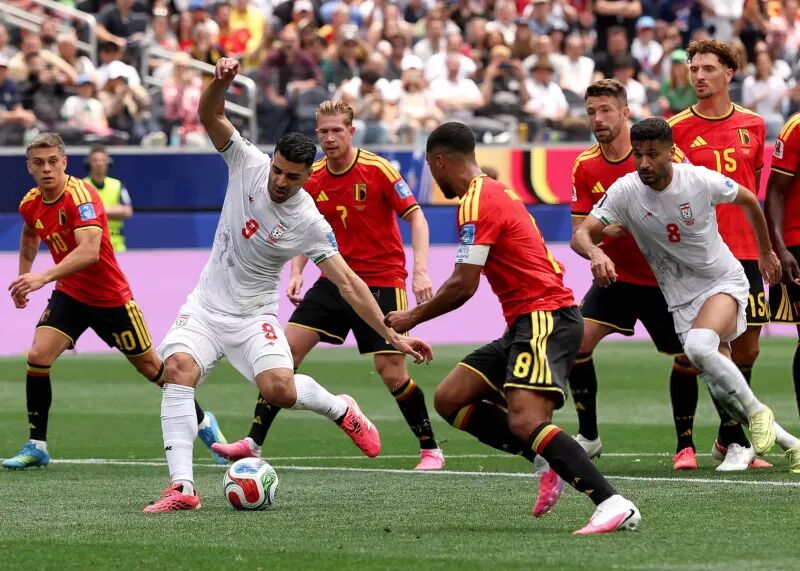
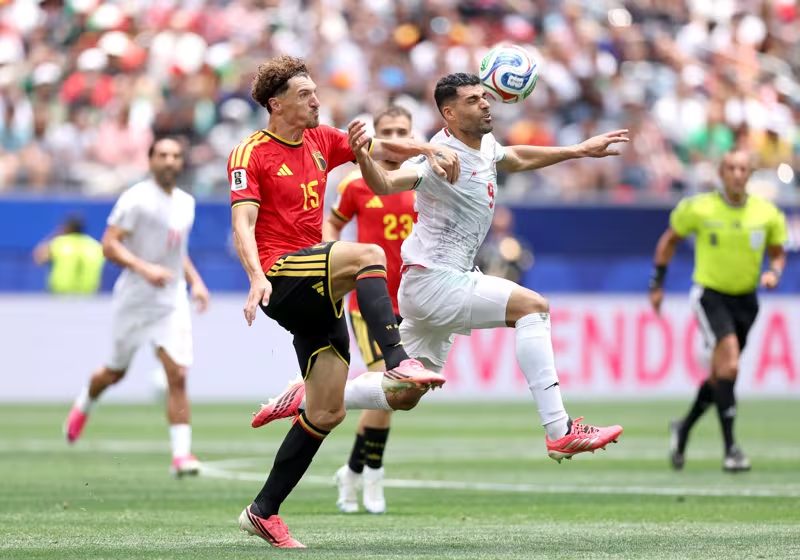
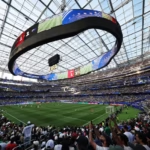
Iran was slated to train at the Kino Sports Complex in Tucson, Ariz., a location they decided on in mid-February before the regional conflict began; however, the country will now train out of Tijuana, a Mexican border city that is less than an hour flight to Los Angeles, where Iran will play its first Group G matches against New Zealand on June 15 and Belgium on June 21.

Tijuana is of similar distance to Seattle as Tucson would have been, with Seattle Stadium the final site of group play for Iran, facing off against Egypt on June 26.

“All team base camps for the countries participating in the World Cup must be approved by FIFA,” Taj said.

“Fortunately, following the requests we submitted and the meetings we held with FIFA and World Cup officials in Istanbul, as well as the webinar meeting we had on Friday in Tehran with the respected FIFA secretary general [Mattias Grafström], our request to change the team’s base from the United States to Mexico was approved,” he added, although FIFA has yet to confirm the move publicly.

“We will be based in the Tijuana camp, which is near the Pacific Ocean and on the border between Mexico and the United States, but within Mexican territory. The contract will be finalized, and there are no issues, as it has already been approved by FIFA.”

The question and capacity of Iran’s participation in the World Cup has loomed since late February, when World Cup co-host U.S. first launched its aggression, killing over 100 students in a girls’ school in Minab.

Directly after the initial airstrikes, Iran put their World Cup participation in question. “What is certain is that after this attack, we cannot be expected to look forward to the World Cup with hope,” Taj told the Iranian sports outlet Varzesh3.

Iran was then the only country not present the following week for FIFA’s three-day event in Atlanta to review the logistics of the tournament, an absence which saw U.S. President Donald Trump fuel the fire, stating: “I really don’t care [if Iran participates]. I think Iran is a very badly defeated country. They’re running on fumes.”

While Iran backtracked on some statements regarding the World Cup boycot and with much convincing by FIFA and Gianni Infantino in person, it was finally confirmed that Iran will compete at the 2026 edition. Nevertheless, Iran did try to move its World Cup matches to Mexico following what many interpreted as a veiled threat from Donald Trump to the Iranian delegation. In a pointed remark, the U.S. president declared that while Iran “is welcome to the World Cup, [he] doesn’t really believe it is appropriate that they be there, for their own life and safety”, a statement in which he made clear that the U.S. government cannot guarantee the safety of Iran’s squad on American soil.

Iran’s request to move its games to Mexico was a logistical undertaking that FIFA President Gianni Infantino outright denied; however, it seems the country and global organization reached some sort of compromise by having the Mexican training base, enabling Iran to fly to and from the U.S. only for matches.

FIFA refuses Iran request to move games to Mexico amid US conflict

FIFA has decided against moving Iran’s World Cup matches from the United States to Mexico despite the war in the Middle East, Mexican President Claudia Sheinbaum said on Friday.

Iran requested not to play its three group stage matches in the US, after the US and Israel attacked Iran on February 28 in fighting that has only stopped in recent days in a fragile ceasefire, with Washington threatening to continue its attacks.
“FIFA ultimately decided that the matches cannot be moved from their original venues,” Sheinbaum said at a press conference. From FIFA’s perspective, this would have entailed “an enormous logistical effort,” she said.

The world governing body had previously expressed reservations about Iran’s request to move their matches againast Belgium, New Zealand and Egypt at the June 11-July 19 World in the US, Mexico and Canada.

FIFA president Gianni Infantino had been pushing for Iran to take part, despite fraught relations between Tehran and Washington.

“We want Iran to play; and Iran will play in the World Cup. There is no plan B, C or D – there is only plan A,” Infantino told Mexican broadcasters N+ Univision two weeks ago.

Iranian football federation president Mehdi Taj has recently said the team is boycotting the US, but not the World Cup, without providing further details, according state-run news agency IRNA.
US President Donald Trump has said he considers it not “appropriate” for Iran to take part “for their own life and safety”.

Amid the ceasefire, called on Tuesday, talks between the US and Iran on a lasting peace settlement are set to take place in the Pakistani capital, Islamabad, as of Friday.

Iran retaliated after the United States and Israel launched the war, including targeting Gulf states and effectively closing the Strait of Hormuz, a key shipping lane.

Mexican President Claudia Sheinbaum

Iran could face sanctions if it withdraws from the World Cup.

Iran could face disciplinary action from FIFA, including a possible ban from future tournaments, if they unilaterally withdraw from the World Cup.

Donald Trump told Politico last week that he “really doesn’t care” if Iran fail to take part in this summer’s tournament, but FIFA remains committed to the World Cup going ahead with all qualified teams participating.

The president of the country’s football federation, Mehdi Taj, cast doubt on Iran’s involvement last week by saying “we cannot be expected to look forward to the World Cup with hope”, but pulling out may not be straightforward.

Under FIFA statutes, member associations are not permitted to withdraw from competitions, and declining to take part in a World Cup would be unprecedented in the modern era. No country has pulled out of the tournament after the draw since France and India did not take part in 1950, citing travel costs.

FIFA has protections in its tournament rules, which sources have indicated would be upheld. The regulations state that withdrawing before the tournament incurs a fine of between €275,000 (£238,000) and €555,000, depending on the date of the withdrawal, and triggers a referral to FIFA’s disciplinary committee, which could impose sporting sanctions.

“Participating associations that withdraw at any stage of the Fifa World Cup 2026 shall be required to reimburse all funds received from Fifa for the preparation of their national team, as well as any competition-related contributions received from Fifa,” the regulations state.

“The Fifa disciplinary committee may impose additional disciplinary measures, taking into account in particular the timing of the withdrawal or exclusion, the seriousness of the infringement that led to the inadmission or exclusion, possible mitigating factors, and any other relevant circumstances.

“These disciplinary sanctions may include the exclusion of the association concerned from a future Fifa competition or the replacement of that association by another.”

Iran have played at six World Cups, including the past three, in Brazil, Russia and Qatar. Their Group G opponents this summer are New Zealand, Belgium and Egypt, and they would face the United States in the knockout stage if both sides qualify as group runners-up.

Iranians are barred from entering the US under a travel ban introduced by the Trump administration last June, although it permits exemptions for athletes involved in the World Cup or 2028 Olympics in Los Angeles.

FIFA was contacted for comment.

Guide to Group G at World Cup 2026

Guide to Group G at World Cup 2026

Dan Goldfarb/The Athletic By The Athletic UK Staff

Dec. 5, 2025Updated Dec. 6, 2025 9:41 pm GMT+3

The World Cup draw is complete and Belgium, Egypt, Iran and New Zealand have been drawn together in Group G.

How did the teams qualify? How do the different countries play? And who are the key protagonists in the group?

Group G

Games in: Los Angeles, Seattle, Vancouver, Canada

See full draw results


The schedule: Games, venues, dates and kick-off times

Matchday 1

  • Monday, June 15: Iran vs New Zealand (9pm ET, 6pm PT, 2am BST+1) — SoFi Stadium, Los Angeles
  • Monday, June 15: Belgium vs Egypt (3pm ET, 12pm PT, 8pm BST) — Lumen Field, Seattle

Matchday 2

  • Sunday, June 21: Belgium vs Iran (3pm ET, 12pm PT, 8pm BST) — SoFi Stadium, Los Angeles
  • Sunday, June 21: New Zealand vs Egypt (9pm ET, 6pm PT, 2am BST+1) — BC Place, Vancouver

Matchday 3

  • Friday, June 26: Egypt vs Iran (11pm ET, 8pm PT, 4am BST+1) — Lumen Field, Seattle
  • Friday, June 26: New Zealand vs Belgium (11pm ET, 8pm PT, 4am BST+1) — BC Place, Vancouver

Belgium

Dan Mullan/Getty Images

How did they qualify?

With relative ease. Despite two draws against North Macedonia and another with Kazakhstan delaying the inevitable, Belgium still went unbeaten across their eight games.

It was never going to be a tough group for Belgium, given it’s been a decade since they last lost a World Cup or European Championship qualifying game. That defeat came against Wales, but the Belgians paid them back in this qualification competition. The Welsh were their closest challengers for top spot, and will be in the UEFA playoffs in March, but got beaten 4-3 and then 4-2 in the two meetings.

What is their World Cup pedigree?

Belgium first made a dent in a World Cup in 1986, finishing fourth. Argentina’s Diego Maradona prevented them reaching the final but Enzo Scifo was named the young player of the tournament, before helping them get out of the group stage again four years later.

It was not until the 2014 World Cup that Belgium were considered a powerful nation once more but they lost to Argentina again in the quarter-finals that year and then at Russia 2018, when they were among the favourites, they lost to eventual champions France beat them in the semi-finals. Both 1-0 defeats were seen as missed opportunities for a team of such quality. Belgium’s failure to make it out of the group in 2022 was widely regarded as the end of that chapter for a golden generation of players who had grown old together.

Who is the coach?

Rudi Garcia. The Frenchman took over in January from Domenico Tedesco, who failed to build on Roberto Martinez’s six-year tenure, half of which they spent in first place in the FIFA world rankings.

Garcia, who oversaw a 4-3 aggregate play-off victory against Ukraine in March to keep Belgium in the top tier of the UEFA Nations League, made his name in club management by winning the French title with Lille in 2011 and finishing second in Italy’s Serie A twice with Roma in 2014 and 2015. Known for his attractive style of play, he also took Lyon to the Champions League semi-finals in 2020 by beating Manchester City but his star has faded in recent years after Napoli’s form dropped off after he was appointed in summer 2023.

The 61-year-old Frenchman’s previous role had been at Saudi Pro League club Al Nassr, but the two parties mutually parted ways after 10 months with the team trailing Al Ittihad in the table and reports of an uneasy relationship between Garcia and star player Cristiano Ronaldo.

How do they play?

Garcia has stuck with a 4-3-3 shape so far, in contrast with Tedesco’s regular switches of formation. Right-back Thomas Meunier has praised how he has breathed fresh optimism into the group with a major focus on possession and counter-pressing. Garcia has been bold in giving opportunities to several new faces, including Rangers midfielder Nicolas Raskin and Club Brugge full-back Joaquin Seys.

Other defenders, such as Sporting CP’s Zeno Debast, Koni De Winter of Milan and Brighton & Hove Albion’s Maxim De Cuyper are taking on the mantle left by the ‘golden generation’ back line featuring Vincent Kompany, Toby Alderweireld, Jan Vertonghen and Thomas Vermaelen. Garcia is blessed in terms of his wide options. Jeremy Doku, Leandro Trossard, Charles De Ketelaere, Alexis Saelemaekers and Malick Fofana have all been utilised, but it is Doku who is emerging as the key threat.

Who is their key player?

Doku. The 23-year-old Manchester City winger has taken a step up at club level this season and looks to be taking on more responsibility with Belgium, too. He started all eight games during qualification, scoring five goals and assisting three, as he switched between the left and right flanks. Napoli midfielder Kevin De Bruyne, once he returns from the serious hamstring injury suffered in late October, could still be their talisman with his vision as a passer but is slowing down at age 34 (he’ll turn 35 during the World Cup). Doku is the player Belgium look to feed most often now, because of his unrivalled one-v-one ability.

What else should we know about them?

They have Thibaut Courtois back in goal after his controversial refusal to play under Tedesco. The Real Madrid goalkeeper fell out with their previous manager and said in August 2024 that he would not add to his then total of 102 caps as long as he remained in the job. Fortunately for Courtois, he only had to wait just over six months and was brought back into the fold post-Euros after talks with new coach Garcia. However, Belgium have had internal problems previously, with big-name players such as De Bruyne and Vertonghen clashing at the last World Cup over the midfielder’s comments about their aging defence.

Jordan Campbell


Egypt

NurPhoto via Getty Images

How did they qualify?

Egypt did not lose a single game in Group A in the African qualifiers, winning eight and drawing twice.

However, they only confirmed their qualification in October, by topping the group after beating Djibouti 3-0 with two goals from Mohamed Salah.

Burkina Faso were tailing them throughout the qualifiers, but the 0-0 draw between the sides in Ouagadougou in September maintained Egypt’s five-point gap and solidified their status at the top of the group.

FIFA MEN'S WORLD CUPTop FIFA MEN’S WORLD CUP Stories

2026 World Cup final set for 3pm ET kick-off: Full tournament schedule

Determining hardest, easiest groups, best games and Golden Boot winner at the 2026 World Cup

This was a World Cup draw to whet the appetite for a tournament full of stars and intrigue

What is their World Cup pedigree?

Despite being the first Arab and African nation to participate in the World Cup, in 1934, Egypt has never won a match at the tournament.

Granted, they only qualified two times after that, in 1990 and 2018, with World Cup qualification being a hoodoo in the period in between. Egypt were pitted in the group of death in the 2002 and 2006 qualifiers, lost a tie-breaker against Algeria in 2009, and broke down against Ghana in the play-off round of the 2014 qualifiers.

The 2018 edition was a disappointment, with Salah entering the tournament injured and the team losing their three matches in the group stage.

Who is the coach?

The legendary striker, Hossam Hassan.

The three-time AFCON winner is one of the best centre-forwards in Egypt’s history. He holds the record for the most goals scored for the national team (69) and is only bettered by Ahmed Hassan (no relation) in terms of the number of appearances.

Hassan, who played in the 1990 World Cup, won numerous domestic trophies alongside the CAF Champions League in 2002 with Zamalek.

However, he had to cross the biggest divide in Egyptian football to join Zamalek. As a young player, Hassan was brought up through Al Ahly’s youth ranks, and went on to become one of the best players in the club’s history.

His managerial career has mainly been inside Egypt, apart from a brief spell with Jordan’s national team in 2013-14.

How do they play?

In their 4-3-3, Salah and Manchester City’s Omar Marmoush flank the front line. It is therefore understandable why Egypt focus on attacking the wide areas, with Salah having the freedom to drop and roam.

Zizo operates as the right-sided midfielder, and his attacking profile complements Salah’s tendency to drop and create from midfield.

The left No 8 role has recently been occupied by Trezeguet, but Emam Ashour’s return from injury might alter the team’s starting line-up.

Ashour’s profile is more suited to the midfield role, and he offers something different than the ex-Aston Villa winger.

Who is their key player?

The man needs no introduction.

Salah has been the key player in Egypt’s national team for many years now, and unlike other Egyptian legends, he has not played with the strongest of squads.

Despite that, he managed to guide Egypt to the 2018 World Cup, ending the country’s 28-year wait to appear at the finals. However, the Liverpool forward’s shoulder injury in the 2018 Champions League final against Real Madrid affected the national team going into the tournament.

Then, his penalty miss in the shootout in the play-off round against Senegal in 2022 harmed Egypt’s chance of reaching the 2022 World Cup.

In 2026, he will be hoping to help open a new page in his country’s World Cup history.

What else should we know about them?

By the World Cup, Salah might be in position to surpass his head coach as the top goalscorer in Egypt’s history.

Currently, Salah is on 63 goals – six away from Hassan – and can increase his tally in the upcoming AFCON.

Yet, it would be a greater achievement if Salah can couple that with winning AFCON and helping Egypt reach the knockout stage of the World Cup for the first time in their history.

Ahmed Walid


Iran

Markus Gillar/Getty Images

How did they qualify?

There were a few bumps along the way and some unconvincing performances, but ultimately Iran made it through without too many alarms and with two games to spare — their only defeat of the entire 16-match, two-round qualifying campaign came against Qatar, after safe passage had already been sealed.

What is their World Cup pedigree?

This will be their fourth World Cup in a row, meaning they will have now participated in more tournaments since 2014 than in their entire history before that. Iran are yet to make it past the group stage, though, with their best performance coming in 2018, when they dramatically beat Morocco and drew with Portugal but a narrow defeat by Spain kept them from the knockouts. Last time, they were comfortably beaten by England and the United States, their only success coming thanks to goals in the 98th and 101st minutes against a Wales side down to 10 men by that stage.

Who is the coach?

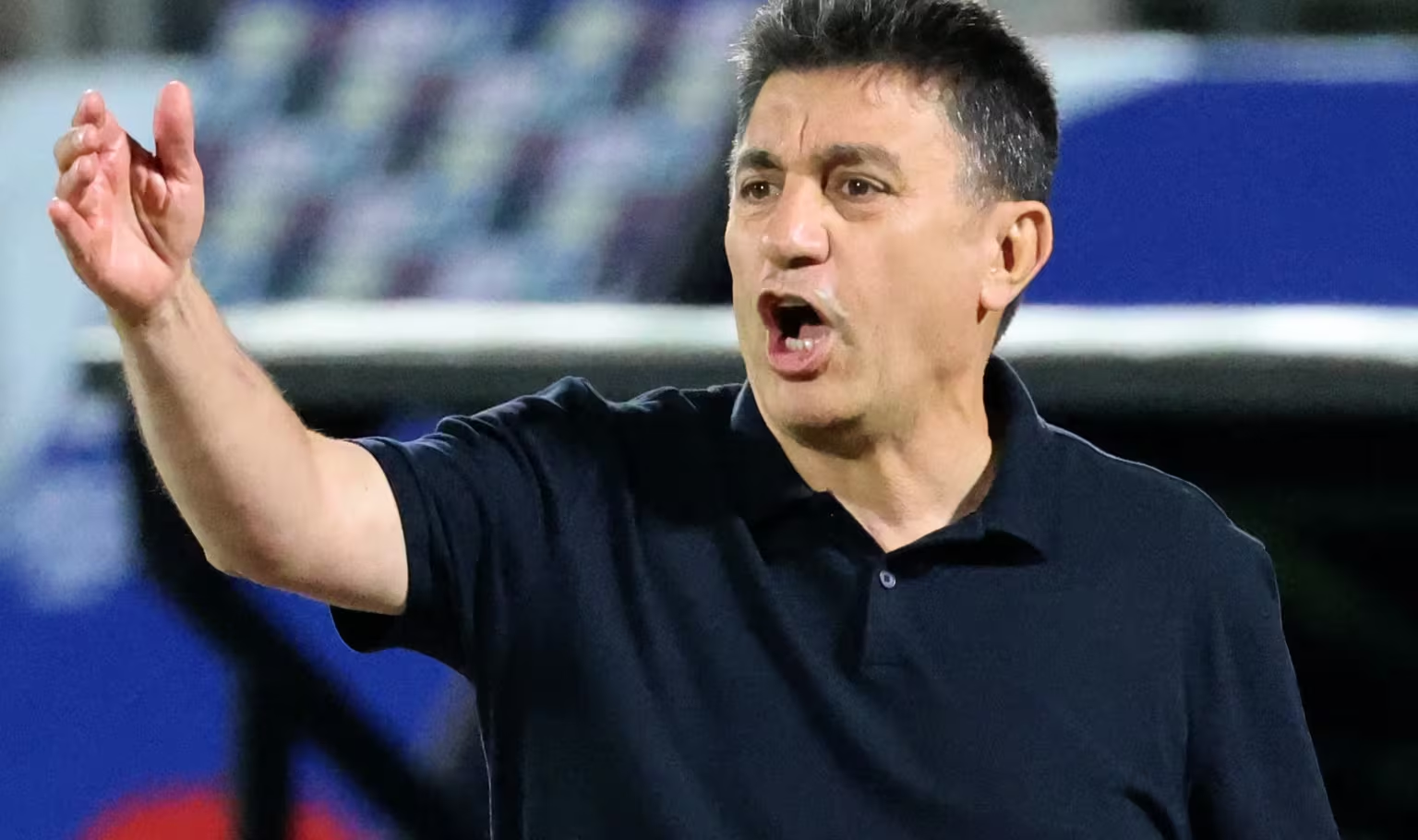
This will be their first World Cup since 2006 without Carlos Queiroz in the dugout, his successor Amir Ghalenoei having taken over for a second spell in charge following that 2022 World Cup. On paper, Ghalenoei’s record is pretty good: qualification was relatively straightforward and his win percentage is up in the 70s. But there is plenty of dissatisfaction with his approach, not least that he still relies on the old guard — players in their thirties such as Alireza Jahanbakhsh and former Brentford midfielder Saman Ghoddos.

How do they play?

Do not expect attractive, expansive football. Under Queiroz, they were very solid: no frills, two banks of four with a couple of forwards, usually Mehdi Taremi and Sardar Azmoun. It largely worked, and it continues to work in terms of results, but there has been a desire to offer something slightly more interesting and attacking, which in theory should have come with a younger generation of players emerging, but neither has really materialised.

Who is their key player?

It is still probably Taremi, now scoring goals for Greek champions Olympiacos after a season in Italy with Inter. It will be fascinating to see how they deal with Jahanbakhsh if he does not find a club before the tournament starts. On talent, he would still probably be in their strongest team, but surely they cannot pick someone who, by the time Iran’s first group game kicks off in June, will not have played club football for over a year. In terms of young talent, watch out for midfielder Mohammad Hosseinnejad and striker Kasra Taheri.

What else should we know about them?

Of all the teams at the tournament who will have to deal with outside distractions, Iran surely have the most. The issue of how many of their fans will even be allowed into the United States to watch their games is something that will run and run from now until the whole thing starts in June. And also remember that at the previous World Cup three years ago, Iran’s players protested against the repression of protests back home. Will all of that be too much for them to actually perform as they can?

Nick Miller


New Zealand

Sebastian Frej/Getty Images

How did they qualify?

Since Australia became Asian for footballing purposes ahead of South Africa 2010, New Zealand are the game’s big hitters in Oceania. A bye into the second stage of that confederation’s qualifying competition for the side ranked 86th in the world by FIFA, was followed by three wins from three, 19 goals scored and one conceded as New Zealand breezed past Tahiti, Vanuatu and Samoa. A 7-0 thrashing of Fiji in a third-phase semi-final and then a 3-0 defeat of New Caledonia sealed their World Cup place at a canter.

What is their World Cup pedigree?

Modest. This will be New Zealand’s third appearance at the finals, though each has represented progress of various kinds. Their debut came in 1982, the first edition that was expanded from 16 teams to 24. It started with New Zealand’s first World Cup goals, coming in a 5-2 opening defeat by Scotland. Their group-stage exit was sealed by defeats to the Soviet Union (3-0) and Brazil (4-0). Then in 2010, Winston Reid’s stoppage-time equaliser against Slovakia gave them their first World Cup point. They also led a match in the finals for the first time, during a 1-1 draw against Italy, before finishing third in their four-team group after a goalless draw with Paraguay. New Zealand were the only team to finish that South Africa World Cup unbeaten (eventual winners Spain ost their opening group match against Switzerland).

Who is the coach?

Darren Bazeley will be familiar to some Watford fans. The English-born full-back made almost 300 appearances for that club to begin a senior playing career during which he eventually swapped EFL side Walsall for the Auckland-based New Zealand Knights in the Australian A-League 20 years ago. His subsequent coaching career led him to joining the New Zealand setup as under-17s assistant in 2009 — his only break from the national team since being a stint in MLS with Colorado Rapids and A-League at Newcastle Jets. Come July 2023, Bazeley was appointed New Zealand’s head coach for this World Cup cycle, while simultaneously leading the under-23s at the 2024 Olympics. Bazeley’s side were knocked out in the group stage there, finishing behind the United States and hosts France, who went on to win silver medals.

How do they play?

Despite New Zealand’s limited resources and lowly FIFA ranking, Bazeley has his side trying to play possession football. They use a 4-2-3-1 formation and look to build up without the default option of whacking long balls up to the obvious focal point of Nottingham Forest striker Chris Wood. A 1-0 defeat in Poland and 1-1 draw in Norway — albeit the latter was against a team without Erling Haaland — during their two October friendlies showed this team can make that plan work to a point. The greater difficulty was taking the chances they did create, especially when falling to someone other than their No 9. Wood’s involvement in those two friendlies was limited to 68 minutes.

Who is their key player?

A very simple answer to this. Shall we say it all together? Yes, it’s Wood. The 33-year-old, long-time Premier League striker with West Brom, Leicester, Burnley, Newcastle and now Forest is New Zealand’s highest-profile player, the country’s all-time leading scorer with 45 goals and the joint highest appearance-maker alongside former Eredivisie defender Ivan Vicelich, with 88. The tall, rangy, dangerous finisher is also their captain. Wood has already been prolific in the English top flight, and has scored at European level this season. Come the summer, he will aim to get his first goal at a World Cup.

What else should we know about them?

New Zealand’s All Whites nickname came about when the team appeared in a — no prizes here — all-white kit for the first time in the lead-up to that World Cup debut in Spain. No surprises either that it is a soccer counterpoint to the continuing legend of New Zealand’s rather more successful All Blacks rugby union squad. However, in recent years there have been discussions over cultural diversity and representation, and whether the name should continue to be used. More colourful kits for match officials in modern football at least ensure New Zealand can have an all-black change strip these days.

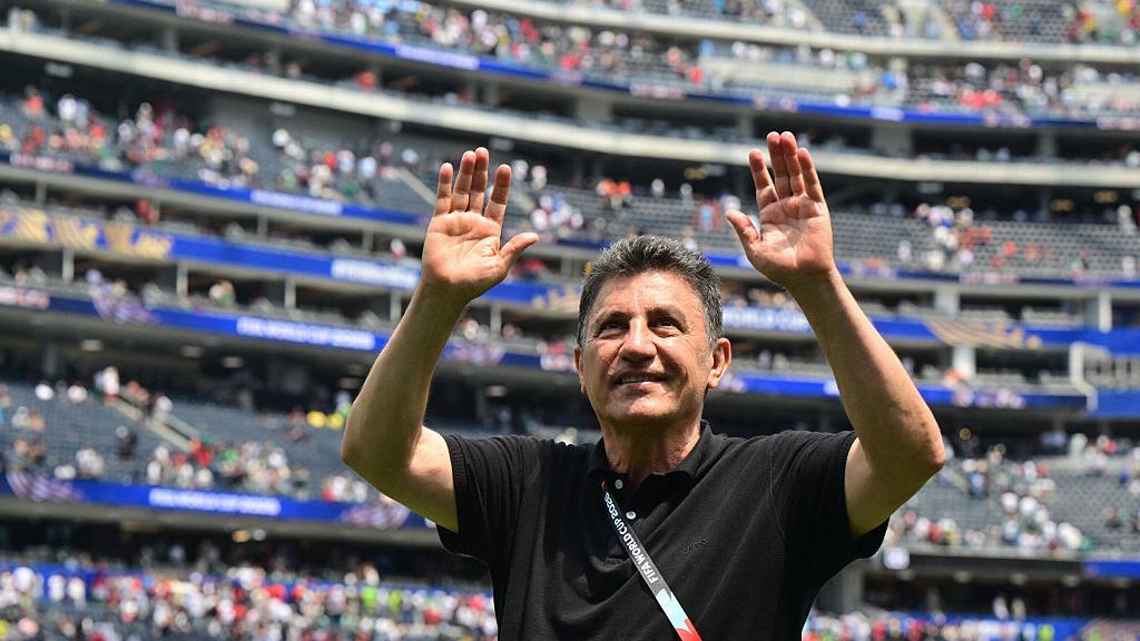
Amir Ghalenoei

WORLD CUP 2026: NO MORE EXCUSES. GHALENOEI’S “GOLDEN DRAW” DEMANDS HISTORY.

The lot is cast. The path is clear. For Iran’s Team Melli, the 2026 FIFA World Cup draw wasn’t just favorable—it was a screaming mandate from destiny itself.

Group G: Belgium. Egypt. New Zealand.

This is the draw Head Coach Amir Ghalenoei practically conjured in his sleep. Now, his grand, repeated promise—to finally smash the 48-year curse and reach the knockout stages—isn’t just a coach’s hopeful chatter. It’s a blood contract with 85 million expectant souls. There are no more shadows to hide in. The spotlight is white-hot and fixed squarely on him and his squad.

The Equation is Brutally Simple:
Belgium is the Goliath. New Zealand is the appetizer. Egypt is the DOOR. That single, 90-minute battle against the Pharaohs is the gate to history. Win that, and the promised land is in sight. Stumble, and the “golden generation” becomes another footnote in a chronicle of heartbreak.

Forget “What If.” This is “What Must Be.”

Ghalenoei wanted this. He called it. Now he must own it. The excuses of “groups of death” are gone. The lament of impossible odds is silenced. This group is a corridor, not a cage. Belgium’s glittering stars—Doku, Trossard, Lukaku—are a test, not a death sentence. Egypt’s Mohamed Salah is a challenge to be neutralized, not a myth to be feared.

The Pathways to Glory (or Infamy):

  • Finish Second. Slay the Dragon. Do the job. Beat Egypt, handle New Zealand, and you’ll likely face the USA in a Round of 16 firestorm dripping with a quarter-century of geopolitical tension. It’s the blockbuster the world wants and the trial by fire Iran needs to prove it belongs.
  • Win the Group. Seize the Throne. Shock Belgium, and the tournament cracks wide open. A smoother path emerges, daring the nation to dream not of one win, but of a quarter-final run.
  • Squeak Through Third. Walk Through Hell. The coward’s path. It likely means France in the last 16, then Germany. A brutal, glorious slaughterhouse.

The calculus is clear. Second place is the only acceptable answer. Third is a nervous disgrace. First is a statement that would echo for decades.

This is it. The perfect storm of opportunity, talent, and timing. The draw has handed Iran a blade sharp enough to cut through its own history of anguish. The question is no longer about possibility. It’s about nerve. Does Team Melli have the cold-blooded fortitude to grip that blade, look Egypt—and its own haunted past—in the eye, and finally, finally, carve its name into the next round?

Ghalenoei made the promise. The football gods have delivered the stage. Now, Iran must deliver the blood, sweat, and glory. No more excuses. No more “next time.” The clock starts now.

World Cup 2026 Draw: Iran’s Golden Opportunity in a Tantalizing Group G


The path for Iran’s historic quest to reach the knockout stages of a FIFA World Cup for the first time since 1978 has been revealed. Drawn into Group G for the 2026 tournament alongside Belgium, Egypt, and New Zealand, Team Melli finds itself in a promising, yet delicately balanced, constellation.

On paper, this is arguably the most favorable draw Iran could have hoped for from Pot 3. Avoiding global powerhouses and continental giants, the group presents a clear hierarchy and a defined target: second place.

The Hierarchical Favorite: A Belgian Juggernaut

At the summit sits Belgium, the undeniable frontrunner. A nation brimming with elite talent, they represent Iran’s most formidable challenge. Stars like the creative force of Leandro Trossard (Arsenal), the electrifying Jérémy Doku (Manchester City), and the prolific Romelu Lukaku (Napoli) form an attack capable of breaching any defense.

For Iran, this matchup is a dual threat. Not only is it a first-ever meeting at any level, posing tactical unknowns, but it also starkly highlights Team Melli’s most significant vulnerability: a historically inconsistent and vulnerable defensive line. Containing Belgium will require peak organization, discipline, and likely a game plan built on resilient defending and exploiting rare counter-attacking opportunities. A point against the Belgians would be a monumental result; the primary objective will be to keep the goal difference intact.

The Decisive Duel: Iran vs. Egypt for Progression

The pivotal battle in Group G will almost certainly be the clash between Iran and Egypt. This is the match that will likely determine which nation advances alongside Belgium. The Pharaohs, record seven-time African champions, present a fascinating paradox.

While they have experienced a slide in consistency under new manager Hossam Hassan, they possess the ultimate wildcard: Mohamed Salah (Liverpool). Alongside the rising talent of Omar Marmoush (Manchester City), Egypt boasts individual brilliance that can single-handedly decide matches. Iran’s task is clear: neutralize these threats. The midfield battle will be crucial, requiring Iran to control the tempo and deny service to Egypt’s star forwards. A draw here would be a setback; victory would place Iran’s destiny firmly in its own hands.

The Presumed Must-Win: Navigating New Zealand

Completing the group is New Zealand. While the All Whites are a physically robust and organized side, they represent a matchup where anything less than three points would severely damage Iran’s progression hopes. Iran’s historical advantage (undefeated in previous meetings) and New Zealand’s lack of week-in, week-out high-level competition in the OFC confederation are tangible factors in Team Melli’s favor.

However, underestimating New Zealand would be a grave mistake. Their athleticism and set-piece prowess demand utmost respect. This match is where Iran must demonstrate the clinical edge and tactical maturity that has sometimes been lacking in past World Cups.

The Road Ahead: Beyond the Paper Advantage

Labeling this a “golden opportunity” is accurate, but the real work begins now. To transform this favorable draw into history, Team Melli must address deep-seated challenges in the coming months:

  • Tactical Cohesion: Coach Ghalenoei must devise a flexible system—one that can withstand Belgian pressure, wrestle control from Egypt, and break down a stubborn New Zealand.
  • Defensive Solidity: Fixing the frail defense is non-negotiable. This requires identifying a stable backline and cultivating an understanding that can survive 90 minutes against the world’s best.
  • Mental Fortitude: The weight of 48 years of knockout-stage absence is heavy. The team must cultivate a winning mentality, replacing fear with belief in high-stakes moments.
  • Administrative Stability: Off-field harmony and unwavering support from the football federation are essential to provide the team with an optimal environment to prepare.

Conclusion: Group G is a gift of chance, but advancement will be earned through preparation, precision, and passion. The dream is alive and well. For the first time in generations, the path for Iran to make World Cup history is not just a hope—it’s a clear and achievable mission.


Kaveh Rezaei is a free agent.

The Belgian club OH Leuven has announced that it will not renew Kaveh Rezaei’s contract and that the Iranian striker will soon join a team outside the Belgian league.

According to sport website, Sportal, Kaveh Rezaei is now a free agent. The leaders of the OH Leuven decided against contract extension due to several reasons. Rezaei never proved himself in Leuven and failed to score even a single goal in 13 games, after which a broken leg ended the season prematurely for Team Melli forward.

  • Rezaei last made an appearance in a First Division A-game on February 9, playing only 10 minutes for OH Leuven versus Genk in a 2-1 win. This season he has registered one league assist. He has been shown one yellow card.
  • OH Leuven are 11th in the league standings with 41 points and next face a home match against Antwerp in First Division A action on April 2.

Rezaei played for OH Leuven since last summer when he was transferred from Club Brugge. He performed very well in 2018, especially in Charleroi. Thus, Kaveh Rezaei is unlikely to stay in the Belgian league.


Kaveh Rezaei Stats

Season Team Minutes Started Started Sub in Sub out Bench Goals YC
2021/2022 OH Leuven 497 13 5 8 3 11 0 1
2020/2021 Sporting Charleroi 1570 25 18 7 11 8 7 1
2019/2020 Sporting Charleroi 1641 22 18 4 9 5 12 2
2019/2020 Club Brugge 0 0 0 0 0 1 0 0
2018/2019 Club Brugge 409 11 4 7 4 12 1 0
2018/2019 Sporting Charleroi 287 4 3 1 2 1 3 0
2017/2018 Sporting Charleroi 3118 39 34 5 11 6 16 6
7522 114 82 32 40 44 39 10

Team Melli complexion is changing rapidly.

After the transfer of Sepahan’s and Team Melli Captain Ehsan Hajsafi to AEK Athens, Iran has just five players playing in the domestic Persian Gulf league. That puts Iran among the group of countries whose majority of the national team players play abroad. These countries, including World Cup holder France and FIFA Top ranking team Belgium, have only a few footballers that are based at home.

With the conclusion of the 2020/21 season of the Persian Gulf League in which Persepolis won the title for the fifth time in a row, 3 significant transfers were confirmed. Hossein Kanani from Al Ahli of Qatar from Persepolis, Payam Niazmand to Portimonense of Portugal, and Ehsan Hajsafi to AEK Greece from Sepahan, the last 23-man squad of Team Melli home-based players reduced to five only,

Vahid Amiri,  Milad Sarlak, Ahmad Nourollahi, Mehdi Torabi (all Persepolis), and Mehdi Ghaedi (Esteghlal) are the only players present in the World Cup qualifiers who are based in Iran. As for the latter player, Mehdi Ghaedi, his suitors have increased since his brilliant performance in AFC Champions League. Farhad Majidi announced a while ago, that he will not stop Ghaedi from seeking his fortunes in other pastures to improve his standard, which means the possible transfer of the best current talent in Iranian football to a foreign club.

The full list of Team Melli with 19 players

Team Melli legionnaires also include the following players who were not part of the squad for the return legs of the FIFA World Cup Qatar 2022, who could be possibly invited to the next stage of qualifiers. These 6 players are as follow

In total 25 (83%) players are legionnaires out of 30

It is quite possible that under these circumstances, Iran will probably not have any players from domestic league playing for the country in the national team for several years to come, and there will be no trace of the old superiority and total control of Team Melli squad by the to poles of Iran football, Esteghlal, and Persepolis.

Several years ago, at the time of the decline of the domestic leagues of France and Belgium, all the players of these two powerful national teams were players working outside the domestic leagues. It seems that no player from the Belgian league was in the Red Devils’ starting line-up at Euro 2020 this year, and that was the case in France before the re-emergence of Paris Saint-Germain in France as one of the top teams in Europe.

The standard of Iran’s domestic league has fallen quite badly in the last few years due to several factors. Total government hegemony on clubs, chronic incompetent management, nepotism, poor coaching, politics, lack of resources, favoritism, corruption, and exceptional indiscipline have all resulted in a league that is relegated in the AFC Asian ranking to mid tables.

Iranian clubs have never won the AFC Champions League and the last time a club from Iran won a trophy was back in 1990/91 when Esteghlal won the Asian Club Championship, the predecessor of Champions League.

FFIRI board and Minster of Sports summoned to the Majlis.

Finally, Mehdi Taj and his entourage board members of the Football Federation are to be challenged about the circumstances of the suspicious and highly controversial deal by the parliament.

Mehdi Taj, along with several members of FFIRI board of directors and several current and former directors, attended a questioning session in the Islamic Consultative Assembly.

According to ISNA, the purpose of FFIRI board of directors’ appearance in Majlis is to determine if there was wrongdoing, negligence or corruption behind the signing of the deal with Wilmots, especially since the federation has been claiming for many years under both Ali Kaffashian and Mehdi Taj that it is critically short of funds even to pay its basic obligation, like the employee’s salaries, National teams training camps and inability to arrange meaningful friendly games for Team Melli to prepare for the World Cup citing fund shortage. Yet, the same federation that has been constantly seeking handouts from the government in effect using blackmail tactics, signs a multi-million dollar contract with a coach who has lasted only six months with Ivory Coast before he was sacked!

The FFIRI had steadfastly refused to disclose the terms of the deal and the justifications until public pressure and the threat of law suite finally exposed this horrendous commitment by the bankrupt federation.


Mehdi Taj and Ebrahim Shakoori, along with the current board of directors are under investigation for signing the worst sporting contract in the history of Iran at all levels. A contract with Marc Wilmots which resulted in Iran’s Team Melli not only risking eliminations from the qualifiers with two consecutive defeats under the Belgian but also resulted in the coach of Team Melli leaving the country accusing his employer of several breaches of the contract, which was supported by FIFA’s committee with Iranian side ordered to pay some € 6.2 million in fines to the person who has put Team Melli on the brink of elimination from the World Cup !.

The Minister of Sports and Youth Masoud Soltanifar and his deputies are also summoned for the hearing. It is strongly believed that the influence of the Minister was telling in the conclusion of the contract. With FFIRI board constantly seeking handouts, it is believed that none dared to challenge the Ministry’s choice while Soltanmifar denies any wrongdoing and only introducing the coach by recommendation of Iran-Belgium Chambers of commerce.

The executives are expected to answer questions from members of the Parliament about the background and the termination of the contract with Wilmots. FFIRI has borrowed over € 2.2 million from the social security organization to pay Wilmot’s salary.

Many observers are skeptical about any progress of the proceeding as it is feared that the issue will be kept under wrap and no one will be prosecuted especially since the Ministry of Sports and Youth is involved in the case as defendants.

Alireza Beiranvand to Antwerp

In the winter transfer window this season, Alireza Beiranvand signed a three-year contract with the Belgian side Antwerp, The Team Melli and Persepolis club goalkeeper was supposed to start his term in Belgium by today 1st July 2022, however, the COVID19 endemic and travel restrictions have postponed Beiranvands joining the team.

Beiranvand face difficulties attending Antwerp’s medical tests earlier due to the restrictions imposed.

The Team Melli goalkeeper, who had twice booked a ticket to travel to Belgium, stayed in Tehran due to flight restrictions. Persepolis Club also wanted to continue negotiations with their Belgian counterpart to keep Beiranvand until the end of the current season of the Persian Gulf league, but Antwerp in an official response to Persepolis Club’s letter called for Beiranvand’s presence in Belgium and did not allow him to continue his activities with Persepolis. Therefore, Beiranvand will not be able to participate in Persepolis training from today to wait for the flight to Belgium.

The latest announcement by the EU countries included a list of countries that are allowed to travel. Iran is not on the list hence Beiranvand needs to wait that much longer.