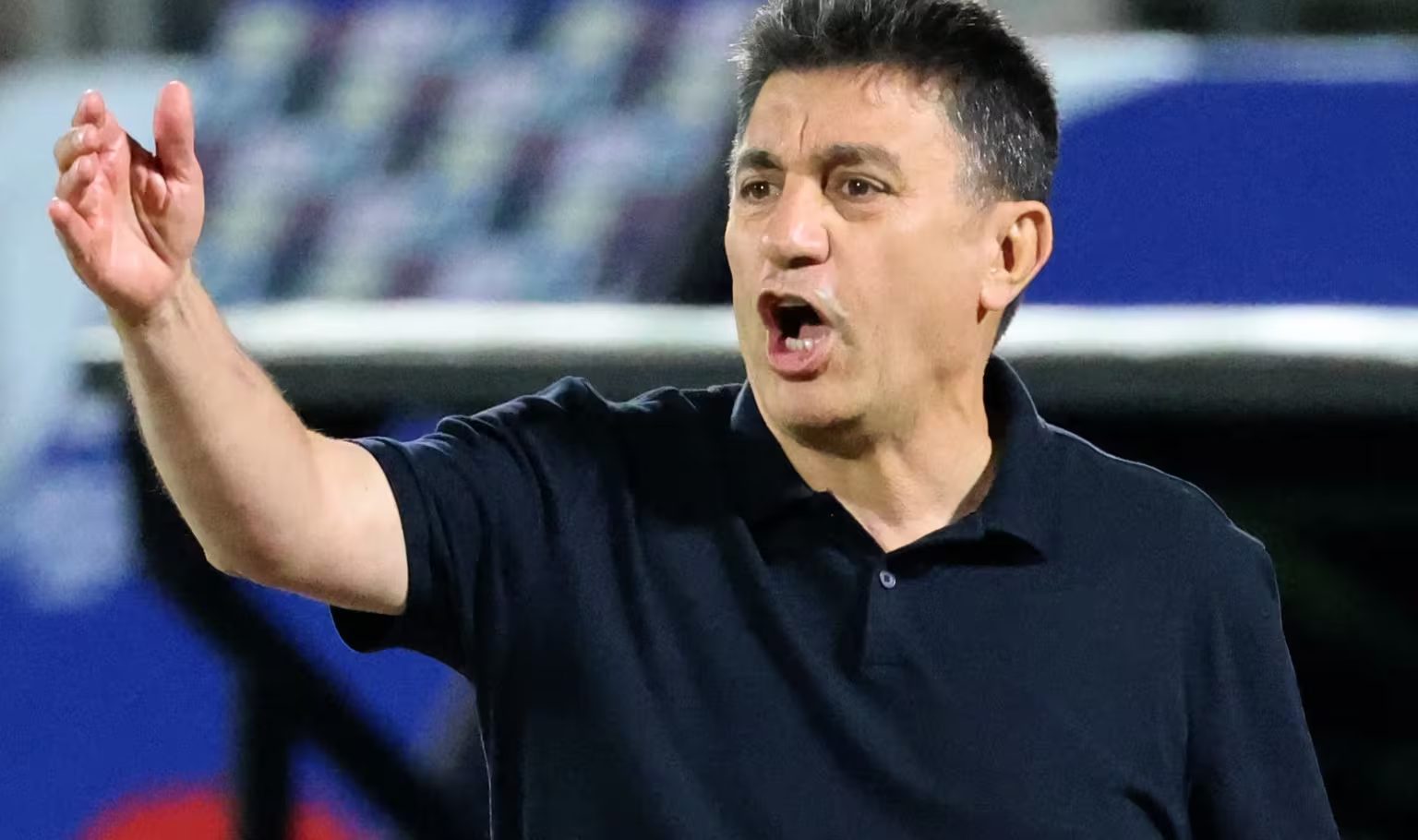
Tag: Amir Ghalenoei

Why so many Managerial Changes , but not in Iran !

As is customary in global football, failure at a FIFA World Cup almost always triggers accountability. Consequently, coaches resign, federations sack managers, and administrators step aside. Even so, although the 2026 edition is still ongoing, we already have 15 departures — a clear sign that many nations take their shortcomings seriously.

However, what stands out is that almost every manager on that list performed better than Team Melli, yet Iran once again appears immune to change. Despite this, and despite failing to qualify from one of the weakest groups in the tournament, there is no indication of introspection, responsibility, or even basic acknowledgment of failure.

In fact, although not officially announced, the head of FFIRI has already hinted that Amir Ghalenoei will continue leading Iran into the AFC Asian Cup 2027 and beyond. Ultimately, continuity is not the problem — blind continuity is.

The Illusion of Success

The hope for fundamental change in mentality, player selection, or tactical evolution remains remote. Moreover, what has improved, ironically, is the federation’s ability — along with the head coach — to manipulate public perception. As a result, a clear failure has been reframed as a “respectable performance,” a narrative that is repeated so often it begins to sound like truth.

Therefore, this is not football analysis; it is political messaging.

The Media’s Role in Manufacturing Consent

Furthermore, another striking element is the behavior of the domestic media. Almost all major outlets are state-controlled, and the football federation itself is under the same umbrella. Consequently, the result is predictable: full‑fledged support for the team, regardless of performance, wrapped in nationalistic rhetoric and political justification.

Instead, of honest evaluation, we get excuses. Instead, of accountability, we get slogans. Instead, of progress, we get stagnation.

Ultimately, the missed opportunity of this World Cup — a tournament where Iran genuinely had a chance to advance — is buried under layers of propaganda.

A Contrast: Saudi Arabia’s Example

Among the many departures worldwide, one stands out: Saudi Arabia’s football federation president, Yasser Al‑Misehal, resigned after his team failed to reach the knockout stage.

His statement was simple, direct, and refreshing:

“The failure of the national team to qualify for the next round of the World Cup is a result that falls short of all our ambitions, and I bear full responsibility for it. I offer my apologies to everyone who hoped to see our team in a better position.”

He continued:

“A sense of responsibility requires giving the opportunity to open a new chapter, and I have decided not to continue until the end of my current term.”

Clearly, this is not just a resignation — it is a culture of accountability. It also signals a country seeking progress, acknowledging shortcomings, and making room for improvement.

By contrast, such honesty is almost alien within FFIRI’s current culture and its political backers.

The Core Problem

Iran’s footballing stagnation is not due to lack of talent, resources, or passion. Rather, it is due to a system that:

  • refuses to admit mistakes,
  • punishes criticism,
  • rewards loyalty over competence,
  • and treats football as a political tool rather than a sporting project.

Until this changes, Iran will continue celebrating imaginary achievements while other nations — even those who performed better — take real steps toward improvement.

📌 Summary Count

Across all sources, at least 15 managers and coaches left their positions after the 2026 World Cup — roughly 25–27% of all head coaches, according to The Guardian and beIN SPORTS.

🟦 Post–World Cup 2026 Departures (Managers + Federation Chiefs)

Resigned / Sacked / Mutual Termination

Country / TeamNameRoleReason / NotesSource
Saudi ArabiaYasser Al‑MisehalPresident, Saudi Arabian Football FederationResigned after Saudi Arabia’s group‑stage exitbeIN SPORTS
TunisiaSabri LamouchiHead CoachSacked after 5–1 loss to SwedenCAF / beIN
TunisiaHervé RenardHead CoachResigned 18 days after appointmentAFP / Arab News
GhanaCarlos QueirozHead CoachResigned after Round of 32 exitGhana FA
Senegal Pape ThiawHead CoachSacked following  elimination in the round of 16 AP Sports
South KoreaHong Myung‑boHead CoachResigned after group‑stage eliminationNDTV / Guardian
CzechiaMiroslav KoubekHead CoachResigned after winless group stageCzech FA
ScotlandSteve ClarkeHead CoachResigned after failing to reach knockoutsBBC
NetherlandsRonald KoemanHead CoachResigned after Round of 32 loss to MoroccoDutch FA
GermanyJulian NagelsmannHead CoachLeft role after Round of 32 elimination to ParaguayDFB
PortugalRoberto MartínezHead CoachResigned after Round of 16 defeat to SpainPortuguese FA
CroatiaZlatko DalićHead CoachResigned after Round of 32 defeat to PortugalbeIN
MexicoJavier AguirreHead CoachDeparted as part of federation transition after eliminationFMF
UruguayMarcelo BielsaHead CoachLeft role after group‑stage eliminationCONMEBOL
EcuadorSebastián BeccaceceHead CoachDeparted after Round of 32 loss to MexicoEcuador FA

📌 Total Count

15 confirmed departures (14 head coaches + 1 federation president)

.

Amir Ghalenoei

The Ghalenoei Paradox: Statistical Brilliance or Competitive Failure?

A statistical examination of Amir Ghalenoei’s two managerial stints with Team Melli reveals a paradox: impressive numerical consistency on paper that contrasts sharply with a tangible lack of competitive pedigree.

First Tenure (2006–2007)
Ghalenoei’s initial spell began on August 8, 2006, with a 1–0 friendly victory over the UAE at Azadi Stadium. It lasted just over a year, culminating in a quarter-final exit from the 2007 AFC Asian Cup, where Iran were eliminated on penalty kicks by South Korea following a goalless draw. Remarkably, across these 21 matches, his side suffered only a single defeat—a heavy 4–0 loss away to Mexico in San Luis Potosí. His final record stood at:

  • P: 21 | W: 13 | D: 7 | L: 1 | Win%: 61.9%

Second Tenure (2023–Present)
His return to the helm began on March 23, 2023, with a 1–1 draw against Russia at Azadi. This second stint has featured participation in major tournaments and yielded one piece of silverware—the inaugural CAFA Nations Cup in 2023. His current record to date is:

  • P: 47 | W: 31 | D: 11 | L: 5 | Win%: 66.0%

The statistical veneer of Ghalenoei's record—particularly the low number of losses—belies a more troubling reality. A deeper critical assessment reveals persistent tactical shortcomings, a failure to capitalize on a favorable draw at the 2026 World Cup, and an inability to translate domestic success into continental or global glory.

🥇 The "CAFA" Asterisk

The solitary piece of silverware from his second tenure, the 2023 CAFA Nations Cup, offers limited vindication. The tournament's participants—Uzbekistan, Kyrgyzstan, Afghanistan, Tajikistan, Turkmenistan, and Oman—are not Asia's traditional powerhouses. While a victory is a victory, this triumph does little to address the more significant failures on the bigger stages that truly define a national team's legacy.

🏆 Continued Continental Failure

The primary indictment of Ghalenoei's tenure is the inability to end Iran's decades-long wait for an AFC Asian Cup title. At the 2023 Asian Cup, despite boasting a squad described as a potential "golden generation", Iran fell in the semi-finals to Qatar. The defeat was widely attributed to tactical errors in his lineup and substitutions, which Ghalenoei himself partially dismissed as misfortune. This failure to convert a talented squad into a championship, echoing the disappointment of his first stint in 2007, remains a significant blemish on his record.

🌍 A Wasted Opportunity at the 2026 World Cup

The 2026 World Cup represents perhaps the most glaring example of style over substance. Ghalenoei's side finished the group stage unbeaten, with draws against New Zealand, Belgium, and Egypt. However, they were still eliminated, finishing ninth among third-placed teams and missing the knockout rounds by a single spot.

This exit was particularly damning given the context:

  • A Favorable Draw: Iran was placed in a group with Belgium, Egypt, and New Zealand, which many saw as the team's most hopeful opportunity to advance in World Cup history.
  • Tactical Bankruptcy: The team was criticized for its "route one" or "Ali Asghari" football, a long-ball strategy that failed to create coherent attacking patterns. The coach was described as lacking the tactical flexibility required against elite opposition.
  • Questionable Squad Management: Perhaps most controversially, Ghalenoei left star striker Sardar Azmoun at home, a decision labeled a "tactical crime". He also relied on a core of players over 30, neglecting younger talent.
  • Poor In-Game Decisions: His substitutions and in-game reading were heavily criticized, with baffling decisions made against Belgium and a failure to adjust tactics when key players like Mehdi Taremi were isolated.

📉 Out of His Depth at the Highest Level

The recurring critique is that Ghalenoei, despite being a legend in the domestic league, is out of his depth at the international level. At the World Cup, he appeared "reactive, hesitant, and ultimately outmatched" compared to other coaches. His pragmatic, defensive approach may succeed against continental rivals, but it lacks the tactical nous required to compete with the world's elite.

📊 A Statistical Mirage

The impressive win percentage and low loss count are, therefore, a statistical mirage.

  • Inflated by Weak Opposition: Many of these victories have come against weaker Asian and Central Asian sides.
  • Context of the World Cup: The unbeaten record at the 2026 World Cup is a hollow achievement, as the team failed to secure the single win needed to progress from a group they were expected to navigate.
  • Elite-Level Failures: When faced with the highest level of competition or the pressure of a knockout tournament, the team has consistently fallen short.

In essence, Ghalenoei's record is one of a manager who has mastered the art of not losing but has repeatedly failed to master the art of winning when it truly matters.

TOURNAMENTS

#CompetetionYearLevelResult
1AFC Asian Cup 2007ContinentalQuarter-Finals
2CAFA Nations Cup2023RegionalChampion
3AFC Asian Cup 2023ContinentalSemi-Final
4CAFA Nations Cup2025RegionalFinal
5FIFA World Cup2026WorldGroup Stage

RESULTS OF THE LAST 10 MATCHES

#DateOpponentStage / TypeScoreResultVenue / Stadium
4721 Jun 2026BelgiumFIFA World Cup0 - 0DSofi Stadium , Los Angeles
4615 Jun 2026New ZealandFIFA World Cup2 - 2DSofi Stadium , Los Angeles
4504 Jun 2026MaliFriendly2 - 0WMardan Stadiuml
4429 May 2026GambiaFriendly3 - 1WMardan Stadium , Antalya
4331 Mar 2026Costa RicaFriendly5 - 0WMardan Stadium , Antalya
4227 Mar 2026NigeriaFriendly1 - 2LMardan Stadium , Antalya
4118 Nov 2025UzbekistanFriendly0 - 0DHazza Bin Zayed Stadium, Al Ain
4013 Nov 2025Cape VerdeFriendly0 - 0DHazza Bin Zayed Stadium, Al-Ain
3914 Oct 2025TanzaniaFriendly2 - 0WRashid Stadium, Dubai
3810 Oct 2025RussiaFriendly1 - 2LVolgograd Arena , Volgograd

Players used- 10 TOP

Ghalnnoei has selected 122 players in his two tenures with Team Melli. Some players he selected were not able to play any matches. The top players who played are as follows:

#Player NameMatches Played
1Mehdi TAREMI44 Caps
2Saman GHODDOS36 Caps
3Saeid EZATOLAHI35 Caps
4Shojaa KHALILZADEH35 Caps
5Mohammad MOHEBI35 Caps
6Alireza BEIRANVAND34 Caps
7AliReza JAHANBAKHSH33 Caps
8Hossein KANANI-ZADEGAN30 Caps
9Milad MOHAMMADI30 Caps
10Ramin REZAEIAN28 Caps

Ghalenoei's Reign of Mediocrity – How Iran's World Cup Dream Was Wasted by Incompetence

The Inquest Begins: Ghalenoei's Failures Leave Iran's World Cup Dream in Tatters

A Golden Opportunity, Squandered

This was supposed to be Iran's moment. With three winnable matches, a favorable group draw, and a squad boasting genuine quality, Team Melli had perhaps the most hopeful—and certainly the easiest—opportunity to qualify out of the group stage in the entire history of their World Cup participation. Instead, they leave with unfinished business, unanswered questions, and the bitter taste of what might have been.

The excuses are already being prepared. The Iranian Football Federation (FFIRI) has begun circulating the usual litany of justifications: Iran was the most oppressed team in the tournament; the Americans made life deliberately difficult; the logistical hurdles were insurmountable. These narratives, recycled after every failure, have become a convenient smokescreen—hiding the bitter truth that an incompetent and self-serving establishment has run Iranian football into the ground for decades, systematically preventing natural progress.

Ghalenoei's Culpability: A Catalogue of Errors

When it comes to World Cup performance, the head coach and his assistants must bear the brunt of responsibility. Amir Ghalenoei's failures were numerous, repeated, and inexcusable—and they began long before the first whistle blew in Los Angeles.

The Azmoun Exclusion: A Tactical Crime

Months ago, when Ghalenoei announced his preliminary training camp squad, the exclusion of Sardar Azmoun bordered on a tactical crime. Iran's most ready, most competent striker—a player with proven pedigree at the highest level—was left at home without any credible explanation. Ghalenoei has yet to offer a satisfactory reason for this omission, and the void left by Azmoun's absence was glaring throughout the campaign.

Beyond the Azmoun debacle, Ghalenoei's player selection was suspect at best. He leaned heavily on a core of players over 30, ignoring several promising young talents who could have injected energy and freshness into the squad. This was not a team built for the future—it was a team built for comfort, familiarity, and short-term expediency.

Tactical Bankruptcy: Route One Football

Ghalenoei's tactical failures were equally damning. His insistence on "route one" football—referred to derisively in Iran as "Ali Asghari" football—was exposed time and again. Against New Zealand, the team that would later be handsomely beaten by both Belgium and Egypt, Iran struggled to impose any coherent attacking pattern. The long-ball strategy may have suited a squad with pace and aerial dominance, but Iran possessed neither in sufficient measure.

His reading of the game was poor; his substitutions, extremely so. Against Belgium, the baffling decision to introduce Alireza Jahanbakhsh—who offered nothing—while leaving more dynamic options on the bench was emblematic of a coach who simply does not trust his squad. Against Egypt, the failure to adjust tactics when it became clear that Taremi was isolated and ineffective was inexcusable.

Out of His Depth

The uncomfortable truth is that Ghalenoei is out of his depth at the international level. He lacks the charisma, character, and technical know-how to lead Iran at the highest level of football. Compared with other opponent coaches,ff, Ghalenoei appeared reactive, hesitant, and ultimately outmatched. This is not a coach who inspires confidence—it is a coach who inspires anxiety.

Taremi: A Captain's Failure

While leaving your best forward out of the squad is inexplicable, the other best forward—Mehdi Taremi—proved to be one of the tournament's major disappointments. With 60 goals to his name as Iran's active top scorer, Taremi carried the weight of the nation's expectations. He failed to deliver. The missed penalty against Egypt—a spot-kick that would have changed the complexion of the match and perhaps the entire campaign—was the defining moment of his tournament. A captain must lead by example; Taremi's body language, decision-making, and finishing all fell short when it mattered most.

A Cycle of Failure

The fear among Iranian football fans is that Ghalenoei is going nowhere soon. Despite repeated failures and heartbreaks, he is expected to remain at the helm for the AFC Asian Cup 2027. The reason is simple: Ghalenoei pulls the right strings and wields considerable influence alongside his ally, FFIRI President Mehdi Taj. Taj himself is untouchable, protected by powerful connections that insulate him from accountability. This toxic partnership ensures that mediocrity is rewarded, and genuine progress is stifled.

The Illusion of Renewal

While everyone expects a new generation of players to emerge after this failure, fans should not place their hopes too high with Ghalenoei still in charge. He has shown no inclination to rebuild, no appetite for youth development, and no capacity for tactical evolution. The squad will age, the opportunities will diminish, and the cycle of failure will continue—unless the federation finally acts or forces more powerful than the federation.

A Final Word on the Excuses

Let us be clear: the Americans and FIFA undoubtedly made life difficult for Team Melli. The logistical hurdles, the visa games, and the political posturing were all real and unacceptable. But let us also remember that Iraq won the AFC Asian Cup in 2007, just years after their country was devastated by war. They overcame unimaginable adversity, not by complaining about it, but by rising above it. Iran's excuses ring hollow when compared to such resilience.

The Verdict

Iran's World Cup campaign will be remembered not for the moments of brilliance—Beiranvand's heroics, Rezaeian's stunning equalizer—but for the opportunities squandered. A favorable group, a talented squad, and a golden chance to make history—all wasted by a coach who was simply not up to the task.

The inquest has begun. The question is whether anyone in Iranian football has the courage to act on its findings.

Iran’s Tactical Blueprint vs. Egypt: Ghalenoei Rings the Changes to Neutralize Salah

As Team Melli prepares for their crucial Group Stage clash against Egypt, all eyes are on the tactical chess match that head coach Amir Ghalenoei is orchestrating. While Iran is expected to line up in a fluid 4-3-2-1 formation, the lineup reveals a significant tactical shift designed to counter the specific threats posed by the Pharaohs, particularly the talismanic Mohamed Salah.

The Defensive Backbone: Stability and a Key Swap

Between the sticks, there is no debate. Alireza Beiranvand, the hero of the previous outing against Belgium, will retain his position. His shot-stopping prowess and commanding presence will be vital against Egypt’s rapid transitions.

At the heart of the defense, the trusted partnership of Shoja'a Khalilzadeh and Mohammad Hossein Kananizadegan will resume their duties. Their chemistry and aerial dominance form the bedrock of Iran’s defensive solidity, and they will be tasked with keeping the Egyptian forwards at bay.

The most notable change, however, comes on the left flank. In the previous match, Ghalenoei deployed a three-center-back system, utilizing Ehsan Hajsafi as a hybrid left-sided defender. For this fixture, the coach is pivoting back to a traditional back-four. Ali Nemati is set to step in as the out-and-out left-back, and his primary objective will be a man-marking masterclass: containing the relentless dribbling and cutting-inside runs of Mohamed Salah. This is a bold bet on Nemati’s defensive discipline and pace.

On the opposite side, Saleh Hardani is expected to keep his place at right-back, despite a shaky performance against Belgium where he was substituted to spare him further exposure. Ghalenoei is showing faith in his recovery. However, to ensure the right flank is not a liability, the coaching staff has devised a protective mechanism: Ramin Rezaeian (playing further up the pitch) will be tasked with dropping deep to provide double coverage when Hardani is pressed into one-on-one situations.

The Engine Room: A Hybrid Midfield

The midfield pivot is where Ghalenoei’s tactical flexibility shines. Saeed Ezzatollahi and Ehsan Hajsafi are slated to operate as the two defensive midfielders. Ezzatollahi, who delivered a commanding, redemptive performance against Belgium after a lackluster opener against New Zealand, will be crucial in breaking up Egypt’s play. Fans will be hoping for a similar display of grit and distribution against the Egyptians.

Hajsafi, meanwhile, is the ultimate utility man. After excelling as a left fullback in the last match, he moves into the heart of midfield for this encounter. His versatility is Ghalenoei’s trump card: Should Iran need to shore up the defense late in the game, Hajsafi can seamlessly drop back to left-back, allowing Ghalenoei to swap Nemati for a more attacking outlet. Conversely, if Iran is chasing a goal, Hajsafi can push forward, providing veteran composure in the final third.

Completing the midfield trio is Saman Ghoddos, who will once again operate as the advanced playmaker, sitting just behind the forward line. The coaching staff is banking on Ghoddos’s incisive passing and visionary through-balls to unlock a compact Egyptian defense. He is the linchpin of Iran’s transition play.

The Attack: Width, Work Rate, and the Lone Wolf

On the wings, Iran boasts pace and industry. Ramin Rezaeian will occupy the right-wing role, but his duties extend far beyond attack; he will be the insurance policy for Hardani, embodying the modern "box-to-box" winger. On the left, Mohammad Mohebbi will provide the direct dribbling threat. Both players were standout performers in the first match, and their ability to track back while delivering dangerous crosses will be integral to Iran’s balance.

Leading the line as the lone striker is Mehdi Taremi. The Olympiakos forward was a relentless engine against Belgium, running channels and pressing high with astonishing speed. He came agonizingly close to scoring what would have been one of the most historic and beautiful goals in Iranian World Cup history, while denied by VAR on his well-taken free kick. Against Egypt, Taremi will carry the weight of the nation’s attacking hopes. His movement, hold-up play, and predatory instincts inside the box will be Iran’s primary route to goal.

Summary: A Calculated Risk

Ghalenoei’s selection is a clear signal: Iran will not sit back passively. By reverting to a four-man defense and isolating Salah with a dedicated fullback, Iran aims to stifle Egypt’s greatest weapon while releasing their own dynamic wingers. The midfield flexibility provided by Hajsafi allows for in-game adjustments without using a substitution.

It is a high-risk, high-reward strategy that hinges on defensive discipline and attacking efficiency. If Iran can weather the early Egyptian pressure and allow their creative players—Ghoddos, Mohebbi, and Taremi—to flourish, they have every chance of securing a result that propels them toward the knockout stages.

Belgium Blueprint, Egyptian Threat – Can Iran Finally Break Their World Cup Curse?


The Belgian Revelation – Iran Proves It Belongs on Football's Biggest Stage

The match against Belgium was a revelation on multiple levels. What it demonstrated, beyond any reasonable doubt, is that Team Melli possesses the quality, resilience, and tactical intelligence to qualify for the next round of the FIFA World Cup. This performance lent credibility to Iran's FIFA ranking and proved that—despite the discrimination, logistical hostility, and ill-treatment they have endured throughout this tournament—this team can genuinely challenge the very best in world football.

Ghalenoei's Masterclass – Silence the Critics

Amir Ghalenoei, the target of relentless criticism following the New Zealand draw, experienced a fit of tactical inspiration against Belgium. He had clearly done his homework with remarkable efficiency. Despite retaining both Ali Nemati and Shoja Khalilzadeh—two defenders who had performed poorly against the Kiwis—his masterstroke was the deployment of a three-man central defensive system. This formation suffocated Belgium's attack, neutralizing the most lethal forward line Iran has faced in years. The decision was bold, unconventional, and ultimately brilliant.

What the Draw Means for Group G

The 0-0 stalemate means Iran remains undefeated after two matches but is not yet assured of a place in the Round of 32. The equation is simple but fraught with pressure: Iran needs at least one point against Egypt to keep their destiny in their own hands, while a victory would guarantee qualification. Three points would seal the deal emphatically.

The Ghost of World Cup Finales – A Troubling Trend

Team Melli has previously played in six editions of the FIFA World Cup, and history is not on their side. In their final group matches, Iran has recorded four defeats and two draws—a record that translates into an alarming inability to deliver when it matters most. This is not merely a statistical curiosity; it is a deeply ingrained trend in Iranian football, evident at both club and national level in recent years.

We all remember the heartbreaks: the Asian Cup semi-final failures in 2019 and 2023, and the crushing disappointment of the 2022 World Cup when Iran needed only a draw against the United States to qualify—and fell short. Whatever the reasons for these last-minute flops—whether psychological fragility, tactical conservatism, or sheer misfortune—this time, the players and coaching staff must stand up and be counted. History is a lesson, not a life sentence.

Egypt – A Different Kind of Beast

Some analysts and fans believe Egypt represents a tougher challenge than Belgium. Ghalenoei and his players would certainly beg to differ. The game against Belgium should serve as the template for the Egypt encounter—but there are crucial differences. The towering presence of Romelu Lukaku is replaced by the devastating pace and guile of Mohamed Salah. The same defensive focus, discipline, and collective responsibility must be applied to nullify Egypt's talisman.

However, Salah is far from Egypt's only threat. Omar Marmoush and Mahmoud Trezeguet have proven themselves to be potent attacking weapons capable of exploiting any lapse in concentration. In simple terms, Iran's defense must replicate the near-flawless performance it produced against Belgium—or risk being undone by a single moment of brilliance.

The Peril of Defensive Conservatism

The fear among fans is that Ghalenoei will revert to a cautious, ultra-defensive game plan in pursuit of the single point needed for qualification. That approach is fraught with peril. Sitting deep against a team with Egypt's attacking quality could invite pressure, concede space, and ultimately end in the kind of heartbreaking disappointment that has become all too familiar.

Team Melli possesses genuine quality in attack. Mehdi Taremi, Mohammad Mohebi, Mehdi Torabi, Amirhossein Hosseinzadeh, Mehdi Ghaedi, and even the relatively untested Eckert are offensive weapons capable of causing serious problems for Egypt's defense. This is not a squad that should be shackled by fear. Iran has the tools to attack—and to win.

Mentality Is Everything

Ultimately, the outcome of this crucial fixture will be determined by mentality—both of the team and the coaching staff. If Ghalenoei decides that the reward is worth the risk and opts for an attacking approach, Iran could secure a historic victory. If he maintains the 5-4-1 formation and invites Egypt onto them, the consequences could be disastrous.

The Belgium match has given Iran a blueprint, a template, and a belief system. Now, they must execute. The players must play with freedom, confidence, and the unshakable conviction that they belong on this stage.

Final Verdict

The draw against Belgium was not just a result—it was a statement. It announced to the world that Iran is no longer a team that simply participates; it is a team that competes. With one match remaining, the opportunity to make history is there for the taking. The question is whether Ghalenoei and his players have the courage to seize it.


Ghalenoei : "Iran played 'beautiful game' vs. Belgium under 'worst' conditions"

INGLEWOOD, Calif. -- Iran coach Amir Ghalenoei said his team played a "beautiful game" under the "worst possible conditions" in their 0-0 draw with Belgium at SoFi Stadium on Sunday.

Among the reasons Ghalenoei listed that made life difficult on his team were short travel windows, visa complications entering the United States and Mexico in recent weeks, almost no time to properly prepare the team ahead of the tournament and a world-class opponent in Belgium, FIFA's No. 10-ranked team.

"We came into the World Cup under the worst possible conditions," Ghalenoei told reporters after the Group G game left Iran on two points from two matches. "And still we got a result against a great team and a great manager.

"We played a beautiful game."

Iran, whose travel from their base in Tijuana, Mexico, into and out of the U.S. has been restricted, landed in the U.S. on Saturday night, played Sunday and were due to return to Mexico on Sunday night.

"We had two great games without losing," Ghalenoei said, alluding to his team's opening 2-2 draw with New Zealand. "Tonight, we celebrate. Tomorrow, we focus on Egypt, which is a very strong team.

"We need to recover and then ... we have to fly back. We don't even have enough time to recover. Tomorrow, we will look at [today's] game and look at the game with Egypt."

"Right now, we need recovery," he continued. "Sixteen hours, two flights and a heavy game. I don't think anyone could have endured this. And our players have given everything. What we need the most now is to recover."

Winger Alireza Jahanbakhsh, who plays his club football in Belgium and came on at halftime Sunday, said at the bare minimum Iran wanted to have their entire support staff with them when they traveled and time to adapt to the location they played.

"That's just the fairness," Jahanbakhsh said. "I think for all the teams, and I don't think we are asking for much.

"From the other side, this is part of our culture that in a difficult situation we perform better. I think that united us even more, and that's one of the things we showed today. We showed a great deal of character, and part of it comes from the situation we are in, obviously."

Iran will play their final match against Egypt on Friday at Lumen Field in Seattle with an eye to reaching the knockout stage of the World Cup for the first time in the country's history.

"Hopefully, for the next game, we can go a bit earlier," Jahanbakhsh added. "Seattle is a different city, a different place and further from the place where we are staying in Tijuana."

Ghalenoei and Jahanbakhsh also singled out goalkeeper Alireza Beiranvand for keeping Iran in the game and helping them earn a valuable point.

Beiranvand had several key saves in the game, including one on his own line midway through the second half to keep Belgium out after Kevin De Bruyne's cross rolled across the Iran goalmouth before Beiranvand smothered the chance.

"He is one of our greatest goalkeepers in the history of Iranian football, and he had one of his best days today," Ghalenoei said. "He had the right concentration, and he gave us one very valuable point."

For the second game in a row, Iran played in front of jam-packed stadium -- 70,317 was Sunday's official attendance -- and despite a solid showing from Belgium fans, Iran was roared on by a large contingent of supporters throughout the match.

Grievances Over Game Plans: How Injustice Overshadowed Tactics in Ghalenoei's Pre-Match Address

Amir Ghalenoei stepped up to the pre-match press conference ahead of Iran's crucial clash with Belgium with an opportunity to dissect tactics, address defensive frailties, and outline a coherent plan for upsetting one of Europe's traditional powerhouses. Instead, the microphone became a megaphone for frustration, a litany of complaints about inhospitality, inequity, and the systemic disadvantages his team has endured since setting foot on American soil.

Technical analysis took a backseat. Player selection, formation tweaks, and counter-strategies were scarcely mentioned. The dominant refrain was one of protest: Iran, Ghalenoei insisted, is not competing on a level playing field. Team Melli is handicapped by forces far beyond the white lines of the pitch, and he made certain the world heard it.


"Less Than 16 Hours": A Travel Nightmare

Ghalenoei opened his remarks by drawing a stark contrast between Iran's preparation timeline and that of their opponents:

"In the first game, we were in Los Angeles about 24 hours before kickoff, and we had time. Against Belgium, they gave us less than 16 hours. We were forced to conduct our training half-heartedly. This made the situation difficult for us."

He acknowledged FIFA President Gianni Infantino's efforts to alleviate some of the logistical burdens, but quickly pivoted back to the grim reality:

"Although I know the FIFA president tried his best to solve the problems, these problems have only increased. We left the training session incomplete because we simply did not have enough time. That made our job infinitely harder."

The tone was measured but unmistakably bitter, a coach who feels his team has been set up to fail before a ball is even kicked.


Defensive Woes Acknowledged, But Recovery Denied

When pressed about Iran's defensive vulnerabilities, so painfully exposed by New Zealand, Ghalenoei did not shy away from the issue, but framed it within the broader context of logistical sabotage:

"In the previous game, we had problems with individual mistakes and defensive structure. With the little time we had, we were unable to recover properly because we spent more time traveling by air than on the ground. That prevented us from fully covering our defensive problems."

He emphasized that mental and psychological recovery took precedence over tactical drilling—a telling admission that the team's focus has been fragmented by external stressors. Analysis, he noted, came second.

"What was important to me was the mental and psychological issues. Then we worked on the analysis. We will definitely make changes against Belgium, but we have a very difficult task ahead."


Belgium: Respect Without Fear

On the subject of Belgium—a team boasting stars like Lukaku, De Bruyne, and Doku—Ghalenoei offered respect but refused to concede intimidation:

"As you said, Belgium is one of the very good teams in the world. But the reality is that in football, the game starts when the referee blows the whistle. The players are able to implement tactical orders well during the match. We also have very good, quality players who play with their hearts."

It was a brief nod to footballing matters, quickly overshadowed by a broader lament about the conditions his squad has endured.


Gratitude for Mexico, Silence from Others

In a rare moment of warmth, Ghalenoei extended his thanks to Mexico for their hospitality during Iran's training camp in Tijuana:

"I would like to thank them once again for hosting the team. They made up for all the shortcomings of others. I thank all the Mexican fans in the Tijuana camp."

The gratitude, however, only sharpened the contrast with the treatment Iran has received in the United States—a treatment Ghalenoei characterized as unprofessional and deeply unjust.


"I Asked 47 Other Coaches—I Got No Answer"

Perhaps the most striking revelation came when Ghalenoei disclosed his attempts to seek solidarity:

"I asked 47 other coaches who are at the World Cup, but I did not get an answer. We arrived in Los Angeles very late. We wanted two weeks before the tournament to get acquainted with the hosting conditions."

The implication was clear: Iran stands alone in its struggles, isolated not only by logistical barriers but by the indifference of the wider football community.


Executive Absence: A Team Without Its Leadership

Ghalenoei did not stop at travel grievances. He escalated his critique to include the absence of key Iranian football executives:

"The president of the federation, the team manager, the communication manager, and especially the media team are not with us. These behaviors are not at all in the standards of World Cup hosting. How can a team participate in the World Cup but all the executive staff of that team is absent?"

He connected this injustice to a deeper national narrative:

"These behaviors showed how much the Iranian people—especially the martyrs of the homeland—have been hurt by such behaviors. Even if we had spent billions of dollars, we could not have shown the oppression and rightfulness of the Iranian nation like this. But these behaviors have shown how oppressed a country we are."


A Plea for Justice, Not Politics

Ghalenoei was careful to distinguish his protest from political posturing:

"We did not come here for politics. We are protesting the treatment that is being done to us. I did not see the head coaches of other teams to see how they would react, but if I were there and I saw such injustice being done to another team, I would definitely react."

He reiterated his hope that future World Cups would not institutionalize such discriminatory practices:

"I hope the world will be governed in peace and tranquility, and that these behaviors will not be institutionalized in future World Cups."


Infantino's Efforts: Acknowledged but Insufficient

Ghalenoei carefully parsed his words regarding FIFA's involvement:

"I didn't say Infantino has helped. I said he is trying. For example, they told me I could go to America at 6 o'clock yesterday, and I welcomed that—but no matter how long we waited, nothing happened. This injustice was not good for us."

He pointed to a glaring inconsistency:

"They did not give a visa to the president of our federation, who is the father of the team and can solve many issues with his presence."


The Belgian Contrast: A Tale of Two Preparations

The most damning comparison was reserved for Belgium's preparation timeline:

"Belgium arrived in Los Angeles two nights before the game and had the necessary recovery. We arrived 16 hours earlier. They say we can now go to Seattle two days earlier to play with Egypt. If they had done this earlier, we would not have had problems. I wish they had given us the opportunity to come two weeks earlier—to adapt to the conditions of the match venue. I wish they had done justice to football for Iran as well."

He concluded with a pointed challenge:

"FIFA said in the game with Egypt in Seattle that you can implement the method you want. My question is: why did they not issue our visas earlier, and then not let us come here earlier for the games?"


Final Assessment: A Press Conference of Protest, Not Preparation

By the time Ghalenoei stepped away from the microphone, the assembled media had heard far more about travel schedules, visa denials, and perceived injustices than about the tactical battle awaiting Iran against Belgium. The defensive structure, the midfield pivot, the double-teaming of Doku—all the hard tactical questions that fans and analysts craved answers to were either glossed over or buried beneath the weight of legitimate grievances.

Whether Ghalenoei's complaints will galvanize his squad or serve as a distraction remains to be seen. What is certain is that the press conference will be remembered less for its footballing insights and more for its raw, unfiltered indictment of a host nation's treatment of Team Melli.

The world may not have heard a tactical masterclass from the Iranian coach. But they heard something perhaps more important: a coach fighting not just for a result, but for the basic dignity and fairness that every team deserves—yet Iran, once again, has been denied.


Ghalenoei Under the Gun – Tactical Overhaul Urgently Needed as Belgium Looms

Team Melli's 2-2 draw against New Zealand—a match widely perceived as the most winnable of the three group fixtures—has drawn fierce criticism toward head coach Amir Ghalenoei and a host of underperforming players. With the toughest test of the group stage arriving tomorrow against Belgium, Ghalenoei finds himself with no room for error. He must not only mitigate the expected damage but also salvage Iran's fading hopes of advancing to the knockout rounds.

Limited Options, Limited Vision

Frankly, Ghalenoei does not have a wealth of options at his disposal. The squad lacks strength in depth, and there is no clearly defined, coherent game plan that the coach can confidently deploy. Nevertheless, it is imperative that the technical staff rise to the occasion and devise a strategy capable of neutralizing a completely different threat in the form of Belgium's golden generation.

Defensive Crisis – The Achilles' Heel

The most critical area of concern remains the backline. Alireza Beiranvand is the only viable option in goal, despite a performance against New Zealand that did little to inspire confidence. His shot-stopping was suspect, and his distribution remains a persistent liability.

In central defense, the options are available but far from reassuring. Shoja Khalilzadeh is slow, error-prone, and was directly at fault for both goals conceded against the Kiwis. Ali Nemati offered little alongside him, displaying minimal understanding or coordination with his partner. It is becoming increasingly apparent that Nemati is uncomfortable in the heart of Iran's defense at this level.

The alternative is Mohammad Hossein Kanaanizadegan, Khalilzadeh's usual partner, who has inexplicably found himself on the bench. Also available is Danial Eiri, but selecting him would require a level of courage that Ghalenoei has conspicuously failed to demonstrate throughout his tenure. The odds strongly favor Kanaanizadegan's return to the starting lineup alongside Khalilzadeh, tasked with the unenviable job of neutralizing Romelu Lukaku, who is expected to lead Belgium's attack.

Flank Warfare – Containing the Doku Threat

On the flanks, Ghalenoei has a potential solution in the form of Saleh Hardani—a tenacious, hard-tackling defender who can be deployed specifically to contain the explosive Jérémy Doku. However, Hardani alone may not be sufficient to neutralize a player of Doku's caliber.

This is where Ramin Rezaeian becomes pivotal. By utilizing Rezaeian in a dual role—operating as both a pseudo-right-back and an attacking right winger—Ghalenoei could kill two birds with one stone. Rezaeian possesses the experience, skill, and quality to execute such a demanding role, and history has shown that the closer he gets to the opponent's goal, the more influential he becomes. Deploying both Hardani and Rezaeian simultaneously would create a defensive-offensive partnership while ensuring there is no empty space behind Rezaeian for Doku to exploit on the counter.

Midfield Malaise – Time for Change

The midfield was arguably the weakest link against New Zealand, with Saeed Ezzatollahi and Saman Ghoddos delivering performances that ranged from anonymous to outright detrimental. Introducing Mohammad Ghorbani could provide much-needed defensive solidity and energy in the middle of the park. Ghoddos, for his part, faces no serious challenger for his position—but that is more a reflection of the squad's lack of depth than his own form. The hope is that he will finally wake up and deliver a performance worthy of his reputation against Belgium.

Frontline Adjustments – Time for Ghaedi

In attack, starting Mehdi Ghaedi could give Iran the creative spark and dribbling threat that was sorely missing against New Zealand. Keeping Mohammad Mohebi and Mehdi Taremi in their respective positions remains the best available solution, but Ghalenoei must ensure that the forward line operates with greater cohesion and understanding than it showed in the opener.

The Mental Battle – Composure Is Key

Beyond tactics and personnel, Ghalenoei and his coaching staff must address the emotional fragility that plagued the team against New Zealand. Haste, confusion, and a lack of composure were evident in nearly every area of the pitch. Experienced Iranian players repeatedly failed to execute simple moves or complete basic passes—a damning indictment of their mental state. With only hours remaining before the Belgium clash, this psychological deficiency must be urgently addressed. Whether it can be fixed in such a short time remains highly doubtful.

Inside the U.S. Decision to Block Iran’s World Cup Delegation

While all 26 players and head coach Amir Ghalenoei have successfully received U.S. entry visas for the upcoming World Cup matches, nearly the entire administrative and a portion of the technical and coaching staff have been denied. In total, 12 team personnel will not be permitted to accompany Team Melli on U.S. soil.

The Iranian national football team departed Turkey today, en route to Tijuana, Mexico, where they will establish their base for the tournament. The travel list notably included Mehdi Taj, the head of the Football Federation of the Islamic Republic of Iran (FFIRI).

Key figures denied visas :

Mehdi Mohammadnabi, Team Manager and Board Member of FFIRI.

Mehdi Taj , FFIRI President

Hedayat Mombini, Secretary General of the Football Federation

Siamak Ghlichkhani, media team member

Mohsen Motamedkia, Communications and Media Director

Mehdi Kharati, Executive Director of the national team


Apart from the top two, none of the above individuals are known to have current or prior affiliations with the Islamic Revolutionary Guard Corps (IRGC). Mehdi Taj and Mohammadnabi have faced previous scrutiny over past connections. It has been suggested that the U.S. visa denials may have been informed by intelligence provided by Iranian diaspora groups in California, many of whom are vocally opposed to the current Iranian government. However, this claim remains unverified.

Additionally, sources indicate that none of the security and intelligence personnel, often accompanying Team Melli as informal minders (known as Herasat), applied for U.S. visas altogether, reportedly fearing certain rejection or even arrest upon arrival in the United States.

Technical Impact vs. Logistical Challenges

From a sporting perspective, the team remains intact. The absence of these 12 individuals is not expected to directly affect game plans, player preparation, or on-field training. However, the loss of key administrative and logistical personnel could severely disrupt operations behind the scenes, potentially handicapping Team Melli’s World Cup campaign through disorganized coordination, travel arrangements, and media management.

All 12 denied individuals are expected to remain in Tijuana, Mexico, for the duration of the World Cup, operating from across the border.

Concerns Over Entry Procedures for Players and Coaches

Despite being granted visas, there are growing fears among the Iranian camp that the team’s actual entry into the United States may not go smoothly. U.S. Customs and Border Protection (ICE) officials retain broad discretionary powers at ports of entry, and there are concerns that players and coaching staff could be subjected to extended questioning or detention for hours, adding unnecessary emotional and physical strain ahead of crucial matches.

Some Iranian officials have alleged that U.S. authorities may exploit procedural measures to pressure the team, with one source quoted as saying, “the Americans will do everything in the book and outside it to hurt Iran.” Such claims remain unconfirmed and reflect the heightened political tensions surrounding the Iranian team’s participation in a U.S.-hosted sporting event.

Uncertainty Over FIFA’s Guarantees

It remains to be seen whether FIFA President Gianni Infantino’s personal assurances of safe and swift passage for all World Cup participants will hold true for Iran. With off-field political pressures already mounting, Team Melli faces the dual challenge of navigating both on-field competition and a complicated, high-stakes logistical environment.

FULL LIST OF TEAM MELLI STAFF

Coaching Staff — Iran

AG

Amir Ghalenoei - Head Coach
Rahman Rezaei - Assistant Coach
Andranik Teymourian - Assistant Coach
Alin Dincă - Goalkeepers Coach
Ali Asghar Ghorbanalipour - Fitness Coach
Alireza Shahab - Physiotherapist
Parhan Khanlari - Team Doctor
Amir Esmaeili - Staff

Age of Stagnation: Why Ghalenoei’s Conservative Selections Have Made Iran the Second-Oldest Team at the 2026 World Cup

PERSIAN VERSION
  • پیریِ مرگبار: چرا انتخاب‌های محافظه‌کارانهٔ قلعه‌نویی، ایران را دومین تیم پیر جهان در جام جهانی ۲۰۲۶ کرده است
    با نزدیک شدن به جام جهانی ۲۰۲۶، تمام تیم‌ها لیست نهایی بازیکنان خود را به کمیته برگزاری تحویل داده‌اند. طبق آمار منتشرشده از میانگین سنی هر تیم، تصویری روشن و برای برخی، هشداردهنده به دست آمده است:

Continue reading "Age of Stagnation: Why Ghalenoei’s Conservative Selections Have Made Iran the Second-Oldest Team at the 2026 World Cup"

With the 2026 World Cup rapidly approaching, all participating nations have submitted their official player lists to the organizing committee. Recent data released on the average age of each squad has painted a telling, and for some, alarming picture. According to the records:

  • Panama (30.4 years)
  • Iran (30.3 years)
  • Colombia (30.1 years)

These three nations stand as the oldest teams in the competition. At the opposite end of the spectrum, the Ivory Coast boasts the youngest squad with an average age of just 25.8 years—a full 4.5 years younger than Team Melli.

Iran’s Aging Roster: A Symptom, Not a Coincidence

For Iranian fans and analysts, seeing their national team ranked as the second-oldest in the world is not merely a statistical curiosity. It is a glaring indictment of head coach Amir Ghalenoei’s philosophy, risk aversion, and failure to regenerate the squad since he took over in March 2023, barely three months after the 2022 World Cup in Qatar.

On the surface, relying on experienced players might seem prudent for a team facing the likes of England and European powerhouses. Veterans bring composure, tactical discipline, and big-match know-how. However, the deeper problem is that under Ghalenoei, experience has become an excuse for exclusion, specifically, the systematic exclusion of young, dynamic, and technically gifted emerging talents.

Ghalenoei’s Core Failure: A Closed Door to Youth

The most damning charge against Ghalenoei is his inability, or outright refusal, to introduce a single player of lasting value to the national squad during his entire tenure. In nearly four years at the helm, spanning the AFC Asian Cup 2023, World Cup qualifiers and friendly matches, he has not blooded a promising young star who could credibly claim a starting spot in 2026.

Unlike predecessors who at least attempted transitions (e.g., Queiroz introducing Sardar Azmoun and Saman Ghoddos as youngsters, or even Branko Ivanković giving early caps to Ehsan Hajsafi), Ghalenoei has fallen back on the same core of aging, often injury-prone players. Names like Shoja Khalilzadeh (37), Ramin Rezaeian (36), and Ehsan Hajsafy (36) continue to receive call-ups, while talents such as:

  • Kasra Taheri
  • Mohammad Amin Hazbavi (defensive prodigy)
  • Saeid Saharkhizan (prolific young striker)
  • Javad Hosseinnejad

Are given token minutes that amount to little more than window dressing.

A Culture of Distrust and Fear

Ghalenoei’s selection patterns reveal a deep-seated distrust of youth, often rationalized in press conferences with vague phrases like “they are not ready” or “the pressure is too high.” But this is a smokescreen. The reality is a conservative, fear-driven approach: the coach prioritizes short-term results (avoiding a humiliating loss in a qualifier) over long-term development (giving a 21-year-old 45 minutes against a weaker Asian side).

This fear has paralyzed Iran’s natural footballing cycle. While Japan, Australia, and even Saudi Arabia have lowered their average age and injected pace and energy, Iran has remained static. The result is a squad that, by 2026, will rely on several players past their physical prime, easily exploited by faster, younger opponents in a condensed tournament schedule.

Impunity and Institutional Failure: The Role of Mehdi Taj and FFIRI

Yet, Ghalenoei alone is not the culprit. His job security, despite underwhelming performances and a visible lack of tactical evolution, is underwritten by the blind trust of Mehdi Taj, the president of the Football Federation Islamic Republic of Iran (FFIRI), and a notoriously silent, ineffective board.

The FFIRI has historically oscillated between micromanagement and neglect. Under Taj, the federation has abdicated its responsibility to challenge the head coach. No public questioning of Ghalenoei’s squad selection. No pressure to integrate U-23 players. No performance reviews with clear KPIs regarding player development. Instead, Ghalenoei operates with impunity, knowing that as long as Iran scrapes past Hong Kong or Turkmenistan, his position is secure.

This institutional complacency is catastrophic. It sends a message to every young player in the Persian Gulf Pro League: no matter how well you perform, you will not be trusted until you are nearly 30. That kills ambition, depresses the league’s competitive intensity, and accelerates the exodus of promising talent to Qatar or the UAE merely for playing time.

The Cost of Impunity

The shadow of doubt cast by Ghalenoei’s tenure extends far beyond the 2026 World Cup. Even if Iran manages a respectable performance (e.g., a single win or a draw against top-tier opposition), the underlying structural damage remains. By refusing to build for the future, Ghalenoei and the FFIRI are setting up Iranian football for a hard landing after the tournament.

When the current crop of 30-somethings retires en masse post-2026, there will be no experienced replacements—only a generation of 24-to-27-year-olds with fewer than ten caps and zero big-tournament experience. That is the hallmark of managerial negligence.

Conclusion: A Lost Cycle

The statistic that Iran is the second-oldest team at the 2026 World Cup is not a badge of honor. It is a funeral bell for a lost development cycle. Amir Ghalenoei’s distrust of young players, rooted in a conservative and fearful mindset, has denied a generation the chance to grow. And with Mehdi Taj’s FFIRI offering no oversight, there is no incentive to change.

Iranian football deserves a coach who sees youth as an asset, not a liability. Until Ghalenoei is held accountable, or replaced by someone willing to take calculated risks, Team Melli will remain old, slow, and predictable. And that is a far more dangerous opponent for Iran than any European powerhouse.

Ivory Coast, with an average age of 25.8 years, is known as the youngest team in the competition.

Ranking of the top 10 teams (oldest and youngest) The oldest teams in the 2026 World Cup:

1 - Panama 30.4 years
2 - Iran 30.3 years
3 - Colombia 30.1 years
4 - Cape Verde 29.7 years
5 - Qatar 29.4 years
6 - Brazil 29.2 years
7 - Scotland 29.2 years
8 - Argentina 29.1 years
9 - Congo 29.1 years
10 - Paraguay 29.0 years

The youngest teams in the 2026 World Cup:
1 - Ivory Coast 25.8 years
2 - Bosnia 26.0 years
3 - Ecuador 26.1 years
4 - Morocco 26.4 years
5 - Tunisia 26.6 years
6 - Spain 26.7 years
7 - South Africa 26.8 years
8 - Norway 26.8 years
9 - Algeria 26.9 years
10 - USA 26.9 years

PERSIAN VERSION
  • پیریِ مرگبار: چرا انتخاب‌های محافظه‌کارانهٔ قلعه‌نویی، ایران را دومین تیم پیر جهان در جام جهانی ۲۰۲۶ کرده است
    با نزدیک شدن به جام جهانی ۲۰۲۶، تمام تیم‌ها لیست نهایی بازیکنان خود را به کمیته برگزاری تحویل داده‌اند. طبق آمار منتشرشده از میانگین سنی هر تیم، تصویری روشن و برای برخی، هشداردهنده به دست آمده است:

Continue reading "Age of Stagnation: Why Ghalenoei’s Conservative Selections Have Made Iran the Second-Oldest Team at the 2026 World Cup"