Tag: Alireza Beiranvand

Iran’s Tactical Blueprint vs. Egypt: Ghalenoei Rings the Changes to Neutralize Salah

As Team Melli prepares for their crucial Group Stage clash against Egypt, all eyes are on the tactical chess match that head coach Amir Ghalenoei is orchestrating. While Iran is expected to line up in a fluid 4-3-2-1 formation, the lineup reveals a significant tactical shift designed to counter the specific threats posed by the Pharaohs, particularly the talismanic Mohamed Salah.

The Defensive Backbone: Stability and a Key Swap

Between the sticks, there is no debate. Alireza Beiranvand, the hero of the previous outing against Belgium, will retain his position. His shot-stopping prowess and commanding presence will be vital against Egypt’s rapid transitions.

At the heart of the defense, the trusted partnership of Shoja’a Khalilzadeh and Mohammad Hossein Kananizadegan will resume their duties. Their chemistry and aerial dominance form the bedrock of Iran’s defensive solidity, and they will be tasked with keeping the Egyptian forwards at bay.

The most notable change, however, comes on the left flank. In the previous match, Ghalenoei deployed a three-center-back system, utilizing Ehsan Hajsafi as a hybrid left-sided defender. For this fixture, the coach is pivoting back to a traditional back-four. Ali Nemati is set to step in as the out-and-out left-back, and his primary objective will be a man-marking masterclass: containing the relentless dribbling and cutting-inside runs of Mohamed Salah. This is a bold bet on Nemati’s defensive discipline and pace.

On the opposite side, Saleh Hardani is expected to keep his place at right-back, despite a shaky performance against Belgium where he was substituted to spare him further exposure. Ghalenoei is showing faith in his recovery. However, to ensure the right flank is not a liability, the coaching staff has devised a protective mechanism: Ramin Rezaeian (playing further up the pitch) will be tasked with dropping deep to provide double coverage when Hardani is pressed into one-on-one situations.

The Engine Room: A Hybrid Midfield

The midfield pivot is where Ghalenoei’s tactical flexibility shines. Saeed Ezzatollahi and Ehsan Hajsafi are slated to operate as the two defensive midfielders. Ezzatollahi, who delivered a commanding, redemptive performance against Belgium after a lackluster opener against New Zealand, will be crucial in breaking up Egypt’s play. Fans will be hoping for a similar display of grit and distribution against the Egyptians.

Hajsafi, meanwhile, is the ultimate utility man. After excelling as a left fullback in the last match, he moves into the heart of midfield for this encounter. His versatility is Ghalenoei’s trump card: Should Iran need to shore up the defense late in the game, Hajsafi can seamlessly drop back to left-back, allowing Ghalenoei to swap Nemati for a more attacking outlet. Conversely, if Iran is chasing a goal, Hajsafi can push forward, providing veteran composure in the final third.

Completing the midfield trio is Saman Ghoddos, who will once again operate as the advanced playmaker, sitting just behind the forward line. The coaching staff is banking on Ghoddos’s incisive passing and visionary through-balls to unlock a compact Egyptian defense. He is the linchpin of Iran’s transition play.

The Attack: Width, Work Rate, and the Lone Wolf

On the wings, Iran boasts pace and industry. Ramin Rezaeian will occupy the right-wing role, but his duties extend far beyond attack; he will be the insurance policy for Hardani, embodying the modern “box-to-box” winger. On the left, Mohammad Mohebbi will provide the direct dribbling threat. Both players were standout performers in the first match, and their ability to track back while delivering dangerous crosses will be integral to Iran’s balance.

Leading the line as the lone striker is Mehdi Taremi. The Olympiakos forward was a relentless engine against Belgium, running channels and pressing high with astonishing speed. He came agonizingly close to scoring what would have been one of the most historic and beautiful goals in Iranian World Cup history, while denied by VAR on his well-taken free kick. Against Egypt, Taremi will carry the weight of the nation’s attacking hopes. His movement, hold-up play, and predatory instincts inside the box will be Iran’s primary route to goal.

Summary: A Calculated Risk

Ghalenoei’s selection is a clear signal: Iran will not sit back passively. By reverting to a four-man defense and isolating Salah with a dedicated fullback, Iran aims to stifle Egypt’s greatest weapon while releasing their own dynamic wingers. The midfield flexibility provided by Hajsafi allows for in-game adjustments without using a substitution.

It is a high-risk, high-reward strategy that hinges on defensive discipline and attacking efficiency. If Iran can weather the early Egyptian pressure and allow their creative players—Ghoddos, Mohebbi, and Taremi—to flourish, they have every chance of securing a result that propels them toward the knockout stages.

Ghalenoei : “Iran played ‘beautiful game’ vs. Belgium under ‘worst’ conditions”

INGLEWOOD, Calif. — Iran coach Amir Ghalenoei said his team played a “beautiful game” under the “worst possible conditions” in their 0-0 draw with Belgium at SoFi Stadium on Sunday.

Among the reasons Ghalenoei listed that made life difficult on his team were short travel windows, visa complications entering the United States and Mexico in recent weeks, almost no time to properly prepare the team ahead of the tournament and a world-class opponent in Belgium, FIFA’s No. 10-ranked team.

“We came into the World Cup under the worst possible conditions,” Ghalenoei told reporters after the Group G game left Iran on two points from two matches. “And still we got a result against a great team and a great manager.

“We played a beautiful game.”

Iran, whose travel from their base in Tijuana, Mexico, into and out of the U.S. has been restricted, landed in the U.S. on Saturday night, played Sunday and were due to return to Mexico on Sunday night.

“We had two great games without losing,” Ghalenoei said, alluding to his team’s opening 2-2 draw with New Zealand. “Tonight, we celebrate. Tomorrow, we focus on Egypt, which is a very strong team.

“We need to recover and then … we have to fly back. We don’t even have enough time to recover. Tomorrow, we will look at [today’s] game and look at the game with Egypt.”

“Right now, we need recovery,” he continued. “Sixteen hours, two flights and a heavy game. I don’t think anyone could have endured this. And our players have given everything. What we need the most now is to recover.”

Winger Alireza Jahanbakhsh, who plays his club football in Belgium and came on at halftime Sunday, said at the bare minimum Iran wanted to have their entire support staff with them when they traveled and time to adapt to the location they played.

“That’s just the fairness,” Jahanbakhsh said. “I think for all the teams, and I don’t think we are asking for much.

“From the other side, this is part of our culture that in a difficult situation we perform better. I think that united us even more, and that’s one of the things we showed today. We showed a great deal of character, and part of it comes from the situation we are in, obviously.”

Iran will play their final match against Egypt on Friday at Lumen Field in Seattle with an eye to reaching the knockout stage of the World Cup for the first time in the country’s history.

“Hopefully, for the next game, we can go a bit earlier,” Jahanbakhsh added. “Seattle is a different city, a different place and further from the place where we are staying in Tijuana.”

Ghalenoei and Jahanbakhsh also singled out goalkeeper Alireza Beiranvand for keeping Iran in the game and helping them earn a valuable point.

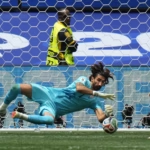
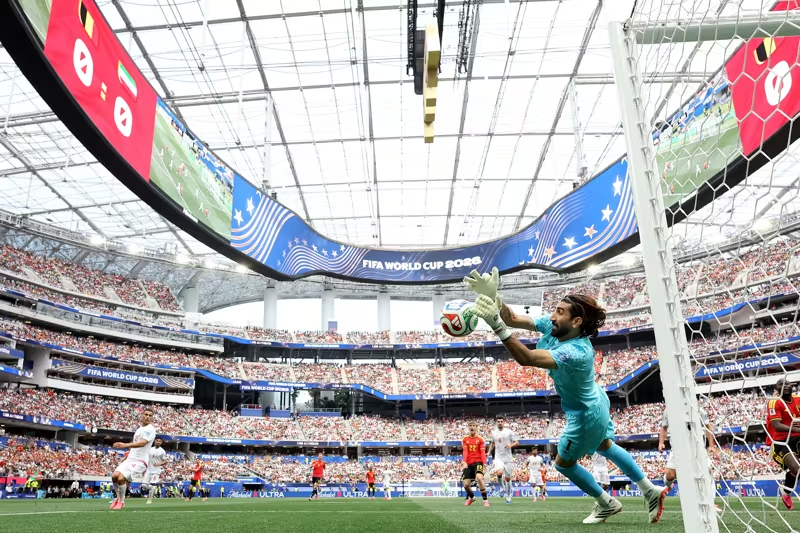
Beiranvand had several key saves in the game, including one on his own line midway through the second half to keep Belgium out after Kevin De Bruyne‘s cross rolled across the Iran goalmouth before Beiranvand smothered the chance.

“He is one of our greatest goalkeepers in the history of Iranian football, and he had one of his best days today,” Ghalenoei said. “He had the right concentration, and he gave us one very valuable point.”

For the second game in a row, Iran played in front of jam-packed stadium — 70,317 was Sunday’s official attendance — and despite a solid showing from Belgium fans, Iran was roared on by a large contingent of supporters throughout the match.

Alireza Beiranvand MVP performance

Team Melli goalkeeper Alireza Beiranvand was awarded the Most Valuable Player award after his sterling performance against Belgium on Monday. The match ended goal-less.

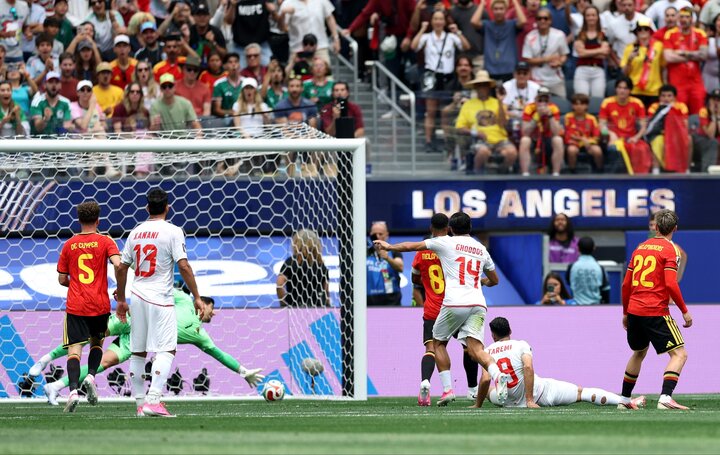
Beiranvand repeatedly ⁠saved his side with crucial interventions, including an extraordinary stop from a point-blank-range effort from Maxim De Cuyper in the second half.

lireza Beiranvand was named Player of the Match after Iran’s 0–0 draw against Belgium.

Goalkeeper statBeiranvand
Total saves7
Goals prevented1.7
Saves from inside the box7
Punches1
Runs out (successful)1 (1)
High claims3

This is the second match in a row that an Iranian player has won the MVP award after Ramin Rezaeian won the same in the firt match of FOFA World Cup 2026 Group G.

From Shambles to Solidity: Iran’s Defensive Masterclass Stuns Belgium


Beiranvand Heroics Earn Team Melli a Vital Point Against Belgium

Iran and Belgium played out a goalless draw at the SoFi Stadium in Los Angeles in the second Group G encounter for both teams. With this result, Iran temporarily sits atop the group on two points, followed by Belgium, New Zealand, and Egypt—all of whom remain in contention ahead of the later match between the Kiwis and the Pharaohs.

A Transformed Team Takes the Pitch

After the disappointing draw and lackluster performance against New Zealand, Amir Ghalenoei made decisive changes that revitalized the team. The individual errors that had plagued Iran in the opener were conspicuously absent, and the team’s weakest link, the defense, emerged as the undisputed star of the show against the Belgian golden generation.

Starting Lineup:
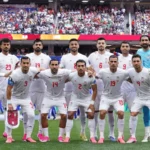
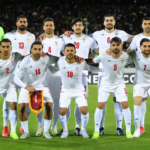
Beiranvand (GK); Hardani, Kanaani, Khalilzadeh, Nemati, Hajsafi; Rezaeian, Ghoddos, Ezatollahi; Mohebi, Taremi.

These changes were clearly designed to neutralize the speed and trickery of Belgium’s wingers, Jérémy Doku and Leandro Trossard. In the end, however, Doku was declared unfit due to a medical issue, sparing Iran one significant headache, though Trossard proved more than capable of causing problems on his own.

Beiranvand: A World-Class Performance

Alireza Beiranvand was the undoubted MVP of the match, delivering a performance that harked back to his heroics at the 2018 World Cup. The Iranian goalkeeper made an astonishing 17 saves, commanding his area with the confidence of a world-class shot-stopper. His timely catches and fearless collection of crosses frustrated Romelu Lukaku, who, despite a strong individual display, was repeatedly denied by Beiranvand before being substituted late in the match.

Defensive Solidity – A Monumental Improvement

Iran’s backline produced one of its most disciplined and cohesive performances in recent memory. Solid positioning, excellent covering work, and timely interceptions ensured that Belgium’s attacking riches were kept largely at bay. The only black mark came on the right flank, where Saleh Hardani was not only ineffective but a genuine liability. Trossard bamboozled him repeatedly, forcing Ghalenoei to haul him off at half-time—a merciful end to a torrid 45 minutes.

Midfield Battle – Grit Over Glamour

The midfield was far more active than in the New Zealand match, with both Saeed Ezzatollahi and Saman Ghoddos contributing their fair share of defensive work. The game plan leaned heavily toward direct, route-one football, bypassing Belgium’s press and targeting Taremi in advanced areas. Ramin Rezaeian, deployed in a more advanced midfield role, was less effective on the right flank than he had been against New Zealand and failed to replicate his Man of the Match performance from the opener.

Taremi: The Captain’s Crusade

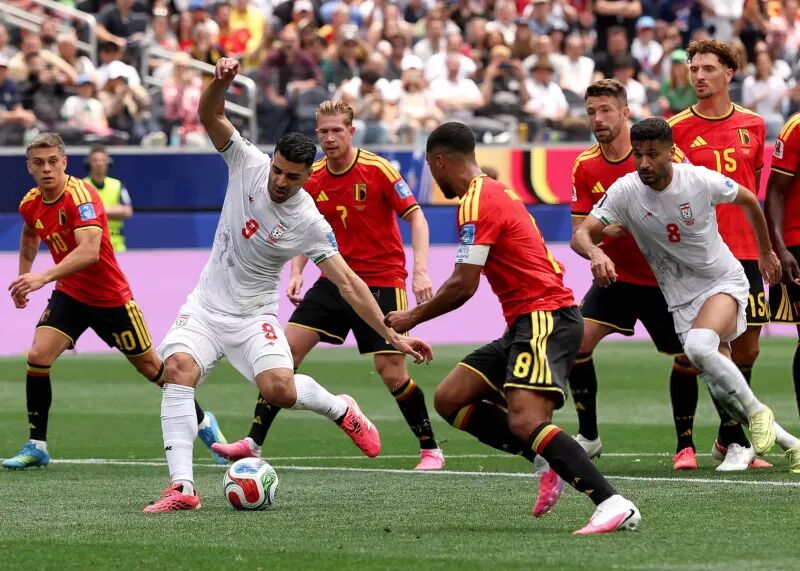
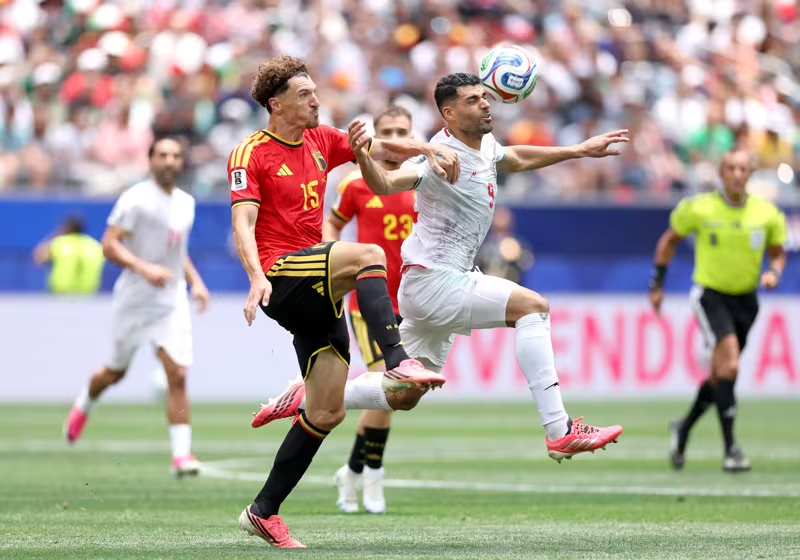
Up front, Mehdi Taremi was immense in every sense of the word. He tackled relentlessly, distributed intelligently, and scored a brilliant goal that was cruelly ruled out for offside after a lengthy VAR review. The captain also tested Thibaut Courtois on multiple occasions, but the Belgian goalkeeper, widely regarded as one of the world’s best, was equal to every effort.

Taremi’s crowning contribution came in the 66th minute, when he robbed Nathan Ngoy of possession after the Belgian defender’s poor ball control. As Taremi bore down on goal, Ngoy hauled him down, resulting in a straight red card. The sending-off tilted the dynamics of the match decisively in Iran’s favor.

Numerical Advantage – But No Decisive Blow

With Belgium reduced to ten men, Iran enjoyed prolonged possession and territorial dominance. Yet, despite the man advantage, Team Melli failed to find the elusive winning goal that would have all but secured qualification. The inability to capitalize on the extra man will rankle with Ghalenoei and his staff—a missed opportunity that could prove costly in the final reckoning.

A Worrying Trend: Ball Retention Woes

One persistent issue that marred an otherwise encouraging display was Iran’s failure to retain possession. Throughout the match, Team Melli lost the ball on average every 12 seconds—a damning statistic that reflected a lack of composure and technical security. This improved somewhat after Belgium went down to ten men, but the underlying fragility in possession remains a serious concern.

Substitutions: A Mixed Bag

Ghalenoei’s substitutions were a mixed bag. Removing Hardani at half-time was unquestionably the right call, but replacing him with Alireza Jahanbakhsh, who offered even less defensive cover and attacking thrust, was a baffling decision. Jahanbakhsh’s introduction did little to stabilize the right flank or exploit Belgium’s numerical disadvantage, raising questions about Ghalenoei’s in-game management.

What It Means for Group G

With two points on the board, nothing is decided in Group G until the final round of matches. However, Iran’s disciplined and resilient performance against a formidable Belgium side has injected genuine hope into fans and critics alike. For the first time in their World Cup history, Team Melli stands on the verge of qualifying for the Round of 32—provided they can deliver one more decisive performance in the final group fixture against Egypt.

The dream is alive. But the hard work is far from over.

Iran 0-0 Cape Verde. Issues Under Ghalenoei persists

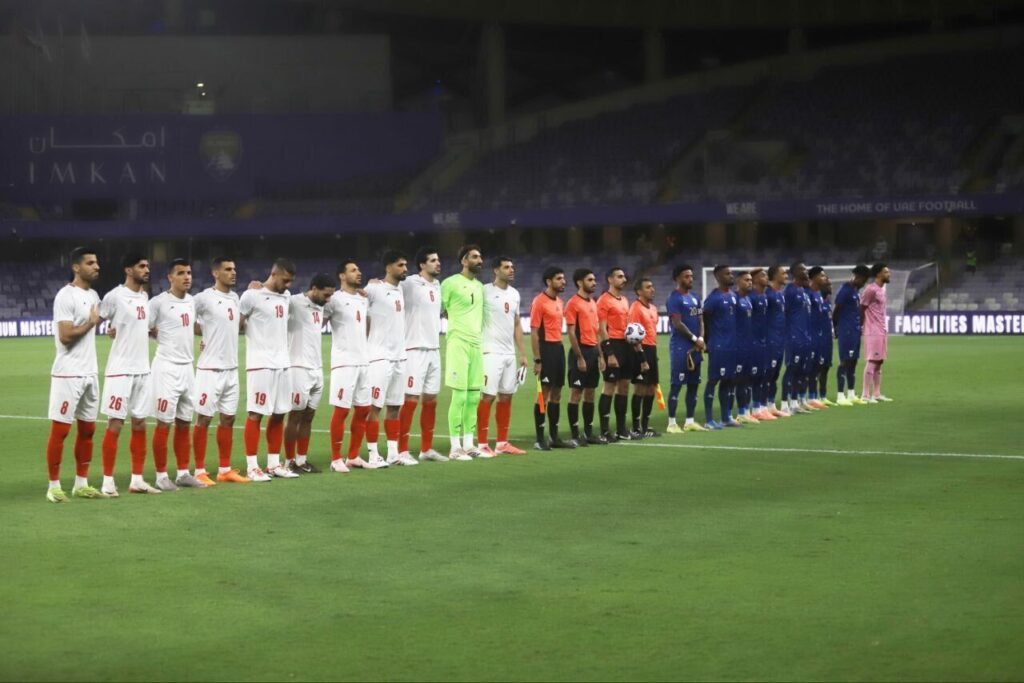
Al Ain, UAE – In another underwhelming performance that has become characteristic of the Amir Ghalenoei era, Iran’s national football team struggled to a goalless draw against World Cup debutants Cape Verde in the Al Ain International Cup on Tuesday. The match, which required a penalty shootout to determine progression, saw Alireza Beiranvand emerge as the unlikely hero with a crucial save that secured Iran’s place in the final.

Tactical Deficiencies Laid Bare

From the opening whistle, the African archipelago nation—ranked 71st in the world—seized control of the match, forcing Team Melli into a defensive posture that has become all too familiar under Ghalenoei’s leadership. While Cape Verde demonstrated why they earned their historic qualification for the 2026 World Cup, their lack of clinical finishing spared Iran from what could have been an embarrassing defeat.

The tactical approach from the Iranian side raised serious questions about Ghalenoei’s footballing philosophy. Team Melli reverted to what has become their default strategy: route-one football characterized by long balls launched from defense toward the forward line. This simplistic approach consistently failed to yield results, primarily due to the glaring absence of pace in Iran’s attacking third.

Second-Half Glimmer Quickly Extinguished

The second half offered marginal improvement, with Iran creating two clear opportunities to break the deadlock. The most notable chance came when Ezzatollah found himself with an open goal, only to see his effort miraculously cleared off the line by a Cape Verde defender’s heroic header. This moment encapsulated Iran’s ongoing struggles in front of the goal, an issue that has plagued the team throughout Ghalenoei’s tenure.

Individual performances further highlighted the team’s decline. Hosseinzadeh, typically a creative spark, delivered a subdued performance that warranted his substitution. Mehdi Taremi, expected to lead the line, endured another forgettable outing in what is becoming a worrying pattern of underperformance. The midfield unit operated on the periphery of the game, failing to establish control or provide meaningful service to the attackers.

Defensive Solitude in a Sea of Mediocrity

Ironically, Iran’s defenders emerged as the team’s strongest performers—a damning indictment of the overall team display when facing a nation ranked 41 places below them in the FIFA rankings. That the backline stood out as the brightest aspect of Team Melli’s performance against Cape Verde underscores the alarming regression of a team that once commanded respect in Asian football.

Ghalenoei’s Post-Match Narrative Defies Reality

Following the match, Ghalenoei continued his pattern of fact-twisting statements that have become hallmarks of his press conferences. Rather than addressing the evident tactical shortcomings and lack of coherent gameplay, the coach opted to glorify what he described as a “disciplined performance” , a characterization that starkly contradicts the reality witnessed by spectators and analysts alike.

The persistence with broken tactical approaches and the refusal to adapt to opponents’ strengths has become a defining feature of Ghalenoei’s leadership. His post-match explanations increasingly resemble exercises in denial rather than genuine assessments of performance.

World Cup Prospects Look Bleak

With the 2026 World Cup expanding to 48 teams, Iran’s qualification prospects should theoretically be more favorable. However, recent performances and especially Thursday’s performance against Cape Verde raise serious doubts about whether Ghalenoei possesses the tactical acumen to navigate even this more accessible pathway. The team’s steady decline under his guidance suggests that Iran risks becoming mere participants rather than competitive forces in global football’s premier tournament.

The technical deficiencies, an aging team, lack of creative solutions, and persistent reliance on outdated tactical approaches paint a worrying picture for Iranian football. As the team prepares to face either Egypt or Uzbekistan in the final, the fundamental questions surrounding Ghalenoei’s leadership remain unanswered—and indeed, grow more urgent with each disappointing performance.

The victory in penalties may have secured progression, but it did little to mask the systemic issues that continue to undermine Iranian football. For the growing number of critics, this match served as further evidence that a change in direction may be necessary before the team’s decline becomes irreversible.

FFIRI Suspension of Alireza Beiranvand includes exclusion from Team Melli selection.

Mashhad, Iran – Mehdi Taj, President of the Iranian Football Federation, confirmed today that goalkeeper Alireza Beiranvand will not join the national team for the foreseeable future due to an ongoing suspension.

The announcement came during a press briefing on the sidelines of the East Azerbaijan Football Board meeting, where Taj also addressed the selection of Mashhad as the host city for the upcoming Tractor vs. Esteghlal match.

Beiranvand’s Suspension: Rules and Next Steps

Regarding Beiranvand’s case, Taj emphasized adherence to regulations while leaving room for further review:

  • The goalkeeper is currently suspended, with half of the penalty still to be served.
  • The Appeals Committee’s detailed 11-page ruling remains open for scrutiny.
  • The option to appeal to the Court of Arbitration for Sport (CAS) is available, per standard statutes.

“While we respect the disciplinary process, the federation is actively working to resolve the situation,” Taj said. “All stakeholders are welcome to present their perspectives formally.”

Commitment to Governance and Future Success

Taj reiterated the federation’s focus on upholding governance standards while supporting teams:
“Our priority is to ensure fair conditions for both the national team and clubs. We remain optimistic about Iranian football’s continued progress.”

The statement concluded with no specified timeline for Beiranvand’s return.

The Controversial Suspension: A Year-Long Saga of Delays

Alireza Beiranvand’s suspension stems from a breach of contract complaint filed by his former club, Persepolis, over a year ago. Despite the straightforward nature of the case, the Football Federation (FFIRI) and its Disciplinary Committee demonstrated puzzling inertia—repeatedly deferring proceedings while Beiranvand completed an entire league season unaffected.

This extraordinary delay in resolving a contractual dispute raises serious concerns:

  • Transparency Issues: Why did a clear-cut case require 12+ months to adjudicate?
  • Selective Enforcement: Was the timing influenced by external pressures or political considerations within Iranian football?
  • Precedent Setting: The federation’s eventual acknowledgment of Beiranvand’s contractual breach—after such protracted deliberations—undermines confidence in its judicial processes.

Critics argue the federation’s sluggishness reflects either institutional incompetence or deliberate stalling to accommodate vested interests. Either way, the handling of this case has become emblematic of systemic governance flaws that demand urgent reform.


Team Melli Secures Fourth Consecutive FIFA World Cup Qualification After Draw with Uzbekistan

Team Melli has officially qualified for the FIFA World Cup 2026 for the fourth consecutive time and a record seventh time following a hard-fought 2-2 draw against Uzbekistan at Azadi Stadium.

In a tense and thrilling encounter, Uzbekistan stunned Iran early when Jasurbek Erkinov capitalized on a defensive lapse to score in the 16th minute. However, Mehdi Taremi leveled the match in the 52nd minute with a spectacular goal, finishing off a brilliant assist from Sardar Azmoun and a sublime pass by Mehdi Ghaedi.

The celebrations were short-lived, as Uzbekistan quickly regained the lead. Just moments after Iran’s equalizer, Fayzullaev curled in a free kick, with goalkeeper Alireza Beiranvand unable to prevent the ball from rolling into the far corner of the net.

Despite the setback, Team Melli remained relentless, dominating possession and pressing forward. Their efforts paid off when Mehdi Taremi struck again, securing Iran’s second equalizer and ensuring the match ended in a 2-2 draw.

With two matches remaining in the qualifiers, Uzbekistan remains in a strong position and is likely to join Iran in securing a spot at the 2026 FIFA World Cup in North America.

However, the post-match atmosphere was bittersweet. While the Iranian squad celebrated their qualification, Alireza Beiranvand was overcome with emotion. The Team Melli goalkeeper broke down in tears, having been repeatedly booed by the crowd—a reaction seemingly tied to his role in Uzbekistan’s second goal and other ongoing issues.

In the other Group A fixture, Kyrgyzstan pulled off an impressive 3-1 victory over Qatar in Bishkek.

Alireza Beiranvand Sets New Guinness World Record

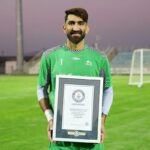
Alireza Beiranvand (32 years), the renowned goalkeeper for Team Melli and Tractor, has added another impressive record to his name. After setting the Guinness World Record for the longest throw of a soccer ball by hand, Beiranvand has now broken the record for the longest kick.

Last season, during a match between Persepolis and Zob Ahan, Beiranvand kicked the ball an astonishing 78 meters, surpassing the previous record held by Ederson of Manchester City, who had kicked the ball 75 meters. This remarkable feat earned Beiranvand a new Guinness World Record, increasing the distance by 3 meters.

Beiranvand’s first record-breaking achievement was during a match between Team Melli and the South Korean national team, where he set the record for the longest throw of a soccer ball by hand. On October 11, 2016, he threw the ball an incredible 61.26 meters (200 feet, 1.57 inches), a record that still stands today.

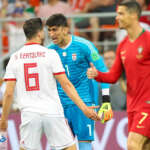
Beiranvand’s journey to these achievements is as inspiring as his records. Growing up in a nomadic family in Lorestan, Iran, he moved to Tehran at the age of 15 to pursue his dream of becoming a professional footballer. Despite facing numerous challenges, including homelessness, he persevered and made his debut for Naft Tehran in 2011. His dedication and hard work eventually led him to become Iran’s first-choice goalkeeper, even saving a penalty from Cristiano Ronaldo during the 2018 World Cup.


Ghalenoei and fans expectations


The fans must be less than impressed at Team Melli’s performance so far despite the minimalistic wins. The expectations were high, but the delivery has been underwhelming.

There weren’t many cheers at the end of the Kyrgyzstan game on that truly embarrassing and awful pitch of Fooladshar. The 1-0 win against a Kyrgyz team ranked 82 places lower came with a bit of luck too, as Beiranvand managed a fantastic save towards the end. The pitch conditions were a significant factor, making it difficult for both teams to play their best football. The fans, who are used to seeing their team dominate, were left disappointed by the lackluster performance.

Then came the UAE. Team Melli’s win in Al-Ain was not a vintage performance by any stretch of the imagination. However, there were positives and progress. Ghalenoei is slowly realizing that his team has many shortfalls and admitted that this was a lucky escape for his team with the late penalty against Hardani overruled by VAR. Adding to that were the many misses by the profligate Team Melli strikers, which highlighted the need for better finishing and composure in front of goal.

Two games have been played in the third – and decisive – round of FIFA World Cup qualification. So far, it has confirmed the feeling that while Team Melli relies on their legionnaires playing in professional leagues to deliver in the big moments, a team like Japan is a well-oiled winning machine. Ruthless, clinical, and disciplined, Japan hardly relies on one or two individuals. Their team cohesion and tactical discipline are exemplary, setting a benchmark for other Asian teams.

Ghalenoei and Ghoddos on touchline
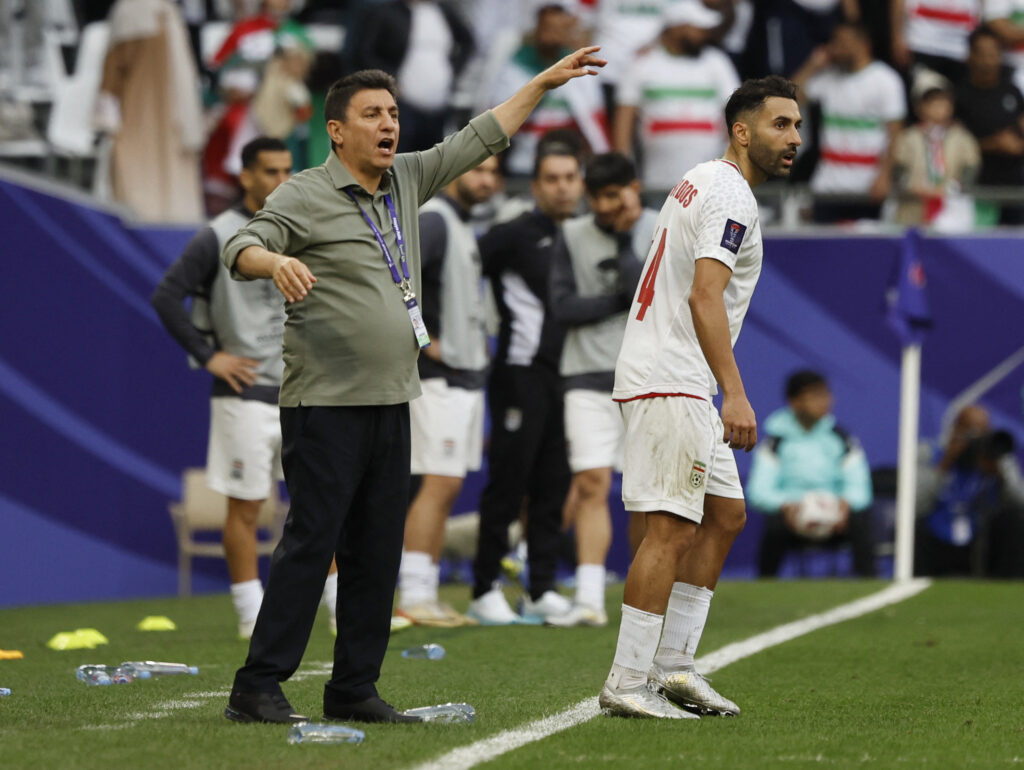
Soccer Football – AFC Asian Cup – Quarter-Final – Iran v Japan – Education City Stadium, Al Rayyan, Qatar – February 3, 2024 Iran coach Amir Ghalenoei REUTERS/Thaier Al-Sudani

While Iran has the bragging rights for arguably having the two most lethal forwards of Asia in Azmoun and Taremi, who amassed more than 100 goals between them, regrettably, they were both guilty of not only failing to deliver but also raising questions about their attitudes and commitment. Their performances have been inconsistent, and their body language on the pitch has sometimes suggested a lack of motivation.

This is where Ghalenoei can make a huge difference. Granted that he will never be a Carlos Queiroz, and the culture of Iranians is different than that of Portuguese or European. Ghalenoei, for example, keeps distributing thanks to everybody and anything that moves between earth and sky. Queiroz was aggressive, demanding, and always critical of the same. Two extremes, mind you, that need to be balanced by Ghalenoei. No one is interested in his sermons of thanks and appreciation; the fans expect results and a beautiful game. If players are not delivering, especially the likes of Azmoun, Taremi, Jahanbakhsh, Ghoddos, and Ezatollahi, then the bench is their place.

Of course, it is easier said than done. The Iranian domestic league is simply not producing quality players en masse. The poor league standard, on top of atrocious playing fields and extremely amateurish management and administration, are some of the factors for poor player production. One must sympathize with Ghalenoei in this sense as he can only play with what is available to him, unlike other countries who have no issues with naturalizing the hundreds of available Brazilian and European players for hire, most of whom are second or third-rate players.

The level of expectation of the Iranian fans is high, and they are not to be blamed. Few accept ridicule, and most of the fans understand and appreciate good football when they watch one. Iran has a footballing pedigree. It is ranked among the top 20 in the world. The sport is the most popular in a land where wrestling, martial arts, and weightlifting are the real sports that bring glory to the nation. So yes, the expectations are high, tolerances low, and the patience of fans is wishful thinking.

The hope is with Ghalenoei and his coaching staff to address the various shortcomings with less than a month left for a crucial tie with the Uzbek team. A Team Melli at its near best can beat Uzbekistan at Tashkent. However, what Team Melli will turn up on October 10th? Anything like the two that played against Kyrgyzstan and UAE, then we are in trouble.

The upcoming matches will be a true test of Ghalenoei’s ability to inspire and organize his team under pressure.

Players ratings UAE vs. Iran

Perhaps the performance of Team Melli was not impressive, but compared to the last time out against Kyrgyzstan, it was a positive improvement. Ghalenoei managed to shake the team and it yielded results. Individually, no player made a big impact, while some key players were quite disappointing, some have improved. Declining performance by key players must worry the head coach as he counts on them in crucial moments as they are the ones who can turn the game and results upside down.

Goalkeeper

Alireza Bieranvand – 7.3

The Iranian custodian too didn’t really face many serious challenges, as he was vigilant throughout and made two saves when needed. He also bagged a clean sheet here. He was helped by some lackluster UAE shooting and a strong defense in front of him

Defenders

Saleh Hardani – 6.5

A vital figure in defense for Team Melli, Hardani made three clearances and blocked one shot. He was quite sloppy in possession though, giving it up 16 times during the game. His runs on the flank were missing.

Hossein Kanaani – 7.0

Kanaani was important in circulating the ball from the defense and showed exemplary positional awareness. His partnership with Khalilzadeh was solid and they covered each other very well.

Shoja Khalilzadeh – 7.4

With six clearances, Khalilzadeh demonstrated wonderful reading of the game and won three of his four ground duels too. The center-back’s passing, though, was questionable at times. Despite a lack of pace, he was never caught off-guard behind any of the UAE forwards due to his excellent positioning awareness.

Milad Mohammadi – 6.9

Mohammadi was overwhelmingly involved in defense, making vital clearances to nip UAE’s chances in the bud while also laying one key pass to open up a chance for his side. He tends to drift in and out of the game. He missed a good opportunity to score.

Midfielders

Omid Noorafkan – 6

An average performance from Noorafkan, who offered no great shakes either defensively or while going forward. He does not seem to be comfortable playing a midfield role

Saeid Ezatolahi – 7

Tough in tackles, Ezatolahi was biting at the heels of the UAE forwards, always looking to pluck the ball off them. In fact, he won five of his six ground duels and made two interceptions. His defensive work was good but his long passes forward lacked the accuracy to create any danger for the opposition

Saman Ghoddos – 6

He was rarely involved during the game, completing just 10 passes in 57 minutes while his only effort at goal was off-target too. If that wasn’t enough, Ghoddos was also booked for an ill-timed challenge early into the second half. Way off his normal standard and showing no sign of improvement from the previous match.

Forwards

Alireza Jahanbakhsh – 6

The Iranian ace struggled to win his duels but made some vital interventions defensively throughout the game. He even mustered two shots in the game, one of which was on target. Not effective as expected. He got cautioned for a wild tackle.

Mehdi Ghayedi – 8.1

The 25-year-old winger put Team Melli in front with a clinical finish just moments before half-time. He kept giving his marker a hard time. Before his goa, Ghayedi scored a goal that was disallowed. His shortfall was too much reliance on the referee to whistle for fouls on him! His goal was an excellent piece of skill, persistence, and accuracy. Man-of-the-match for Iran.

Mehdi Taremi – 4.9

An uncharacteristically poor game for Iran’s prolific hitman, who misfired badly. All three of his efforts on the night were off target, missing two big chances too. His miss from a brilliant assist by Azmoun was unforgivable for a player of such stature and playing in Serie A.

Substitutes

Ali Gholizadeh – 6.3

He can be a much more productive player if he concentrates on his game and refrains from playing referee. His dribbling skills are a delight to watch. He replaced Ghayedi just before the hour.

Sardar Azmoun – 5.8

The Iranian Messi had an off day, failing to light up the stadium with his usual attacking brilliance. The highlight of his performance was the accurate weighted pass to set Taremi which yielded nothing due to his partner’s failure to connect properly.

Mohammad Ghorbani – 6

He made sure the UAE don’t find a late equalizer to share the spoils. More playing time has to be given to this player to integrate with the team. Good potential.

Mohammad Karimi – N/A

He came in the dying embers with only a few seconds remaining on the clock.

Head Coach

Amir Ghalenoei – 7.4

He dared to bench Azmoun and that says a lot about his character. His defensive game plan was executed to perfection against a stubborn and determined opposition, however, upfront, his players failed him. Needs to re-think the route one football though. Unlike the Kyrgyz match, his substitution was positively effective.