Tag: Ehsan Hajsafi

Team Melli vs Russia: Ghalenoei’s Excuses Meet a Sharper Russia

Team Melli will meet Russia in Kazan in a friendly match this evening (Tuesday) at the Ak Bars Arena, kick-off at 19:00 Moscow time (19:30 Iran time).

After the disappointing 3-1 defeat against Uzbekistan in Fergana, which was followed by mass criticism of the team and the coach, this match is supposed to be a chance for Team Melli to redeem itself. In reality, it looks more like another opportunity for Amir Ghalenoei’s limitations to be exposed. Little improvement can be expected from this over-age team unless the coaching staff finally confronts the horrendous defensive errors that have become routine. And that responsibility lies squarely with Ghalenoei.

His failures are not new. The defence lacks organisation, the midfield lacks ideas, and the attack depends on isolated moments rather than a coherent plan. The defeat to Uzbekistan was not simply a bad night; it was the logical result of poor selection, stale tactics, and an inability to react. Yet Ghalenoei is expected to do what he always does: stick with his old faithfuls, avoid drastic changes, and hope that familiarity somehow produces a different result.

The massive anti-Ghalenoei protests, especially on social media, may persuade him to make cosmetic changes to appease the fans and critics. He is good at that—offering the appearance of change while preserving the same failing core. A new face here, a tweaked formation there, and the critics are told to be patient. But cosmetic adjustments cannot hide tactical bankruptcy. Ghalenoei’s game plans remain below the standard required for a team with Iran’s talent, and his stubbornness has turned rebuilding into a permanent delay.

Tactics: Karpin’s 4-3-3 vs. Ghalenoei’s low block

September is Karpin’s first gathering since June. In their last match, Russia beat Trinidad and Tobago 3-0. Their 2026 record so far: victories over Nicaragua (3-1), Burkina Faso (3-0) and Trinidad and Tobago (3-0), a 0-0 draw with Mali, and a 0-1 defeat to Egypt.

Karpin has a clear plan:

  • A 4-3-3 core, a departure from the cautious schemes of 2025.
  • Pressure on the ball from the first minutes, aimed at a team accustomed to conceding possession and absorbing pressure.
  • A defensive line of Adamov, Vakhaniya, Beveev and Diveev gives Karpin options: he can push the defenders wider to stretch Iran’s block, or send the full-backs forward.
  • Miranchuk and Glebov operate in the creative zone between the lines.
  • Golovin, as captain, sets the tempo and initiates attacks.

Iran Team is expected to make changes in the defensive line, with Hajsafy possibly remaining on the bench; Arya Yousefi and Khalilzadeh are possible starters. Up front Sardar Azmoun is expected to start alongside Mehdi Taremi.

Iran, by contrast, will likely set up a compact low block and look to attack the flanks of Russia’s defence. That is a reactive plan, not a proactive one—a reflection of Ghalenoei’s cautious and increasingly outdated approach. Russia’s task is to prevent the game from becoming a scrappy battle in the centre. If Iran score first, they will have to open up; if they concede, there may be an episode, because they know how to keep the scoreline respectable.

Prediction

The first half will be cautious, with set pieces important for both sides. The first goal will be decisive: Iran’s recent games have rarely produced an early breakthrough. Our assessment: a Russia victory, but not a crushing one. Karpin’s scheme is stronger than Iran’s one-on-one defending, though a compact block is difficult even for the hosts. The most likely scenario is a one-goal Russia win after the break. The last meeting between the two teams ended 2-1 to Russia.

For Ghalenoei, a narrow defeat would probably be spun as evidence of resilience. But it would be another mask over the same failures. Until Iran’s coach accepts that loyalty to old players and cosmetic tweaks are not a strategy, Team Melli will continue to survive matches rather than build a team.

Ghalenoei's Old Guard Fail Him as Iran Suffer Second Humiliation in a Week

Amir Ghalenoei issued an apology to the fans and people of Iran following Team Melli's 3–1 friendly defeat to Uzbekistan—but his words did little to conceal the contradictions at the heart of his tenure.

"We conceded the first and second goals due to individual errors, specifically at times when we were controlling the game," Ghalenoei said. "The first goal resulted from a very childish mistake on our part (Hajsafy), though we managed to score in the second half thanks to our substitutions. We were aiming to score the equalizer, but one of our most experienced players (Beiranvand) committed another very childish error, and our situation fell apart after that."

Conveniently absent from his assessment was any mention of the defensive frailties that allowed Uzbekistan's third goal—least of all the role of Shojaa Khalilzadeh.

The irony is difficult to ignore. Here stands the standard-bearer of Iran's aging veterans—the very man who insists that blooding young players is a lengthy, risky process—forced to concede that his trusted old guard committed "childish" errors on the pitch. This is hardly the first time Iran's leaden-footed, laboured veterans have been exposed, yet Ghalenoei has always found an excuse at the ready. Against Uzbekistan, the blunders were so glaring that even he could not look away.

One might even call it karma. Imagine, for a moment, if those same mistakes had been made by Saman Fallah, the 25-year-old defender. Would Ghalenoei have been so forgiving?

The match laid bare not only Ghalenoei's flawed logic in squad selection but, more damningly, his lack of situational awareness. He credited Iran's equalizer to his own substitution—conveniently ignoring that the goal came from an own goal by Uzbek defender Jakhongir Urozov, who turned Rezaeian's cross into his own net. And even if Ghalenoei wishes to take the credit, Rezaeian is hardly a spring chicken he plucked from obscurity.

Pressed on whether the squad needed an overhaul and younger players blooded after the World Cup, Ghalenoei offered familiar caution: "We don't have much time left before the Asian Cup. We want to make changes, but we have to do so in a way that doesn't leave us too vulnerable. Unfortunately, today we conceded goals due to errors by two experienced players—though that is part of football. Nevertheless, I was the one primarily at fault; even though it was a friendly match, we owe an apology to the dear people of Iran. I am confident the national team's trajectory will turn upward again."

Yet the apology rings hollow. Ghalenoei operates with a remarkable sense of impunity, shielded by rock-solid support so long as no one at the FFIRI demands real answers. Meanwhile, Iranian football continues to suffer at the hands of coaches who have proven nothing on the field and keep failing match after match.

For Iran, this is now the second humiliating defeat in a single week.

Ezatollahi Hardani abbosbek Fayzullaev

Iran’s Defensive Calamity Proves Costly in 3–1 Friendly Defeat to Uzbekistan

FERGANA, Uzbekistan — Iran’s national football team opened its September 2026 FIFA international window with a chastening 3–1 friendly defeat against Uzbekistan on Thursday at Fergana’s Istiqlol Stadium. The match, which kicked off at 17:30, carried significance beyond a routine warm-up given the long history between the two sides.

From the opening whistle, both teams looked to control possession and build attacks, but the first half turned on a bizarre error by Iran’s captain, Ehsan Hajsafi. In the 10th minute, his misplaced pass akin to a perfect assist , was seized upon by Eldor Shomurodov, who capitalized and beat goalkeeper Alireza Beiranvand to give Uzbekistan an early lead. Iran were fortunate not to concede again shortly afterward. In the 25th minute, another Shomurodov effort struck the woodwork and went wide, keeping the score at 1–0.

The remainder of the first half offered little comfort for Amir Ghalenoei’s side. Beiranvand made a mistake, the defense lacked coordination, and Iran’s finishing was inaccurate. At the break, Ghalenoei’s men trailed and had produced little to suggest a comeback.

Ghalenoei responded with tactical changes at halftime, introducing Sardar Azmoun, Ramin Rezaeian, and Khalilzadeh in place of Denis Dargahi, Saleh Hardani, and Saman Fallah. Azmoun was immediately handed the captain’s armband and took up a position in Iran’s attack for the final 45 minutes.

The changes paid off quickly. In the 49th minute, Iran equalized from a set piece. Rezaeian’s delivery went straight into Vladimir Nazarov’s net without touching any other player, bringing the score to 1–1 and giving Iran renewed hope.

But parity was short-lived. Minutes later, after a questionable incident in Iran’s penalty area caused by a lapse in judgment from Beiranvand, Uzbekistan were awarded a penalty, albeit a harsh one. Shomurodov stepped up and converted, scoring his second goal of the match and restoring Uzbekistan’s lead.

In the 80th minute, the referee sent off Uzbekistan’s Djiyanov, but the decision was reversed after a VAR review, allowing both teams to continue with eleven players. As the match entered stoppage time, Hossein Norchaev scored a third goal past Beiranvand, sealing a heavy defeat for Ghalenoei’s squad.

The result was made more striking by the age gap between the sides: Iran’s average age was 29.5, compared with 25.6 for Uzbekistan. Uzbekistan, coached by Fabio Cannavaro, looked sharper and more energetic in key moments.

Uzbekistan lineup: Vladimir Nazarov, Abdukodir Khusanov, Sonatullo Karimov, Mukhammadkodir Urozov, Akmal Mozgovoy, Odil Khamrobekov, Azizjon Ganiev, Sherzod Nasrullaev, Eldor Shomurodov, Dostonbek Khamdamov, Abbosbek Fayzullaev.
Head coach: Fabio Cannavaro.

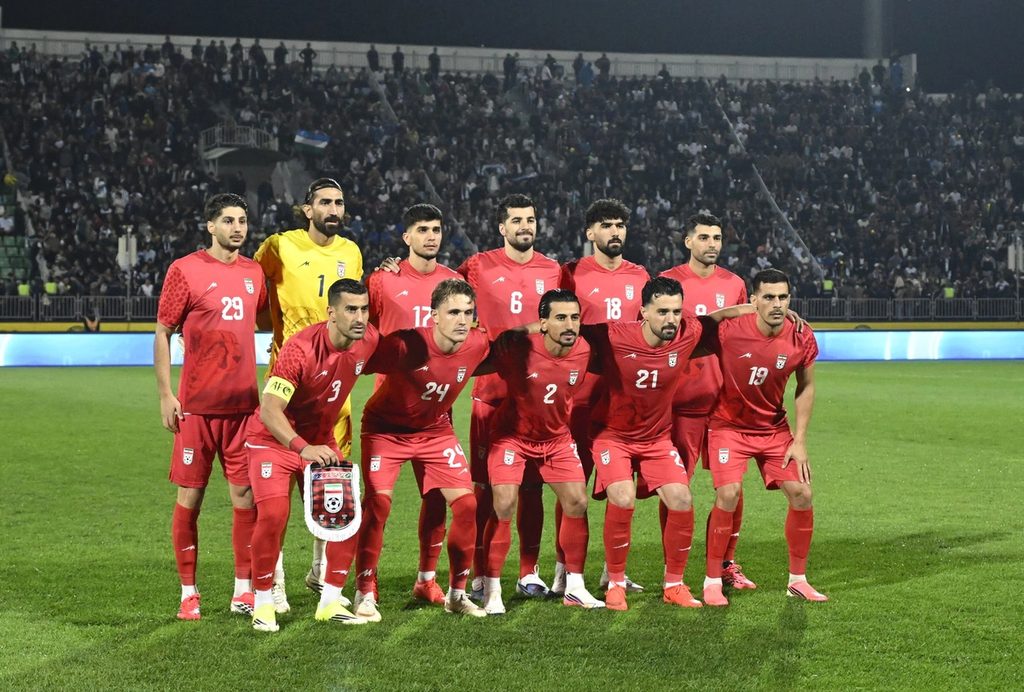
Iran lineup: STANDING L2R: Mohammad-Mehdi Mohebbi, Alireza Beiranvand, Aria Yousefi, Saeid Ezatolahi, Saman Fallah, Mehdi Taremi, SITTING L2R: Ehsan Hajsafi, Denis Dargahi, Saleh Hardani, Omid Noorafkan, Ali Nemati, .
Head coach: Amir Ghalenoei.
Substitutes used: Sardar Azmoun, Ramin Rezaeian, Khalilzadeh, Limouchi, Ghorbani, Mahmoudi

For Iran, the match will serve as a warning. Defensive lapses, a costly goalkeeper error, and an inability to turn first-half possession into chances left Ghalenoei’s side with a heavy defeat. While it is expected that those defensive shortfalls will be addressed in the next warm-up fixtures ahead, the concern is that Ghalenoei and his coaching staff lack the tactical prowess and skill needed to provide solutions and turn this ageing team into winners come AFC Asian Cup 2027.

But the defeat also raised a more fundamental question: Ghalenoei’s insistence on ageing players. Iran’s average age was 29.5, compared with Uzbekistan’s 25.6, and the gap showed. The veterans entrusted with key roles—Hajsafi, Beiranvand, Ezatolahi, Taremi and later Azmoun , Khalilzadeh and Rezaeian—could not match Uzbekistan’s energy, speed or pressing. The captain’s error led directly to the first goal, Beiranvand’s lapse contributed to the penalty, and the team’s overall lack of legs made it easy for a younger, sharper opponent to exploit spaces.

Ghalenoei’s substitutions, rather than injecting youth, simply replaced one set of experienced players with another. That conservatism may buy short-term stability, but it is not a credible path to renewal. If Ghalenoei and his staff cannot adapt their tactics, trust younger players, and build a side capable of coping with modern, high-tempo opponents, then this defeat will be more than a warning: it will be a preview of what awaits Iran at the AFC Asian Cup 2027.

Azmoun has an amazing scoring record.

Sardar Azmoun scored against Palestine to reach the 50-goal mark equaling Karim Bagheri. As Azmoun has a higher Goal Per Match GPM, he stands second only to the legendary Ali Daei whose record will not be broken anytime soon.

Azmoun is only 29 years old and has a good 5-6 years left for him to reach a scoring figure close to Daei. He has been playing for a decade for Team Melli and narrowly missed selection for the FIFA World Cup Brazil 2014. However, he has been present in every season since, and this year he celebrates 10 years with an amazing record of 50 goals.

Azmoun's records show that he played an average of 7.6 matches for Team Melli every year and scored 5 goals in these 7.6 matches an average of .66 GPM. A terrific record only bettered by the legendary Ali Daei whose Goals Per Match is 0.74

Astonishingly, Sardar has yet to play in the domestic league, although he was registered with Sepahan at the start of his career. As he was playing abroad all his career, he missed many chances to play for Team Melli.

SARDAR AZMOUN CAREER
SeasonOpenin.Subst.Caps.GoalsYellowsReds
2014123100
20159211720
2016628810
2017538610
201810010210
201910010820
2020101110
2021909620
2022628200
2023617800
2024011100
Total63137650100

TEAM MELLI TOP SCORING CHART

RANKSCORERGOALSGPMACTIVE
1ALI DAEI113.74N
2SARDAR AZMOUN50.66Y
3KARIM BAGHERI50.54N
4MEHDI TAREMI45.58Y
5JAVAD NEKOUNAM41.26N
6MOHAMMAD ALI KARIMI38.29N
7KARIM ANSARIFARD29.29Y
8GHOLAMHOSSEIN MAZLOOMI19.45N

THE 100 CAPS (CENTURY) CLUB

Only 8 players in the history of Team Melli have managed to pass the 100 caps club, the latest of them is Karim Ansarifard. The list is headed by Javas Nekounam followed by Daei with Ehsan Hajsafy lurking in third place with 15 matches short of Daei. The 33-year-old Team Melli Captain has a good chance of surpassing both Daei and Nekounam as Team Melli is involved in the FIFA World Cup 2026 preliminaries with games coming thick and fast.


RankPlayerCaps
1Javad NEKOUNAM 157
2Ali DAEI 151
3Ehsan HAJSAFI 136
4Mohammad Ali KARIMI 130
5Jalal HOSSEINI 114
6Mehdi MAHDAVIKIA 111
7Andranik TEYMOURIAN 101
8Karim ANSARIFARD 101

Desperate FFIRI losing battle!

According to Mehr reporter, Dragan Skočić, the former head coach of Iran's Team Melli, who was fired a few months before the World Cup, decided to confront FFIRI personnel following their slanders against him in the aftermath of Team Melli in the World Cup elimination. Those accusations were expressed by the vice president of the football federation, Mohhamadnabi on Friday.

For the first time since his departure, Skočić defended himself while harshly criticizing his successor, Mehdi Taj, and MohammadNabi,

In a hastily arranged, quirky, and clichéd response, the FFIRI while refuting Skocic's statements (...), claimed that it will file a law suite against Skočić for defamation.

In the published statement of FFIRI, it was not clear which part of the Croat coach's recent post, is false, libelous, or made to be harmful to FFIRI's reputation, which a court of law can accept for such a case.

Skočić claimed that Nabi and his entourage were in contact with a certain group of Team Melli players before the elections of the Football Federation and lobbied them for support. It was the same group that had been in contact with Queiroz. This issue was brought up many times before by Mirshad Majdi, the acting head of the federation, as well as Hamid Estili, the head of the national team, and it was never denied, by Team Melli players, especially the supporters of Queiroz, who were mainly the senior players. The disgruntled players were subject to Skocic exclusion from the squad due to various reasons but mainly, an attempt by the Croat to introduce younger and more energetic players from the domestic league as replacements.

A smear campaign against Skočić started by spreading stories in several media outlets supporting the return of the former Team Melli coach, who has a track record of failure after failure not only with Iran but with Colombia and then Egypt. On the eve of the football federation elections, this shadowy group invited the members of the federation assembly to vote for Mehdi Taj to improve the conditions of the national team. Some unconfirmed stories of intimidation were published but quickly withdrawn after threats against the publishers. The group sought the support of Team Melli players.

In the end, it became clear that the senior players' group was supporting the election of Taj, on the condition that Queiroz returns to Team Melli after the dismissal of Skocic, and of course, a guarantee that these old players are included in the squad participating in the World Cup.

Around the same time as these events, Carlos Queiroz, posted on his social media page a message that confirmed that he was fully aware of the situation in Iran, confirming contact(s) between Queiroz and his supporting players.  As such, such contacts as stated by Skocic is not a deniable or hidden issue that the Football Federation could use against Skocic to file a lawsuit!

In the post published by Skocic, he claimed that the Iranian national team was the oldest team present in the World Cup, which is easily proven based on statistics, and of course, the reason for the increase in the average age of the national team was the presence of older players who are, not accidentally, the proponents of Carlos Queiroz. To enhance his chances, Mehdi Taj and his aids, a group supported by the regime anyway, approached the Minister of Yout and Sports, Hamid Sajjadi, and claimed that the majority of Team Melli players and certainly the senior members are dissatisfied with Skocic while giving the minister several false and fabricated stories. Taj warned that time was critical, and his election will save Team Melli from humiliation in Qatar.

Sajjadi hardly bothered to research the issue meticulously or have his own audit or investigation, so he hastily approved the Taj's plans and backed him fully to win the election. Since almost all the clubs are owned directly or indirectly by the government, it was not too difficult for the owners to demand their CEOs to vote for Taj.

It was quite predictable, that those players, such as Ehsan Hajsafi, Karim Ansarifard, Vahid Amiri, Alireza Jahanbakhsh, and Mehdi Taremi got rewarded for the efforts by being assured of a pace in the final list of Team Melli heading to Doha. With that list, Iran officially becomes the oldest team in its history present in the FIFA World Cup Qatar 2022.

In another part, Skocic addressed the members of the Federation by mentioning that they can enjoy the rewards and vehicles tax-free imports that they were awarded as a result of his efforts to assure Team Melli qualification. The reward officially announced by FFIRI specifically for qualifying for the World Cup, and naturally, this progress was guided by and achieved during Skocic's coaching period, Therefore, this part of Skočić's statement seems completely accurate and logical, and apparently cannot be denied by the Football Federation.

The former head coach of Team Melli also pointed out in another sarcasm that with the significant income he brought to the football federation (9 million dollars FIFA reward for qualifying for the World Cup), the officials of the federation can pay off the heavy debts resulting from their past bad deals and poor management. A veiled reference to the amount due to Marc Wilmots who was recruited by Mehdi Taj. That is, of course, an undeniable fact.

In other parts of Skocic's post, issues such as players' selection, trust in loyalty (towards the regime), and the lack of courage and bravery in the strategy of the game, are opinions on team issues that have already been discussed by many experts and veterans. Many experts and Iranian analysts have raised concerns similar to what Skočić mentioned. As such, these are not items that one party can file a lawsuit against.

In the end, the Football Federation should clearly and explicitly describe what it means by such accusations against Skočić instead of the issue of the clichéd statement against Skocic's post and accusing the Croat of publishing lies and untrue statements. It is also prudent to mention how can these statements be prosecuted.

Guessing the lineup for US game tonight.

A win against the US Team will assure Iran's qualification to the round of 16 of FIFA World Cup Qatar 2022 for the first time. No need to emphasize the importance of this day and match to the squad and what is expected from them.

With two different lineups against England and Wales, Queiroz was a few days wiser and perhaps realized the players' selection and game plan errors he committed against England while working to strengthen his much-improved performance against Walse when Team Melli dominated the game.

We will take a look at the possibilities of tonight's lineup vs a desperate US team.

Goalkeeper.

The "Masked man" is ready! Alireza Beiranvand suffered a broken nose during the game against England when he clashed with Majid Hosseini, so he was replaced by Seyed Hossein Hosseini. Although Hosseini could not be faulted for the heavy defeat, he showed his abilities in the match against Wales by keeping a clean sheet, only the second in Iran's history in the World Cup. However, Beiranvand, in a rather petulant manner wants to play on and with a protective mask, which has given Queiroz a selection headache. Will the Portuguese opt for Beiranvand, a keeper that he blindly trusts in, or take no risk and play Hosseini or Abedzadeh as a second choice?

It remains to be seen as this one could be a last-minute decision.

Defense To say that the disastrous defending against England has improved against Wales is an understatement, and that has given Queiroz some peace of mind, but that does not mean it is perfect. The way that Rashford and BUkayo Saka bamboozled Iranian defenders to score was an embarrassment and could well occur again.

Group defending and defenders' positioning is still lacking coordination. Iranian players seem to be over-enthusiastic at times and at times they pay for that.  A defensive coordinator in the coaching staff needs to work hard to assure the threats of the likes of Weah and Pulisic in the US team are neutralized. Saying that perhaps the defense line has picked up itself for the US game after the Win against Wales.

In the central role, Majid Hosseini and Morteza Pouraliganji could be Queiroz's picks. It is hardly unlikely to disturb the stability here. On the flanks, it is also logical for Ramin Rezaian to maintain his post despite the shaky start initially. At left back Milad Mohammadi has not performed as best he can and was short of confidence in both matches. His inclusion is under question against the USA, as Queiroz has two good options there. Players such as Vahid Amiri or Abolfazl Jalali can fill the role with the latter being a useful player on attacking.

Midfield

Perhaps Team Melli's weakest link. Lack of leadership, poor control, and shortage of creative players have marred this line. Al Gholizadeh stands out among the weak midfiled and he has proven that he can change the outcome of the match with his clever passing and shooting. He has already earned his place in the starting lineup. Ahmad Nourollahi has been disappointing as an offensive midfielder and lacks the capacity to control the game and provide quality balls to the forwards. He also has a slight knock from the previous game that will force Queiroz to leave him on the bench.

Team Melli needs creativity and pace here. This can be provided by Saman Ghoddos and/or  Mehdi Torabi who can complement Ali Gholizadeh. It remains to be seen if Queiroz is brave enough to opt for an offensive lineup such as this.

Alireza Jahanbakhsh is suspended for getting himself two yellow cards so he is out.

On the defensive side of Midfield, Ehsan HajSafi, with his superior performance against Wales, can once again be the starter next to the disappointing Saeed Ezatollahi.

Forwards

The least of Queiroz's worries. Two excellent forwards who can play alongside each other and disturb any defense as the match against Wales proved.

Aggressive or cautious;

Is it the main issue? If Queriz wants to be conservative, he will play Mehdi Taremi in the starting lineup without Azmoun, or vice versa otherwise, both strikers will be playing against USA America.

Game Plan

Perhaps being cautious is a good thing when Team Melli needs to avoid defeat to make it to the round of 16, but the World Cup has taught us that goals can be scored with half chances and at any time in the game including added time. Team Melli scored against Wales in minutes 98 and 101. So, it is not very wise to depend entirely on the defense trying to achieve a draw. Iran has the tools and the players that can excel in offensive games and score against any team. The team has already scored four goals, a record in its own right. This has to be utilized and force the Americans back.  The USA despite two draws, is not a team that is to be taken lightly. Christian Pulišić (Chelsea), Timothy Weah (Lile), Weston James McKennie (Juventus), and Haji Amir Wright (Antalyaspor) are all potential threats to Team Melli's defense.

Gregg Berhalter, the USA coach must have done his homework on Team Melli. There are no secrets and no hidden weapons here. What Queiroz needs to do is play a balanced game. Tight at the back but effective on offenses and less of those Hail Mary direct one football.

Team Melli stage silent protest

5 hours ago

While the people of Iran protest back home, the national team sent a powerful message of their own from Qatar. Iran coach Carlos Queiroz conceded his players are "affected by the issue" after a 6-2 defeat by England.

Football is the last thing on most people's minds in Iran at the moment, but the country's men's team used the 2022 World Cup in Qatar to launch a powerful protest.

While the national anthem played ahead of their game against England, the team stood silently, refusing to sing. Their decision was met with raucous cheers from the Iran fans, who tried to drown out the anthem with boos for the music and cheers of support for the players. Some applauded with tears in their eyes.

"Everybody knows the circumstances, the environment of my players is not ideal in terms of commitment and concentration, and they are affected by the issue," a clearly emotional Carlos Queiroz, head of the Iranian team, said afterward. "They are human beings, they are kids."

"You don't even know behind the scenes what these kids have been living in the last few days, just because they want to play football," Queiroz continued.

Before the game, Iran captain Ehsan Hajsafi expressed his condolences to all the bereaved families in Iran, saying: "They should know that we are with them, we support them and we sympathize with them."

More than a match

Thousands of Iran fans were at the Khalifa International Stadium in Doha and although Iran lost 6-2, it was clear long before kick-off this was much more than another game of international football. Some fans cheered on their way out of the metro. Some wore t-shirts with the words: "women, life, freedom" written on them. During halftime, an Iranian flag with the same three words was held aloft. Another fan wore a t-shirt with the message: "75 million. We want change, but not a change that will lead to the destruction of Iran." One girl, stood with her family, took photos of their tickets and laughed, such was her happiness at having the chance to watch their team play at the World Cup. Indeed, for many fans attending the game, this was an emotional moment. "The Iranian regime kills us. I'm here because they killed our children," Rosita told DW. "I am here just for Iran, for my country, not the Iranian regime. We hate the Iranian regime. We like Ali Karimi, Ali Daei, we like all people who support Iranian people, not those who don't support Iranian people."
"Woman Life Freedom" — the message from Iranian fans at the Khalifa International StadiumImage: Mike Egerton/PA/IMAGO

'We are Iranian'

For Fatima, this was a moment of joy and pain. "I'm so happy but the people in my country are so unhappy. It's the first time I have experienced the World Cup, and I am very happy to be here. In Iran, women are not allowed to go to the stadium," Fatima said. "This is the first time my brother and I go to the stadium." In August this year, for the first time in over four decades, Iranian authorities allowed female football fans to attend a men's league match. "All Iranian people I think have their hearts with the people in Iran. We are Iranian, all of us," Behman said before the game. Some fans didn't want to talk or wanted the conversation to be about football. "We are gathering here as football fans to enjoy the game and not to talk about what's happening in Iran," said Abdallah.
Iran's players stand together, united in not signing the country's national anthem
Iran's players stood together, united in not signing the country's national anthem images: Han Yan/Xinhua/IMAGO

Months of unrest

Ever since the death of 22-year-old Jina Mahsa Amini in September, protests against the government across the country have spread. At Amini's funeral, the words "women, life, freedom" were first sung. They became a rallying cry across Iran as civil unrest unfolded. Hundreds of protesters are reported to have been killed and thousands more detained. Before the World Cup began, Iran's record goal scorer and former Bayern Munich striker Ali Daei refused an invitation to attend the tournament in a show of solidarity with Iranian protesters. During the Iran game, there were chants of support for Daei and Karimi. In September, star player and Bayer Leverkusen forward Sardar Azmoun posted on Instagram saying: "My heart breaks for Mahsa Amini… I will always support you…  I hope that one day your place in this country will be justified and I hope that the women of my country will never suffer the same."
Many thought he might not even make the World Cup squad when, after having blacked out his Instagram profile picture in support of the protests, Azmoun posted more support on Instagram stories, saying: "That is worth sacrificing for one strand of Iranian women's hair. Shame on you who kill people so easily. Long live Iranian women." But Azmoun is there in Qatar and although he didn't start against England he did come off the bench. When he took to the field, he was met with a huge cheer from the crowd — the same was not true for Mehdi Torabi when he came on. From the protest during the anthem to the visible emotion in the stands and Queiroz's words late on, this was a historic day for Iranian football. Two goals were cheered late on, but for many here it was clear the desired victory lies beyond the football fields of Qatar.

Iran uprising seen through the eyes of Iranian women

Iran’s Ehsan Hajsafi: ‘The conditions in our country are not right’

The Guardian Monday 21 November 2022

In a significant, politically freighted intervention, Iran’s captain Ehsan Hajsafi has said he would be happy for his team to serve as a force for change in a country where protests against the regime in Tehran continue to escalate.

As Iran’s government faces its most critical moment since the Islamic revolution in 1979, Hajsafi, a left-back at AEK Athens, on Sunday night addressed a press conference before his team’s opening World Cup group game against England in Doha on Monday.

“We have to accept the conditions in our country are not right and our people are not happy,” he said. “We are here but it does not mean we should not be their voice or we must not respect them. “Whatever we have is from them. We have to fight. We have to perform and score some goals to present the brave people of Iran with a result. I hope conditions change as to the expectations of the people.”

A popular uprising has been gaining momentum since September after the death of Mahsa Amini, a 22‑year‑old detained by the country’s morality police for allegedly not covering her head properly.

Since then protests against the rules forcing women to wear the hijab have expanded into widespread discontent with the country’s strict theocracy, with more than 380 people said to have been killed by security forces.

As a byproduct, Carlos Queiroz’s team has been placed in the unenviable position of being required to represent the Islamic republic while being under intense pressure to support millions of protesting compatriots. “The situation in Iran is very difficult,” said Hajsafi, who is aware human rights groups have called for Iran’s expulsion from the World Cup.

Tellingly, before taking questions he opened by offering support for those who had lost loved ones during the recent turmoil. “I would like to express my condolences to all the bereaved families,” he said. “They should know we are with them, we support them and we sympathize with them.”

A key moment will arrive shortly before kick-off when members of a squad thought to be still slightly divided as to how to respond must take individual decisions as to whether to sing a national anthem, all about glorifying the 1979 revolution.

It all dictated that, at the end of a day in which light winds whipped through Doha, creating piles of dust at almost every turn, Queiroz found himself at the eye of a diplomatic sandstorm he opted to ignore on Sunday.

Iran’s Portuguese coach, and former assistant to Sir Alex Ferguson at Manchester United, preferred to concentrate on a different type of whirlwind. “England have a storm of talent,” the 69-year-old said as he smothered Gareth Southgate with flattery. “England are one of the top teams in the world. They are a contender to be the world champion. They have fantastic, strong talent and a great coach.”

It will be the first time Queiroz has faced England and he claimed not to have sought any advice from Ferguson. “I did not receive any help from Scotland,” he said. “Of course, we talk frequently as friends. But you can relax!”

He then launched into an ode to English players, claiming they were superior to the team of recent predecessors dominated by David Beckham, Rio Ferdinand, and Paul Scholes. “This new generation of players Southgate is bringing for the national team in my opinion is probably the most competitive English team since 1966 that I have the opportunity to see – and I remember that team very well. But this team is very functional, very practical, very realistic.

“I worked with the generation of Rio, of Paul Scholes. Fantastic players, David Beckham and all those guys. But this national team is really different. They make a realistic approach to every single game which makes them very, very dangerous.”

Although Queiroz said Iran believed they could reach the knockout stage he confessed Monday would contain a surreal quality. “For many of our players to play against England is like magic, it’s a gift,” he said. “Since watching football as kids, it’s been a lifelong dream for my players to play in this game. We will enjoy it.”

Positive cases 3 and more bad news for Team Melli ahead of the crucial qualifiers.

A number of legionnaires invited to Team Melli training camp and the subsequent matches versus Iraq and UAE have not yet been able to join their teammates at the team's camp in Tehran.

Mojtaba Khorshidi said "the latest situation of the legionnaires is as follows: Mehdi Taremi is still stuck in that small town in Turkey due to snowfall and poor flight conditions, and it is not yet clear what time he will leave for Iran. Karim Ansarifard has also recently arrived in Dubai after changing his flight route from Turkey to the UAE.  Sardar Azmoun has not yet traveled from Paris to Dubai."

The Manager of Team Melli in response to the fact that these legionnaires will not arrive in time at the national team camp said: "Even if they leave now as we speak, they will be absent from training because they need to follow the health protocols process as they will have to quarantine first until the corona test result is proved negative. After the negative tests can join the squad and start training. As a result, they will be absent from today's (Wednesday) practice. Regarding Azmoun, Nourollahi and Hajsafi, they can join the team's camp after their corona test is negative: ‌ You know that the course of contracting Omicron is 3 to 7 days. We have to see what happens in the coming days."

Khorshidi also mentioned the situation of 13 players who have joined the national team yesterday: "The PCR test results of these players has not arrived yet. This will probably happen in the next two hours, and after the tests are negative, they can start training. :

The Manager of the national team commented on the addition of new players to the national team camp from the waiting list: "The coaching staff has not decided yet."

According to ISNA, since yesterday, the PCR test of three key players of Team Melli has been positive. Nourollahi, Azmoun, and Hajsafi are the players who will be absent from this camp.

Only Kamal Kamiabinia has been added to the squad from the waiting list as a replacement for Nourollahi. Team Melli will face Iraq in two days' time in a match that could be the qualification prize for FIFA World Cup Qatar 2022. Iran needs three points from the next two games to book its place to Doha, Qatar

Group A: IR Iran tighten grip with victory over Syria

the-afc.com    - 16.Nov.2021

Amman: A dominant display from the Islamic Republic of Iran at the King Abdullah II Stadium saw them cruise past Syria 3-0 on Matchday Six of the AFC Asian Qualifiers – Road to Qatar on Tuesday. Team Melli went into the game off the back of a five-match unbeaten run, and they cemented their place at the top of Group A with a fifth win in their last six, moving up to 16 points, while Syria was rooted to the foot of the group without a win and remained there after the game.

A touch away from creating a goalscoring opportunity, Syria watched on as Omar Al Soma’s attempted through pass at the edge of the opponent’s box was intercepted and turned into the quickest of counterattacks with Vahid Amiri supplying an exquisite overhead pass for Sardar Azmoun, who broke through between the Syrian center-backs and kept his composure to slot home the opener for IR Iran in the 33rd minute.

Both Amiri and Al Soma were involved in the build-up to another attempt nine minutes later. This time the Iranian winger attempted a cross on from the left with Syria’s number 9 blocking his path and Al Soma’s misfortune continued as he was adjudged to have handled the ball inside the box, leading to the visitors being awarded a penalty that Ehsan Hajsafi (pictured below) duly converted to make it 2-0.

A quick Syrian response saw the Qasioun Eagles come within millimeters of instantly halving the deficit as Mahmoud Al Mawas showed nifty feet to trick two Iranian defenders and rifle from just outside the box, but he watched in agony as his effort beat goalkeeper Amir Abedzadeh only to cannon off the underside of the crossbar and out.

Ahmad Nourollahi nearly found the back of the net for the second game in a row as he attempted his luck in back-to-back shots just after the 70th minute, but the Shabab Al Ahli midfielder was denied on both occasions by the fingertips of Syrian goalkeeper Khalid Al Haji who made flying saves.

Gholizadeh went from provider to scorer, doing so in style with his last touch of the ball before being replaced by Mehdi Ghayedi in the final minute of the match.

The RSC Charleroi winger beat the offside trap and went on to waltz his way past three Syrian defenders before calmly placing the ball into the bottom corner to confirm the Iranian victory with a third goal.

Iran continues their campaign at home against Iraq at the end of January while Syria’s chase of a first win sees them traveling to third-placed United Arab Emirates next.