Tag: USA

Amir Ghalenoei

Iran’s Parliament Pushes for World Cup Participation, but Final Decision Hinges on U.S. Security Assurances

Tehran – Amid widespread popular enthusiasm and a clear political will to compete on the global stage, Iran’s Parliamentary Cultural Commission has confirmed that a specialized committee is actively reviewing the conditions for Team Melli’s potential participation in the FIFA World Cup 2026 in the United States. However, officials stress that no final decision has been reached, and any move forward is contingent on binding security guarantees from hostile U.S. authorities.

Strong Domestic Desire to Compete

Speaking to reporters, Ahmad Rastineh, spokesman for the Islamic Consultative Assembly’s Cultural Commission, underscored that both the Iranian public and political establishment are keenly determined to see Iran’s national team at the World Cup. Following a recent meeting with Ahmad Donyamali, Minister of Sports and Youth, and his deputies, Rastineh noted that participation in the 2026 World Cup is viewed as a matter of national pride and sporting excellence.

“The meeting extensively discussed the need for better planning to prepare national teams for Asian and world competitions, as well as securing future Olympic quotas,” Rastineh said. “Given the immense importance of the World Cup, detailed discussions were held with the minister and commission members. The popular demand and political inclination to participate are very strong, and we are exploring every avenue to make this happen.”

No Final Decision: Awaiting U.S. Assurances

Despite the widespread desire to attend the tournament, Rastineh made it clear that a final decision has not yet been made. The primary obstacle remains the absence of reliable security guarantees from U.S. authorities, whom Iranian officials characterize as a hostile government.

“In light of the multifaceted nature of these competitions and the conditions that occurred during past tensions—specifically the hostile atmosphere created by U.S. authorities—the need to form a specialized working group was emphasized,” Rastineh explained. “It was decided that a final decision will be made soon, but only after receiving concrete assurances from American officials regarding the safety and dignity of Iran’s national team delegation, including players, coaches, and accompanying personnel.”

He added that until such guarantees are provided and thoroughly vetted, the Islamic Republic will not commit to sending Team Melli to the United States, regardless of the strong popular and political inclination to participate.

Looking Ahead

The specialized committee will continue its review, weighing the passionate demands of Iranian football fans against the necessity of securing firm commitments from U.S. authorities. For now, Iran’s World Cup hopes remain alive, but officially on hold.

Meanwhile, Team Melli held its first training session under Amir Ghalenoei in preparation for the World Cup. 30 domestic league players are involved in the training camp. Iran matches are to be held in Los Angeles and Seattle.


Team Melli to set up camp in Antalya, Turkey.


Members of Team mELLI are set to depart for Turkey later this week as part of their preparations for the 2026 FIFA World Cup. According to reports from Tasnim News Agency, the team will play two international friendly matches against Nigeria and Costa Rica on the 27th and 31th of March 2026, respectively. These fixtures will provide a valuable opportunity for the coaching staff to evaluate the squad and fine-tune tactics ahead of the global tournament.

The team is scheduled to travel by land to the Turkish city of Van on Friday before continuing by air to Antalya, where the training camp will be held. Players based abroad are expected to join the squad following their club commitments, ensuring that the national team assembles at near full strength in the days leading up to the matches.

The coaching staff is also expected to announce the list of invited players soon. The selection will likely combine experienced internationals with emerging talents, as the team builds toward what is hoped to be a strong World Cup campaign.

However, preparations are unfolding under the shadow of a far more serious reality. Iran is currently facing ongoing military aggression carried out by the United States and Israel, part of a rapidly escalating conflict that has seen airstrikes on Iranian territory and retaliatory actions across the region. These developments have introduced a level of uncertainty rarely associated with sporting preparations of this scale.

Beyond the immediate challenges of training and squad selection, there are growing concerns about Iran’s ability to participate smoothly in the 2026 World Cup. Logistical issues such as international travel, airspace restrictions, and player movement could all be affected by the continuation of hostilities. In addition, the role of Donald Trump remains a point of concern, particularly given his administration’s direct involvement in the military campaign and past positions on restricting entry for Iranian nationals. The possibility—whether explicit or implied—of visa limitations or political barriers affecting players, staff, or supporters cannot be entirely dismissed.

This combination of sporting ambition and geopolitical pressure places the Iranian national team in a uniquely difficult position. While the players and coaching staff remain focused on their duties on the pitch, the broader circumstances serve as a reminder that international football is sometimes deeply intertwined with global events beyond its control.

For now, the team presses ahead with its preparations—determined to compete, but aware that factors beyond football may ultimately shape its path to the World Cup.

Amir Ghalenoei

WORLD CUP 2026: NO MORE EXCUSES. GHALENOEI’S “GOLDEN DRAW” DEMANDS HISTORY.

The lot is cast. The path is clear. For Iran’s Team Melli, the 2026 FIFA World Cup draw wasn’t just favorable—it was a screaming mandate from destiny itself.

Group G: Belgium. Egypt. New Zealand.

This is the draw Head Coach Amir Ghalenoei practically conjured in his sleep. Now, his grand, repeated promise—to finally smash the 48-year curse and reach the knockout stages—isn’t just a coach’s hopeful chatter. It’s a blood contract with 85 million expectant souls. There are no more shadows to hide in. The spotlight is white-hot and fixed squarely on him and his squad.

The Equation is Brutally Simple:
Belgium is the Goliath. New Zealand is the appetizer. Egypt is the DOOR. That single, 90-minute battle against the Pharaohs is the gate to history. Win that, and the promised land is in sight. Stumble, and the “golden generation” becomes another footnote in a chronicle of heartbreak.

Forget “What If.” This is “What Must Be.”

Ghalenoei wanted this. He called it. Now he must own it. The excuses of “groups of death” are gone. The lament of impossible odds is silenced. This group is a corridor, not a cage. Belgium’s glittering stars—Doku, Trossard, Lukaku—are a test, not a death sentence. Egypt’s Mohamed Salah is a challenge to be neutralized, not a myth to be feared.

The Pathways to Glory (or Infamy):

  • Finish Second. Slay the Dragon. Do the job. Beat Egypt, handle New Zealand, and you’ll likely face the USA in a Round of 16 firestorm dripping with a quarter-century of geopolitical tension. It’s the blockbuster the world wants and the trial by fire Iran needs to prove it belongs.
  • Win the Group. Seize the Throne. Shock Belgium, and the tournament cracks wide open. A smoother path emerges, daring the nation to dream not of one win, but of a quarter-final run.
  • Squeak Through Third. Walk Through Hell. The coward’s path. It likely means France in the last 16, then Germany. A brutal, glorious slaughterhouse.

The calculus is clear. Second place is the only acceptable answer. Third is a nervous disgrace. First is a statement that would echo for decades.

This is it. The perfect storm of opportunity, talent, and timing. The draw has handed Iran a blade sharp enough to cut through its own history of anguish. The question is no longer about possibility. It’s about nerve. Does Team Melli have the cold-blooded fortitude to grip that blade, look Egypt—and its own haunted past—in the eye, and finally, finally, carve its name into the next round?

Ghalenoei made the promise. The football gods have delivered the stage. Now, Iran must deliver the blood, sweat, and glory. No more excuses. No more “next time.” The clock starts now.

Iran Withdraws from 2026 World Cup Draw in Protest Over U.S. Visa Denials


Tehran – In a significant diplomatic and sporting escalation, the Iranian Football Federation has announced it will boycott the official draw ceremony for the 2026 FIFA World Cup, citing “unsportsmanlike” and politically motivated visa denials by the United States for two members of its delegation.

The decision, confirmed by Iranian football official Amir Mehdi Alavi, follows days of frantic negotiations and represents a direct challenge to FIFA’s authority and its guarantees of fair access to all member associations.

A Decision Forced by “Unsportsmanlike” Actions

According to Alavi, the crisis unfolded when the United States failed to grant visas to several essential members of the Iranian contingent slated to travel for the draw ceremony. The U.S., along with Canada and Mexico, is a co-host of the 2026 tournament.

“After extensive inquiries within the Football Federation, a meeting of the Board of Directors, and high-level consultations with officials from the Ministry of Youth and Sports and the Ministry of Foreign Affairs, this issue was formally reported to FIFA,” Alavi stated.

He emphasized that the nature of the visa denials forced Iran’s hand. “Given that the decisions taken are unsportsmanlike and the path has strayed entirely from the sporting process, it was decided that the Iranian delegation will not be present at the Official World Cup 2026 draw ceremony,” Alavi declared. “We cannot participate in a process that is already compromised.”

Direct Appeals to FIFA’s Highest Levels

The Iranian Federation has not been silent in its protest. Alavi revealed that over the past 48 hours, the federation has been in urgent correspondence with world football’s governing body, bringing the matter directly to the attention of FIFA President Gianni Infantino and Secretary General Mattias Grafström.

“FIFA has acknowledged the gravity of the situation and has announced that it will seriously follow up on the issue,” Alavi said. “We believed it was our duty to inform FIFA, and President Infantino personally, that the fundamental principles of fair play and inclusion are being violated.”

Broken Promises and a Precedent of Assurance

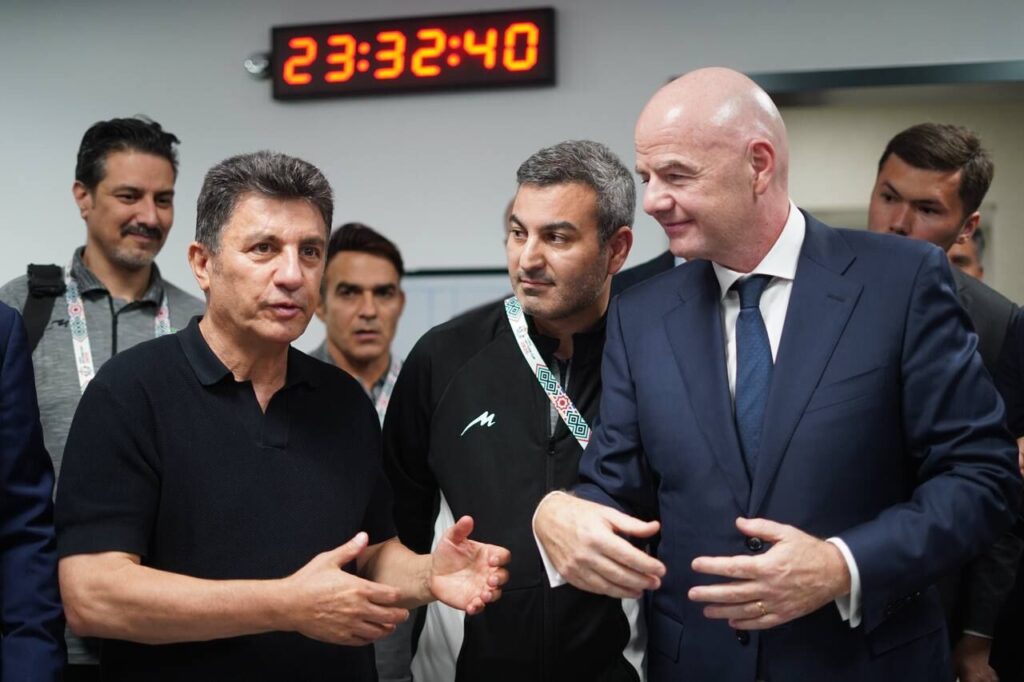
Alavi pointed to a specific precedent that makes the current visa denials particularly jarring. He recalled that during the 2025 CAFA Nations Cup final against Uzbekistan, President Infantino was present in the Iranian national team’s locker room.

“On that occasion,” Alavi recounted, “President Infantino personally assured our players that the presence of the Iranian convoy would be guaranteed from the beginning of the draw ceremony until the last day of the national team’s participation in the World Cup, including all essential workshops and events.”

This assurance now rings hollow, as the logistical foundation for Iran’s participation has collapsed before the tournament draw has even taken place.

A Delegation in Limbo

The practical implications of the visa issue are stark. Alavi explained that even the president of the Iranian Football Federation, who holds official positions within the Asian Football Confederation (AFC) and FIFA, has had his flight ticket issued.

However, the delegation faces a crippling imbalance. “The security director and the executive director, who are indispensable for our participation in the mandatory pre-tournament workshops, have not been granted visas,” Alavi revealed. This creates an untenable situation where the delegation’s leadership could attend, but the operational staff responsible for safety and logistics could not.

“There is no guarantee that the five people scheduled to attend the drawing ceremony will not face problems,” Alavi concluded, underscoring the profound uncertainty that now clouds Iran’s entire pathway to the 2026 World Cup.

A Deeper Conflict Behind the Boycott

However, a different perspective on the visa denials has emerged from sources familiar with the U.S. position. It should be noted that neither the security director nor the executive director, who were denied the visa, are considered essential for Iran’s presence at the drawing ceremony itself. Their roles are primarily relevant for subsequent operational workshops.

In fact, the inclusion of a security director in a delegation for a football draw ceremony has reportedly raised alarms with U.S. authorities. The presence of such a role is unusual for a sporting event of this nature and is understood to be a significant factor in the visa denial. This decision comes as U.S. authorities are in the midst of a broader, heightened crackdown on the activities of non-U.S. citizens within the United States, particularly those affiliated with certain foreign governments.

A Test for FIFA’s Authority

This incident places FIFA in an extraordinarily difficult position, caught between the protest of a member association and the legitimate security and immigration policies of one of its host nations. Iran’s boycott represents a powerful symbolic protest, but the underlying reasons for the visa denials reveal a more complex dispute that extends far beyond the football pitch. The world football body’s next steps will be closely watched as it attempts to navigate this profound diplomatic impasse, which raises serious questions about its ability to insulate the World Cup from international political tensions.

FIFA President Infantino Visits Iran Locker Room, Congratulates Team on World Cup Qualification

(Tashkent, Uzbekistan) – Following Iran’s narrow 1-0 defeat to Uzbekistan in the CAFA Nations Cup 2025 final, FIFA President Gianni Infantino made a surprise visit to the Team Melli locker room to personally congratulate the players on their recent qualification for the 2026 FIFA World Cup.

According to IRNA, the President’s message was one of unwavering support and admiration for Iranian football. He emphasized the significance of their World Cup achievement, stating, “Congratulations on qualifying for the World Cup; it was not an easy task. You have made your country and your families proud, and you have also made Iranians abroad happy.”

Infantino expressed his personal fondness for the team, revealing, “I am a big fan of Iranian football. One of your players gave me his shirt in 2019, and I still have it. It is very valuable to me.”

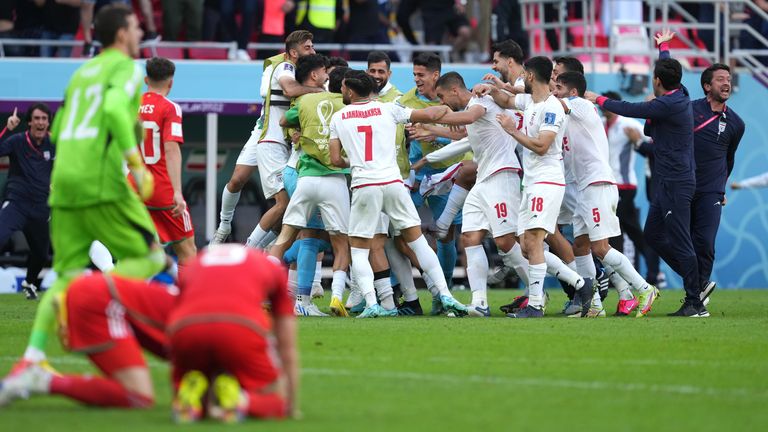
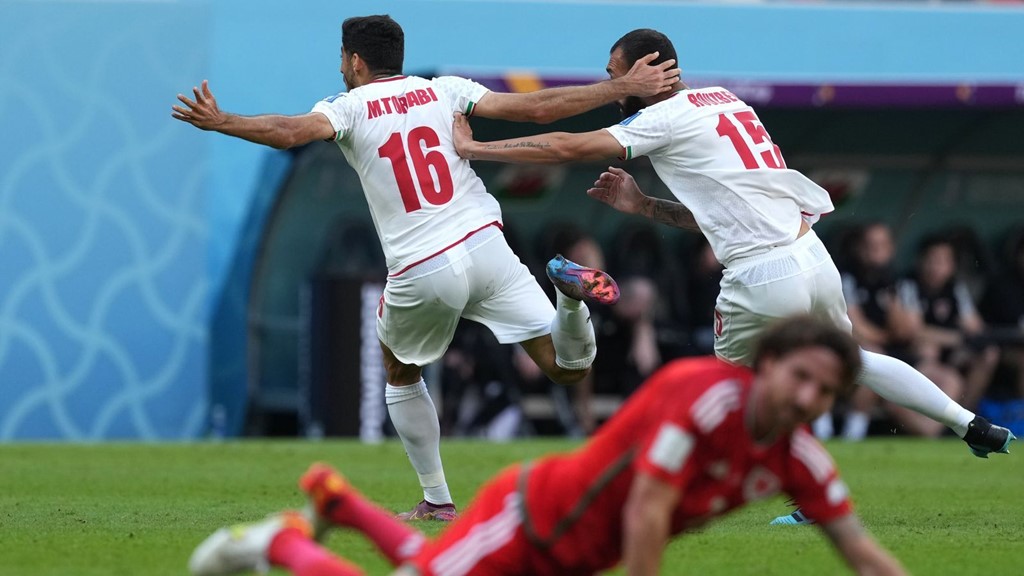
He went on to highlight a iconic moment from the team’s recent history, recalling, “I still remember the Qatar World Cup. The Iran-Wales match was unbelievable. This is the feeling that football can give us; the whole stadium was happy at that moment.”

Addressing the immediate disappointment of the CAFA final loss, the FIFA President offered words of encouragement: “You played very well today, but in football, there are always wins and losses. You are a strong team and should be proud of yourselves.”

Looking ahead to the 2026 tournament in the United States, Canada, and Mexico, Infantino provided a definitive assurance: “As the President of FIFA, I say welcome to the World Cup. I guarantee your presence.”

Concluding his address, Infantino reflected on the unifying power of the sport: “With the help of football, we want to unite the whole world. Unfortunately, the global situation is complex, but football can create this unity that politics often cannot. For the sake of your parents and your families, continue on this path so that you can bring joy to your people. I look forward to seeing you at the World Cup.”


The dream is over.

Team Melli narrowly lost to USA 1-0 in the last game of Group B of the FIFA World Cup Qatar 2022. With that loss, Iran is eliminated from the World Cup as it sits third in the group the same position as the last World Cup but with a point less. USA qualified for Round of 16.

It was the inevitable result and one that is fair comparing the circumstances and form of the two teams. Added to the sporting factors, the external pressure on the Iranian players when the country is under mass protests, citizens losing their lives and limbs, or being incarcerated in mass on daily basis, was perhaps too much to bear.

The oldest team in the tournament, with one of the oldest coaches who only took the job two months before the start of the FIFA World Cup, did not sound much of a hopeful team. Add to that formula, a ridiculously poor preparation, lack of new blood in the squad, and a host of other factors all suggested that Team Melli stood very little chance of qualifying. There was a lot of wishful thinking and much hope for a miracle, but it was not to be as the best two teams in this group qualified on merit. Team Melli and the badly run federations (FFIRI) must go back to the drawing board, however, fans should not hold their breath for vast improvements. The next big assignment is in fact not too far away, again in Doha. The AFC Asian Cup 2023 in June 2023.

In the match against the USA, it was quite clear that the Americans are the much more organized side, with clean and accurate passing, good pace in transition, sensible defending, and sharp offensive moves. They were the more dangerous side. Iranian players on the other hand were found wanting. Lethargic, unable to play even a short series of passes, lack of understanding between the players, confusion and lack of coordination marred the performance of the team. Mehdi Taremi had another bad day up front, the midfield was lost, and all the pre-match analysis about the shortfalls of Team Melli was proven to be true in this match.

The Team came alive late in the match with the introduction of Saman Ghoddos, Abolfazl Jalali, and Mehdi Torabi, but it was too little too late.

Queiroz’s outdated game plans and tactics were easily counteracted by the American coach Gregg Berhalter who outclassed his opposite coach in all departments. Team Melli had 1 shot on target against 5 for the USA. Pulisic proved to be the winner as the defenders had no real solution to contain him.

The same team lineup played exceptionally well against Wales and won deservedly, but four days later it was the same players and the same game plan, however, the opposition was much smarter, stronger, and better organized. There was nothing to cheer about in this match for Team Melli despite the admirable effort by the Iranian fans to cheer Team Melli on. The fans were great, not so was the team.

In the other match played at the same time, England easily defeated Wales 3-0 to confirm its leadership a the top of the table and qualify for round of 16 to meet the African Champions Senegal. For the US Team, it is a difficult encounter against the Netherlands nest.

Iran and Wales are out,

Guessing the lineup for US game tonight.

A win against the US Team will assure Iran’s qualification to the round of 16 of FIFA World Cup Qatar 2022 for the first time. No need to emphasize the importance of this day and match to the squad and what is expected from them.

With two different lineups against England and Wales, Queiroz was a few days wiser and perhaps realized the players’ selection and game plan errors he committed against England while working to strengthen his much-improved performance against Walse when Team Melli dominated the game.

We will take a look at the possibilities of tonight’s lineup vs a desperate US team.

Goalkeeper.

The “Masked man” is ready! Alireza Beiranvand suffered a broken nose during the game against England when he clashed with Majid Hosseini, so he was replaced by Seyed Hossein Hosseini. Although Hosseini could not be faulted for the heavy defeat, he showed his abilities in the match against Wales by keeping a clean sheet, only the second in Iran’s history in the World Cup.
However, Beiranvand, in a rather petulant manner wants to play on and with a protective mask, which has given Queiroz a selection headache. Will the Portuguese opt for Beiranvand, a keeper that he blindly trusts in, or take no risk and play Hosseini or Abedzadeh as a second choice?

It remains to be seen as this one could be a last-minute decision.

Defense
To say that the disastrous defending against England has improved against Wales is an understatement, and that has given Queiroz some peace of mind, but that does not mean it is perfect. The way that Rashford and BUkayo Saka bamboozled Iranian defenders to score was an embarrassment and could well occur again.

Group defending and defenders’ positioning is still lacking coordination. Iranian players seem to be over-enthusiastic at times and at times they pay for that.  A defensive coordinator in the coaching staff needs to work hard to assure the threats of the likes of Weah and Pulisic in the US team are neutralized.
Saying that perhaps the defense line has picked up itself for the US game after the Win against Wales.

In the central role, Majid Hosseini and Morteza Pouraliganji could be Queiroz’s picks. It is hardly unlikely to disturb the stability here. On the flanks, it is also logical for Ramin Rezaian to maintain his post despite the shaky start initially. At left back Milad Mohammadi has not performed as best he can and was short of confidence in both matches. His inclusion is under question against the USA, as Queiroz has two good options there. Players such as Vahid Amiri or Abolfazl Jalali can fill the role with the latter being a useful player on attacking.

Midfield

Perhaps Team Melli’s weakest link. Lack of leadership, poor control, and shortage of creative players have marred this line. Al Gholizadeh stands out among the weak midfiled and he has proven that he can change the outcome of the match with his clever passing and shooting. He has already earned his place in the starting lineup. Ahmad Nourollahi has been disappointing as an offensive midfielder and lacks the capacity to control the game and provide quality balls to the forwards. He also has a slight knock from the previous game that will force Queiroz to leave him on the bench.

Team Melli needs creativity and pace here. This can be provided by Saman Ghoddos and/or  Mehdi Torabi who can complement Ali Gholizadeh. It remains to be seen if Queiroz is brave enough to opt for an offensive lineup such as this.

Alireza Jahanbakhsh is suspended for getting himself two yellow cards so he is out.

On the defensive side of Midfield, Ehsan HajSafi, with his superior performance against Wales, can once again be the starter next to the disappointing Saeed Ezatollahi.

Forwards

The least of Queiroz’s worries. Two excellent forwards who can play alongside each other and disturb any defense as the match against Wales proved.

Aggressive or cautious;

Is it the main issue? If Queriz wants to be conservative, he will play Mehdi Taremi in the starting lineup without Azmoun, or vice versa otherwise, both strikers will be playing against USA America.

Game Plan

Perhaps being cautious is a good thing when Team Melli needs to avoid defeat to make it to the round of 16, but the World Cup has taught us that goals can be scored with half chances and at any time in the game including added time. Team Melli scored against Wales in minutes 98 and 101. So, it is not very wise to depend entirely on the defense trying to achieve a draw. Iran has the tools and the players that can excel in offensive games and score against any team. The team has already scored four goals, a record in its own right. This has to be utilized and force the Americans back.  The USA despite two draws, is not a team that is to be taken lightly. Christian Pulišić (Chelsea), Timothy Weah (Lile), Weston James McKennie (Juventus), and Haji Amir Wright (Antalyaspor) are all potential threats to Team Melli’s defense.

Gregg Berhalter, the USA coach must have done his homework on Team Melli. There are no secrets and no hidden weapons here. What Queiroz needs to do is play a balanced game. Tight at the back but effective on offenses and less of those Hail Mary direct one football.

A knockout like match between IRAN and USA.

Team Melli is still brimming with joy following the dramatic victory over Wales. It was a well-deserved win for Iran, especially after the embarrassing 6-2 hammering by England. It was also timely and Team Melli boys should be full of confidence going into Tuesday’s match against the US team in a politically charged World Cup match.

As for the Americans, there is no other choice except to win, or else they would be on the first flight home. It is claimed that this group of U.S. players is considered the best generation of American soccer. But they finished third behind Canada and Mexico in World Cup qualifying and now face a must-win final group-stage match. Their game against England showed the quality of the Americans. They were brave and logical in the game plan.  The US team rattled the post from a thunderous shot by Pulisic. They were also the better team against Wales and could have put the game to bed by the first half. In the second half, Wales took control and managed to equalize through a late penalty. The American players themselves, know the difficulty of the task ahead as their star player Weston McKennie  said: “The most important thing is that we control the outcome of our journey in this tournament with the last game against Iran, So the next thing is just to go out and get three points against Iran.”

“We got to win the game,” midfielder Gio Reyna said. “We’re not really thinking about anything else, just three points and then we’re through.”

In their last and only meeting in the FIFA World Cup, Iran famously beat the U.S. 2-1 in a 1998 World Cup match in Lyon, France which eliminated the Americans and caused thousands of flag-waving fans to pour into the streets of major Iranian cities in celebration. That was perhaps the greatest post-revolution victory for Iran’s football. In the leadup to the rematch on Tuesday, the U.S. Soccer Federation angered Iran’s government by briefly displaying Iran’s flag on social media without the emblem of the Islamic Republic. Calls by the Iranian side including Queiroz to kick US from the tournament was nothing was “A Storm In A Teacup” meant to politicize the match.

“I just hope we don’t leave it to the 90th-whatever minute,” said Stu Holden, a midfielder on the bench that night and now a Fox commentator. “It would be pretty cool to call a last-second U.S. winner, but selfishly I’m quite OK with us just getting that done early and moving on to the round of 16 because that would be a lot better for my blood pressure.”

As for Team Melli’s readiness, it seems that both Alirezas will be absent. Beiranvand is still unfit after the broken nose in the opener against England, while Jahanbakhsh got himself booked again against wales hence he will serve a one-match ban.

The expectation is that Queiroz will stick to the same game plan that was used against Wales. Why change a winning team?
However, the match against the USA will be much more difficult than the last one as the Americans have to win and that will mean constant pressure and a barrage of attacks. This might be a good thing for Team Melli if the defense does its job and will possibly leave the back line of the US team a bit light. Unfortunately, Team Melli has proven to be slow in transition and counterattack up front. Taremi in particular lacks pace, and the way Queiroz insisted to send the balls directly behind the Welsh defense for Taremi, simply did not work.  Goals have been a struggle for a U.S. team, which got just three from forwards in 14 World Cup qualifiers. Team Melli is much better off keeping the ball and penetrating on the wings and through the middle. With some players who can shoot, it is also a good option too.

Nothing significant has changed on the field of play for Team Melli. Beiranvand’s absence should not be felt as Hosseini or Abedzadeh are well capable of guarding the goal, while Jahanbakhsh’s absence is not a great loss as he has been struggling in this World Cup.

The absence of a schemer in the middle of the field has forced Queiroz to use route one football. It is not pretty and most of it ends up as lost possession allowing the opposition to mount counterattacks. The is still a card in Saman Ghoddos who can be an asset in the midfield and well capable of feeding Azmoun and Taremi. Whether Queiroz has enough trust in the Brentford midfielder is not known.

US AND IRAN PULLED INTO POLITICS

DOHA, Qatar (AP) — The American and Iranian soccer teams are the only ones putting politics aside as the sides meet in a match to determine if either nation continues in this World Cup.

The two met at the 1998 World Cup in France when memories of the 1979 Islamic Revolution were still fresh for both countries. Even the White House was talking about the game as then-President Bill Clinton and Secretary of State Madeline Albright used the match to discuss the possible resumption of diplomatic relations with Iran, which had been cut off since the 1979-81 hostage crisis.

The State Department a month before that game called Iran the world’s “most active″ sponsor of terrorism, so nerves were frayed for both nations. And just a week ahead of kickoff, a French television station broadcast the 1991 film “Not Without My Daughter,″ a movie based on the true story of an American woman who escaped Iran with her daughter against the wishes of her Iranian husband.

The Iranians claimed the broadcast was a purposeful insult.

Iran won 2-1 but neither team advance to the knockout round. They met one other time — a 1-1 draw in a 2000 friendly.

Now the teams head into their final Group B match Tuesday and the United States can only advance with a win. Iran would advance with a win, and perhaps a draw depending on the results of England’s match against Wales.

But headed into one of the most politically charged matches — rematch in this case — in tournament history, the conversation was again not centered on winning or losing.

In Monday’s pre-match news conference, United States captain Tyler Adams and coach Gregg Berhalter were asked about a variety of social and political subjects that had nothing to do with what happens on the field. Adams was asked to defend the U.S.’s treatment of Black people and chastised for pronouncing the opponent “Eye-ran” instead of “E-ran.”

Berhalter was questioned about U.S. immigration and Naval policy and also apologized for the U.S. Soccer Federation’s decision to strip the emblem of the Islamic Republic from Iran’s flag in a since-deleted social media post.

Iran coach Carlos Queiroz was asked about the social media post, which led the governing body of Iranian soccer to demand FIFA expel the United States from the tournament. He said he did not intend to use the controversy as motivation.

“If after 42 years in this game as a coach I still believe that I could win games with those mental games, I think I did not learn nothing about the game,” Queiroz said. “We have solidarity with the humanitarian causes all over the world, whatever they are or who they are. If you talk about human rights, racism, kids that die in schools with shootings, we have solidarity to all those causes, but here our mission is to bring smiles for the people at least for 90 minutes.”

TWO AT A TIME

Tuesday marks the final day of play for both Groups A and B, and it is the first day of simultaneous kickoffs.

The practice of starting two games at the same time began in 1986, four years after a match dubbed the “Disgrace of Gijon.” The match was scandalous because West Germany and Austria both knew that a German win by one or two goals would advance both teams at the expense of Algeria.

After Germany scored an early goal, neither team tried to score again.

Pulisic: US still has a ‘lot of work left to do’ to make World Cup’s last 16

espn.com

AL KHOR, Qatar — United States midfielder Christian Pulisic said he hoped his side’s performance in a 0-0 draw with Group B favorites England “made a lot of people proud” back in the US, but also acknowledged that he and his teammates have “got a lot of work left to do.”

The result leaves the US in third place in Group B, two points behind leaders England and a point behind Iran, who defeated Wales 2-0 earlier on Friday. The US faces Iran in its group stage finale on Tuesday.

It was a game where England had more possessions, but the US created the better chances, with Pulisic rattling the bar with a shot in the first half. England did put the Americans under pressure at times in the second half, but the US defense, ably marshaled by Tim Ream, held firm.

“A draw’s not the worst thing, but I felt like there were stretches of where we showed confidence and had a lot of the play, and created chances, and even could have won the game” Pulisic said.

“But all in all, I thought we managed it quite well.”

The game had been hyped as an opportunity for the US to show it could go toe-to-toe with one of the game’s heavyweights. Pulisic feels the US did that to a degree, but he knows reaching the knockout rounds will do even more to win over new fans.

“Everyone back home watching, I hope we made a lot of people proud,” he said. “But the job isn’t even close to done, so we’ve got a lot of work left to do.”

US manager Gregg Berhalter echoed many of Pulisic’s sentiments, saying his side delivered a “disciplined performance.”

The US now goes into its final group game with Iran knowing it needs a win to advance to the World Cup knockout stages for the fifth time since 1994.

“The final product still could be better… I’m overall pleased with the performance of the group, most importantly the belief of this group because that never wavered,” Berhalter said.

“We played with a ton of spirit but we’re going to have to be up for it [against Iran]. We want a chance to advance… We know it’s going to be a difficult game, and I’m looking forward to the opportunity.”

Of concern for the US is that it is still struggling to make the most of its chances, with Weston McKennie missing a wide-open opportunity in the first half.

Berhalter said he was happy with the positions his team got into, but noted, “It’s hard to score goals.”

Information from Reuters was used in this report.