Author: admin

Jahanbakhsh Joins the Century Club: Iran’s Tenth Player to Reach 100 Caps


Alireza Jahanbakhsh has officially joined the illustrious century club for Team Melli, earning his 100th international cap after coming on as a substitute in Iran’s Group G match against Belgium on Sunday, 21 June, at the FIFA World Cup 2026.

The 32-year-old winger, who is currently under contract with a Belgian club, has enjoyed a distinguished career spanning 12 years and 5 months at the international level. Over that period, he has represented several prominent European clubs, including Feyenoord in the Netherlands and Brighton & Hove Albion in the English Premier League.

Jahanbakhsh holds a unique place in football history as the only Iranian player to have won the Eredivisie’s Top Scorer award. During the 2017–18 season while playing for AZ Alkmaar, he netted 21 goals to finish as the league’s leading marksman—becoming the first Asian player ever to top the scoring charts in a major European league. The achievement remains a landmark moment for Iranian football on the continental stage.

With this milestone appearance, Jahanbakhsh becomes the tenth Iranian player to reach 100 caps for the national team. He now takes his place among an elite group of Iranian football legends, a list headlined by:

  • Javad Nekounam – 151 caps
  • Ali Daei – 149 caps (and the world’s all-time leading international goalscorer)
  • Ehsan Hajsafi – currently among the most capped active players

The achievement is a testament to Jahanbakhsh’s longevity, professionalism, and enduring value to Team Melli—a player who has evolved from a promising young talent into a seasoned veteran and a source of pride for Iranian football.


Statistics: Team Melli

From Shambles to Solidity: Iran’s Defensive Masterclass Stuns Belgium


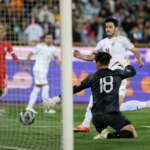
Beiranvand Heroics Earn Team Melli a Vital Point Against Belgium

Iran and Belgium played out a goalless draw at the SoFi Stadium in Los Angeles in the second Group G encounter for both teams. With this result, Iran temporarily sits atop the group on two points, followed by Belgium, New Zealand, and Egypt—all of whom remain in contention ahead of the later match between the Kiwis and the Pharaohs.

A Transformed Team Takes the Pitch

After the disappointing draw and lackluster performance against New Zealand, Amir Ghalenoei made decisive changes that revitalized the team. The individual errors that had plagued Iran in the opener were conspicuously absent, and the team’s weakest link, the defense, emerged as the undisputed star of the show against the Belgian golden generation.

Starting Lineup:
Beiranvand (GK); Hardani, Kanaani, Khalilzadeh, Nemati, Hajsafi; Rezaeian, Ghoddos, Ezatollahi; Mohebi, Taremi.

These changes were clearly designed to neutralize the speed and trickery of Belgium’s wingers, Jérémy Doku and Leandro Trossard. In the end, however, Doku was declared unfit due to a medical issue, sparing Iran one significant headache, though Trossard proved more than capable of causing problems on his own.

Beiranvand: A World-Class Performance

Alireza Beiranvand was the undoubted MVP of the match, delivering a performance that harked back to his heroics at the 2018 World Cup. The Iranian goalkeeper made an astonishing 17 saves, commanding his area with the confidence of a world-class shot-stopper. His timely catches and fearless collection of crosses frustrated Romelu Lukaku, who, despite a strong individual display, was repeatedly denied by Beiranvand before being substituted late in the match.

Defensive Solidity – A Monumental Improvement

Iran’s backline produced one of its most disciplined and cohesive performances in recent memory. Solid positioning, excellent covering work, and timely interceptions ensured that Belgium’s attacking riches were kept largely at bay. The only black mark came on the right flank, where Saleh Hardani was not only ineffective but a genuine liability. Trossard bamboozled him repeatedly, forcing Ghalenoei to haul him off at half-time—a merciful end to a torrid 45 minutes.

Midfield Battle – Grit Over Glamour

The midfield was far more active than in the New Zealand match, with both Saeed Ezzatollahi and Saman Ghoddos contributing their fair share of defensive work. The game plan leaned heavily toward direct, route-one football, bypassing Belgium’s press and targeting Taremi in advanced areas. Ramin Rezaeian, deployed in a more advanced midfield role, was less effective on the right flank than he had been against New Zealand and failed to replicate his Man of the Match performance from the opener.

Taremi: The Captain’s Crusade

Up front, Mehdi Taremi was immense in every sense of the word. He tackled relentlessly, distributed intelligently, and scored a brilliant goal that was cruelly ruled out for offside after a lengthy VAR review. The captain also tested Thibaut Courtois on multiple occasions, but the Belgian goalkeeper, widely regarded as one of the world’s best, was equal to every effort.

Taremi’s crowning contribution came in the 66th minute, when he robbed Nathan Ngoy of possession after the Belgian defender’s poor ball control. As Taremi bore down on goal, Ngoy hauled him down, resulting in a straight red card. The sending-off tilted the dynamics of the match decisively in Iran’s favor.

Numerical Advantage – But No Decisive Blow

With Belgium reduced to ten men, Iran enjoyed prolonged possession and territorial dominance. Yet, despite the man advantage, Team Melli failed to find the elusive winning goal that would have all but secured qualification. The inability to capitalize on the extra man will rankle with Ghalenoei and his staff—a missed opportunity that could prove costly in the final reckoning.

A Worrying Trend: Ball Retention Woes

One persistent issue that marred an otherwise encouraging display was Iran’s failure to retain possession. Throughout the match, Team Melli lost the ball on average every 12 seconds—a damning statistic that reflected a lack of composure and technical security. This improved somewhat after Belgium went down to ten men, but the underlying fragility in possession remains a serious concern.

Substitutions: A Mixed Bag

Ghalenoei’s substitutions were a mixed bag. Removing Hardani at half-time was unquestionably the right call, but replacing him with Alireza Jahanbakhsh, who offered even less defensive cover and attacking thrust, was a baffling decision. Jahanbakhsh’s introduction did little to stabilize the right flank or exploit Belgium’s numerical disadvantage, raising questions about Ghalenoei’s in-game management.

What It Means for Group G

With two points on the board, nothing is decided in Group G until the final round of matches. However, Iran’s disciplined and resilient performance against a formidable Belgium side has injected genuine hope into fans and critics alike. For the first time in their World Cup history, Team Melli stands on the verge of qualifying for the Round of 32—provided they can deliver one more decisive performance in the final group fixture against Egypt.

The dream is alive. But the hard work is far from over.

Grievances Over Game Plans: How Injustice Overshadowed Tactics in Ghalenoei’s Pre-Match Address

Amir Ghalenoei stepped up to the pre-match press conference ahead of Iran’s crucial clash with Belgium with an opportunity to dissect tactics, address defensive frailties, and outline a coherent plan for upsetting one of Europe’s traditional powerhouses. Instead, the microphone became a megaphone for frustration, a litany of complaints about inhospitality, inequity, and the systemic disadvantages his team has endured since setting foot on American soil.

Technical analysis took a backseat. Player selection, formation tweaks, and counter-strategies were scarcely mentioned. The dominant refrain was one of protest: Iran, Ghalenoei insisted, is not competing on a level playing field. Team Melli is handicapped by forces far beyond the white lines of the pitch, and he made certain the world heard it.


“Less Than 16 Hours”: A Travel Nightmare

Ghalenoei opened his remarks by drawing a stark contrast between Iran’s preparation timeline and that of their opponents:

“In the first game, we were in Los Angeles about 24 hours before kickoff, and we had time. Against Belgium, they gave us less than 16 hours. We were forced to conduct our training half-heartedly. This made the situation difficult for us.”

He acknowledged FIFA President Gianni Infantino’s efforts to alleviate some of the logistical burdens, but quickly pivoted back to the grim reality:

“Although I know the FIFA president tried his best to solve the problems, these problems have only increased. We left the training session incomplete because we simply did not have enough time. That made our job infinitely harder.”

The tone was measured but unmistakably bitter, a coach who feels his team has been set up to fail before a ball is even kicked.


Defensive Woes Acknowledged, But Recovery Denied

When pressed about Iran’s defensive vulnerabilities, so painfully exposed by New Zealand, Ghalenoei did not shy away from the issue, but framed it within the broader context of logistical sabotage:

“In the previous game, we had problems with individual mistakes and defensive structure. With the little time we had, we were unable to recover properly because we spent more time traveling by air than on the ground. That prevented us from fully covering our defensive problems.”

He emphasized that mental and psychological recovery took precedence over tactical drilling—a telling admission that the team’s focus has been fragmented by external stressors. Analysis, he noted, came second.

“What was important to me was the mental and psychological issues. Then we worked on the analysis. We will definitely make changes against Belgium, but we have a very difficult task ahead.”


Belgium: Respect Without Fear

On the subject of Belgium—a team boasting stars like Lukaku, De Bruyne, and Doku—Ghalenoei offered respect but refused to concede intimidation:

“As you said, Belgium is one of the very good teams in the world. But the reality is that in football, the game starts when the referee blows the whistle. The players are able to implement tactical orders well during the match. We also have very good, quality players who play with their hearts.”

It was a brief nod to footballing matters, quickly overshadowed by a broader lament about the conditions his squad has endured.


Gratitude for Mexico, Silence from Others

In a rare moment of warmth, Ghalenoei extended his thanks to Mexico for their hospitality during Iran’s training camp in Tijuana:

“I would like to thank them once again for hosting the team. They made up for all the shortcomings of others. I thank all the Mexican fans in the Tijuana camp.”

The gratitude, however, only sharpened the contrast with the treatment Iran has received in the United States—a treatment Ghalenoei characterized as unprofessional and deeply unjust.


“I Asked 47 Other Coaches—I Got No Answer”

Perhaps the most striking revelation came when Ghalenoei disclosed his attempts to seek solidarity:

“I asked 47 other coaches who are at the World Cup, but I did not get an answer. We arrived in Los Angeles very late. We wanted two weeks before the tournament to get acquainted with the hosting conditions.”

The implication was clear: Iran stands alone in its struggles, isolated not only by logistical barriers but by the indifference of the wider football community.


Executive Absence: A Team Without Its Leadership

Ghalenoei did not stop at travel grievances. He escalated his critique to include the absence of key Iranian football executives:

“The president of the federation, the team manager, the communication manager, and especially the media team are not with us. These behaviors are not at all in the standards of World Cup hosting. How can a team participate in the World Cup but all the executive staff of that team is absent?”

He connected this injustice to a deeper national narrative:

“These behaviors showed how much the Iranian people—especially the martyrs of the homeland—have been hurt by such behaviors. Even if we had spent billions of dollars, we could not have shown the oppression and rightfulness of the Iranian nation like this. But these behaviors have shown how oppressed a country we are.”


A Plea for Justice, Not Politics

Ghalenoei was careful to distinguish his protest from political posturing:

“We did not come here for politics. We are protesting the treatment that is being done to us. I did not see the head coaches of other teams to see how they would react, but if I were there and I saw such injustice being done to another team, I would definitely react.”

He reiterated his hope that future World Cups would not institutionalize such discriminatory practices:

“I hope the world will be governed in peace and tranquility, and that these behaviors will not be institutionalized in future World Cups.”


Infantino’s Efforts: Acknowledged but Insufficient

Ghalenoei carefully parsed his words regarding FIFA’s involvement:

“I didn’t say Infantino has helped. I said he is trying. For example, they told me I could go to America at 6 o’clock yesterday, and I welcomed that—but no matter how long we waited, nothing happened. This injustice was not good for us.”

He pointed to a glaring inconsistency:

“They did not give a visa to the president of our federation, who is the father of the team and can solve many issues with his presence.”


The Belgian Contrast: A Tale of Two Preparations

The most damning comparison was reserved for Belgium’s preparation timeline:

“Belgium arrived in Los Angeles two nights before the game and had the necessary recovery. We arrived 16 hours earlier. They say we can now go to Seattle two days earlier to play with Egypt. If they had done this earlier, we would not have had problems. I wish they had given us the opportunity to come two weeks earlier—to adapt to the conditions of the match venue. I wish they had done justice to football for Iran as well.”

He concluded with a pointed challenge:

“FIFA said in the game with Egypt in Seattle that you can implement the method you want. My question is: why did they not issue our visas earlier, and then not let us come here earlier for the games?”


Final Assessment: A Press Conference of Protest, Not Preparation

By the time Ghalenoei stepped away from the microphone, the assembled media had heard far more about travel schedules, visa denials, and perceived injustices than about the tactical battle awaiting Iran against Belgium. The defensive structure, the midfield pivot, the double-teaming of Doku—all the hard tactical questions that fans and analysts craved answers to were either glossed over or buried beneath the weight of legitimate grievances.

Whether Ghalenoei’s complaints will galvanize his squad or serve as a distraction remains to be seen. What is certain is that the press conference will be remembered less for its footballing insights and more for its raw, unfiltered indictment of a host nation’s treatment of Team Melli.

The world may not have heard a tactical masterclass from the Iranian coach. But they heard something perhaps more important: a coach fighting not just for a result, but for the basic dignity and fairness that every team deserves—yet Iran, once again, has been denied.


Ghalenoei Under the Gun – Tactical Overhaul Urgently Needed as Belgium Looms

Team Melli’s 2-2 draw against New Zealand—a match widely perceived as the most winnable of the three group fixtures—has drawn fierce criticism toward head coach Amir Ghalenoei and a host of underperforming players. With the toughest test of the group stage arriving tomorrow against Belgium, Ghalenoei finds himself with no room for error. He must not only mitigate the expected damage but also salvage Iran’s fading hopes of advancing to the knockout rounds.

Limited Options, Limited Vision

Frankly, Ghalenoei does not have a wealth of options at his disposal. The squad lacks strength in depth, and there is no clearly defined, coherent game plan that the coach can confidently deploy. Nevertheless, it is imperative that the technical staff rise to the occasion and devise a strategy capable of neutralizing a completely different threat in the form of Belgium’s golden generation.

Defensive Crisis – The Achilles’ Heel

The most critical area of concern remains the backline. Alireza Beiranvand is the only viable option in goal, despite a performance against New Zealand that did little to inspire confidence. His shot-stopping was suspect, and his distribution remains a persistent liability.

In central defense, the options are available but far from reassuring. Shoja Khalilzadeh is slow, error-prone, and was directly at fault for both goals conceded against the Kiwis. Ali Nemati offered little alongside him, displaying minimal understanding or coordination with his partner. It is becoming increasingly apparent that Nemati is uncomfortable in the heart of Iran’s defense at this level.

The alternative is Mohammad Hossein Kanaanizadegan, Khalilzadeh’s usual partner, who has inexplicably found himself on the bench. Also available is Danial Eiri, but selecting him would require a level of courage that Ghalenoei has conspicuously failed to demonstrate throughout his tenure. The odds strongly favor Kanaanizadegan’s return to the starting lineup alongside Khalilzadeh, tasked with the unenviable job of neutralizing Romelu Lukaku, who is expected to lead Belgium’s attack.

Flank Warfare – Containing the Doku Threat

On the flanks, Ghalenoei has a potential solution in the form of Saleh Hardani—a tenacious, hard-tackling defender who can be deployed specifically to contain the explosive Jérémy Doku. However, Hardani alone may not be sufficient to neutralize a player of Doku’s caliber.

This is where Ramin Rezaeian becomes pivotal. By utilizing Rezaeian in a dual role—operating as both a pseudo-right-back and an attacking right winger—Ghalenoei could kill two birds with one stone. Rezaeian possesses the experience, skill, and quality to execute such a demanding role, and history has shown that the closer he gets to the opponent’s goal, the more influential he becomes. Deploying both Hardani and Rezaeian simultaneously would create a defensive-offensive partnership while ensuring there is no empty space behind Rezaeian for Doku to exploit on the counter.

Midfield Malaise – Time for Change

The midfield was arguably the weakest link against New Zealand, with Saeed Ezzatollahi and Saman Ghoddos delivering performances that ranged from anonymous to outright detrimental. Introducing Mohammad Ghorbani could provide much-needed defensive solidity and energy in the middle of the park. Ghoddos, for his part, faces no serious challenger for his position—but that is more a reflection of the squad’s lack of depth than his own form. The hope is that he will finally wake up and deliver a performance worthy of his reputation against Belgium.

Frontline Adjustments – Time for Ghaedi

In attack, starting Mehdi Ghaedi could give Iran the creative spark and dribbling threat that was sorely missing against New Zealand. Keeping Mohammad Mohebi and Mehdi Taremi in their respective positions remains the best available solution, but Ghalenoei must ensure that the forward line operates with greater cohesion and understanding than it showed in the opener.

The Mental Battle – Composure Is Key

Beyond tactics and personnel, Ghalenoei and his coaching staff must address the emotional fragility that plagued the team against New Zealand. Haste, confusion, and a lack of composure were evident in nearly every area of the pitch. Experienced Iranian players repeatedly failed to execute simple moves or complete basic passes—a damning indictment of their mental state. With only hours remaining before the Belgium clash, this psychological deficiency must be urgently addressed. Whether it can be fixed in such a short time remains highly doubtful.

Group G Reaches the Critical Stage – Iran’s World Cup Hangs in the Balance

The FIFA World Cup 2026’s Group G reaches its pivotal moment on Sunday. With all four teams locked on a single point after opening draws, the mathematics are brutal: defeat in the second round could effectively spell elimination, while victory would almost certainly secure a place in the knockout stage. A draw, meanwhile, would plunge the group into chaotic uncertainty.

Despite navigating a minefield of logistical hurdles, largely imposed by what can only be described as American hostility and a glaring lack of sporting hospitality, Team Melli still harbors a genuine chance to make history by advancing to the next round. But that dream hinges on immediate and tangible improvements to both the game plan and the starting lineup.

Defensive Frailties – The Elephant in the Room

Against New Zealand, Iran’s errors were numerous, yet the players showed resilience to claw back a point on two separate occasions. The recurring Achilles’ heel, however, remains the defensive line. Shoja Khalilzadeh, despite being directly at fault for both goals conceded, is still arguably Iran’s best option at center-back. That says as much about the lack of alternatives as it does about his own ability. His usual partner, Hossein Kananizadegan, has seemingly failed to convince Ghalenoei that he deserves a starting berth, a damning indictment of the squad’s defensive depth, or lack of it, to be precise.

But the defensive crisis is compounded by a dysfunctional midfield. Saeed Ezzatollahi and Saman Ghoddos appeared to be on a collective day off, delivering a performance devoid of the necessary running, sharpness, and stamina required at this level. Against a Belgium side brimming with technical quality, that lethargy could prove catastrophic.

The Belgian Threat – A Calamity in Waiting?

Kevin De Bruyne and Youri Tielemans represent a midfield of the highest calibre, and if Iran’s central pairing repeat their New Zealand horror show, the result could be humiliating. The Red Devils will feast on space and time, and Team Melli’s defense will be exposed mercilessly by forwards like Leandro Trossard and Romelu Lukaku

Given the exhaustive pre-match analysis supposedly conducted for the New Zealand game, it was nothing short of shocking to see Chris Wood open up Iran’s defense and prove instrumental in both goals. If the technical staff had properly analyzed his movements, then their failure to neutralize him constitutes a glaring oversight. At the World Cup level, preparation and planning are nearly as vital as the match itself. Iran’s coaching staff must elevate their tactical reading of the game immediately; otherwise, Ghalenoei will remain handicapped by substandard support. The Belgium match will reveal, once and for all, whether the groundwork has truly been laid—or whether this team is simply making up the numbers.

Tactical Conundrum – What Will Ghalenoei Do?

It remains unclear what defensive system Ghalenoei will deploy against Belgium. A back three is one option, but the most urgent threat is undeniably Jérémy Doku. The Manchester City winger is equally devastating on either flank, and his pace and trickery will test Iran’s full-backs to breaking point. Containing him must be Priority One.

No coach in his right mind would bench his best player, and Ramin Rezaeian must start. Period. But Iran cannot afford to rely solely on defensive resilience; they must carry an attacking threat. Mehdi Taremi, despite a muted and below-par showing against New Zealand, remains Iran’s most potent offensive weapon. However, Taremi is not a player who will single-handedly dribble past defenders. He thrives on service—crosses from the flanks, through balls from midfield, and intelligent movement around him. The onus is on the coaching staff to provide that support, and ultimately, on Taremi to finish the few chances Iran is likely to create against a Belgian side of this caliber.

He must work on his own sharpness and avoid wasting the rare opportunities that will come his way. At this level, profligacy is punished ruthlessly.

Time Is Running Out – But Not Impossible

There is precious little time to correct all of Iran’s shortcomings. The defensive disorganization, the midfield inertia, the tactical hesitancy—these are deep-rooted issues that cannot be fixed overnight. Yet, if Iran is to qualify for the next round, this is the match that can define their tournament.

A victory against Belgium is not impossible. Football has a habit of defying logic. But the next 48 hours on the training pitch and at the drawing table will be absolutely crucial. Whether Ghalenoei and his staff rise to the occasion—or buckle under the weight of expectation—will be answered under the Los Angeles lights.

Iran’s World Cup Campaign Hamstrung by Border Bureaucracy—Nabi Confirms Visa Fix, but Travel Nightmare Continues

Mohammad Mohammad-Nabi, Vice President of the Football Federation Islamic Republic of Iran (FFIRI) and Team Melli manager, addressed the media regarding Iran’s latest preparations ahead of their crucial World Cup clash against Belgium.

“After all four teams in the group drew their opening matches, everything has effectively reset. The group is wide open,” Nabi remarked, reflecting on the competitive balance of Group G.

The national team, currently based in Tijuana, Mexico, has been undergoing recovery sessions following the physically demanding draw against New Zealand. The players are scheduled to train on the main pitch at the Tijuana camp later today (Friday) as they fine-tune their preparations for the Belgium encounter.

On the subject of visa complications that had threatened to disrupt Iran’s campaign, Nabi offered reassurance: “The players and coaching staff have no issues. Only Mehdi Torabi’s visa was initially issued as single-entry, but that problem was resolved yesterday. He is now cleared to re-enter the United States and rejoin the squad for the remainder of the group stage.”

However, Nabi acknowledged ongoing logistical frustrations regarding the team’s travel arrangements. “We had formally requested that the national team be permitted to stay at the tournament site two days prior to each match. We are currently in negotiations with the relevant authorities to resolve this matter. If they do not grant us permission, we will once again adopt the same approach as the first match—traveling to Los Angeles one day before the game and returning to Mexico immediately after.”

Regarding the squad’s fitness ahead of the pivotal Belgium match, the FFIRI Vice President provided a positive update: “The players are currently in a recovery phase, and no player is experiencing any issues at the moment. Mehdi Torabi has been reintegrated into group training following his injury, while Roozbeh Cheshmi is continuing his convalescence period and is being monitored closely by the medical staff.”

Sayyadmanesh signed by Lech Poznan

The Polish football club Lech Poznan officially announced the signing of Iranian winger and striker Allahyar Sayadmanesh.

The player was added to the team’s roster on Friday morning by signing a contract until June 30, 2029, making him Lech Poznan’s second signing of the summer transfer window after the signing of Mateusz Lis. The 24-year-old Sayyadmanesh played for the Belgian team Westerlo in the past two seasons and managed to score 14 goals and record 13 assists in 84 matches.

Lech Poznan’s sports director, Tomasz Jóhanna commented on the signing of the Iranian player: “We are delighted that Allahyar Sayyadmanesh has joined Lech Poznan on a three-year contract. Despite his young age, he has significant experience in the Turkish and Belgian leagues. The 24-year-old player can play in all attacking positions, including right winger, left winger and striker, and increase the competition in the team’s attack line”.

Sayadmanesh left Iran in the summer of 2019 and moved to Turkish football. He first joined Fenerbahce and then played on loan for Istanbulspor, Zorya Luhansk in Ukraine and Hull City in England. The Iranian striker was transferred to Hull City permanently in June 2022 and recorded 3 goals and 2 assists in 40 matches during his time with the English team. Sayyadmanesh also has played for Team Melli in played in 9 international matches so far and managed to score one goal against the Syrian national team. In another match against the same opponent, he had also provided an assist to one of his current Lech Poznan teammates, Ali Gholizadeh.

His absence from Team Melli’s World Cup squad has raised questions, taking into consideration the less prominent players that are already in the squad.

With the finalization of this transfer, Allahyar Sayyadmanesh will play next season alongside Ali Gholizadeh for Lech Poznan, the champions of last season’s Polish Football League. He is only the second Iranian player in the Polish League.

System Shuffle or Structural Fracture? Dissecting Team Melli’s Tactical Identity Crisis Ahead of Belgium


While Team Melli’s performance and result against New Zealand fell short of expectations, the outing was far from the doomsday scenario that critics had prophesied. Predictions of collapse, fueled by contentious player selections, a perceived lack of attacking punch, questionable squad character, and the ever-present shadow of off-pitch political interference, proved exaggerated. Yet, to dismiss the concerns entirely would be equally misguided.

Tactical shortcomings were evident. The defensive fragility, a theme rehearsed ad nauseam, remains the most visible flaw. But more alarming, and arguably more consequential, was the glaring inadequacy in midfield: a void of depth, influence, and effective ball progression that left Iran disjointed and reactive for large stretches of the match.


Three Years, Five Systems, One Persistent Question

It has been three years and three months since Amir Ghalenoei assumed the reins of Team Melli. In that period, he has overseen 44 official matches—including the World Cup opener against New Zealand—deploying no fewer than five distinct starting formations. The preparatory friendlies in March and June, ostensibly the final testing ground for tactical experimentation, saw Ghalenoei cycle through a veritable carousel of systems:

  • Against Nigeria, he unveiled a three-center-back setup with a 4–4–1 structure for the first time.
  • Against Costa Rica, he reverted to his preferred 4–3–1–2, yielding an emphatic victory.
  • Against Gambia, he shifted to a 4–4–2 with two holding midfielders.
  • Against Mali, after a lengthy hiatus, he dusted off a 4–4–1–1.

Despite this tinkering, it was widely anticipated that Ghalenoei would lean on his favored system against New Zealand—arguably the group’s most forgiving opponent. And so he did. Iran took the field in a 4–3–1–2 formation, the nineteenth time he has employed this setup from the opening whistle.

The Starting XI and Structural Blueprint:

  • Center-backs: Nemati and Khalilzadeh held the spine.
  • Full-backs: Ramin Rezaian (right) and Milad Mohammadi (left) provided width.
  • Sole defensive midfielder: Saeed Ezzatollahi sat deep, tasked with shielding the backline.
  • Wingers: Aria Yousefi (left) and Mohammad Mohebi (right), though Yousefi was deployed in an unnatural left-wing role, a position he had only recently trialed in training.
  • Playmaker: Saman Ghoddos operated between the lines.
  • Strikers: Shahriar Moghanloo and Mehdi Taremi formed the attacking duo, with their positioning fluctuating throughout.

Crucially, Yousefi’s unfamiliarity with the left flank was compounded by Mohebi’s altered responsibilities—he was forced to track back and cover the space behind Rezaian, who was given license to bomb forward relentlessly. The result was a lopsided, occasionally chaotic structure that invited pressure.


Substitutions Without Systemic Evolution

Recognizing the ineffectiveness of his initial setup, Ghalenoei turned to his bench. However, the substitutions did little to alter the underlying tactical framework:

  • Ghaedi replaced Yousefi on the left wing.
  • Alipour came on for Moghanloo.
  • Hajsafi took over Ghoddos’s creative role.
  • Hosseinzadeh entered for Taremi.

Personnel changed; the system did not. Iran continued to labour within the same structural constraints, failing to address the midfield disconnect or the defensive vulnerabilities that New Zealand exploited with alarming ease.


Belgium: A Different Beast Entirely

The challenge against Belgium will be of an entirely different magnitude. The Red Devils possess superior technical quality, greater attacking depth, and a midfield engine capable of overrunning any opponent that fails to maintain structural integrity.

Ghalenoei’s selection of Shahriar Moghanloo against New Zealand was a calculated, almost pragmatic move. Moghanloo’s stature was prioritized not for his goal-scoring threat, but for his aerial presence in defending set pieces and his utility in both boxes. Against Belgium, however, where the game will be defined by transitional speed and midfield duels rather than cross-heavy assaults, Moghanloo’s inclusion seems increasingly untenable. His departure from the starting XI against Belgium is all but certain.


Defensive Disarray: The Elephant on the Pitch

What was most glaring, and most heavily criticized against New Zealand, was the structural disintegration of Iran’s defensive organization. Despite packing numbers into their own third, the Iranian backline allowed the Kiwis to carve through with just two or three attackers around the 18-yard box, conceding two goals far too easily.

The problems were systemic:

  • Poor spatial coverage in front of the defensive line.
  • Inadequate communication and coordination inside the penalty area.
  • Mismanagement of covering assignments during transitional phases.

These are not individual errors; they are collective breakdowns, and against a Belgian attack far more clinical and inventive than New Zealand’s, such lapses would be fatal.


Expected Adjustments: A Shift to Two Holding Midfielders

Given the defensive frailties and Belgium’s superior attacking pedigree, a systemic change is not just likely—it is imperative. Ghalenoei is expected to abandon the single-pivot setup and instead field two defensive midfielders in a 4–2–3–1 (or 4–3–1–2–1) shape.

  • Ezzatollahi will likely be joined by Mohammad Ghorbani (the more probable choice) or, less likely, Amir Mohammad Razaghinia, to form a double pivot.
  • This dual-screen arrangement aims to:
  • Better shield the central defensive duo (Khalilzadeh and Nemati, who are expected to retain their places).
  • Close the dangerous spaces in front of the backline.
  • Reduce the isolation of defenders when Belgium’s midfielders drift into half-spaces.

In this recalibrated setup, Mehdi Taremi is likely to operate as a lone striker, with the freedom to drop deep and link play—a role he has performed with distinction at club level.


Wing Reconfiguration: Rezaian Unleashed, Hardani Anchors

Further changes are anticipated in the wide areas:

  • Aria Yousefi is expected to drop out, with Mohammad Mohebi shifting to the left wing, his more natural flank.
  • Ramin Rezaian, given his offensive instincts and goal-scoring ability, could be pushed higher to right wing.
  • Behind him, a more defensively disciplined full-back, likely Saleh Hardani, would provide cover, allowing Rezaian greater freedom to attack without exposing the flank.

Saman Ghoddos will retain his central playmaking role, operating at the tip of the midfield triangle, tasked with linking defense to attack and unlocking Belgium’s defensive block.


Ghalenoei’s System History: A Pattern of Pragmatism

It is worth contextualizing these potential changes within Ghalenoei’s broader tactical portfolio:

  • 4–4–2 with two holding midfielders has been used in 11 matches.
  • 4–3–1–2 (as seen against New Zealand) has been deployed in 19 matches.
  • 4–2–3–1 (or its variant) has been used in 8 matches, which would become the ninth if selected against Belgium.
  • 4–1–4–1 has featured in 5 matches.
  • 4–1–4–1 with a single pivot has been used in 1 match.

The data suggests that Ghalenoei is not averse to systemic flexibility—but the question remains whether these shifts are proactive tactical evolutions or reactive patchwork responses to emerging crises.


Belgium’s Vulnerabilities: Lessons from Egypt

It would be remiss not to acknowledge that Belgium, for all their star power, are far from invincible. Their last match against Egypt offered a revealing blueprint:

  • Doku, Belgium’s most dynamic dribbler, was effectively neutralized by double-teaming, a tactic that nullified his direct threat and forced him into predictable passing lanes.
  • The midfield axis of Tielemans and De Bruyne was disrupted by Egypt’s compact pressing and disciplined positional play, limiting their ability to dictate tempo and thread penetrating passes.

Ghalenoei would have been remiss not to take meticulous notes. If Iran can replicate Egypt’s defensive discipline, doubling Doku when necessary, cutting off supply lines to De Bruyne, and maintaining compactness between the lines, they may find avenues to frustrate the European side and exploit counter-attacking opportunities.


Final Verdict: Adaptation or Repetition?

The Belgium match represents a crossroads. Ghalenoei has the personnel, the data, and the tactical history to make informed adjustments. But the recurring concern is whether he will commit to meaningful systemic evolution or simply shuffle personnel within a failing framework.

Iran’s World Cup aspirations do not hinge solely on this single fixture—but the manner in which they approach it will speak volumes about the coaching staff’s ability to learn, adapt, and impose their will on a high-caliber opponent. The fans, the pundits, and the players themselves deserve a coherent, courageous plan—not another chapter in an ongoing tactical identity crisis.


The Eckert Enigma: A VIP Passenger or a Secret Weapon? The Question Ghalenoei Must Answer


When Dennis Eckert boarded the plane to the United States alongside 25 other Team Melli players, his luggage carried no international caps, no national team pedigree—not even a single minute of competitive football for Iran. His inclusion on the World Cup roster is, by any measure, an anomaly so striking that it borders on the unprecedented in Iranian football history.

To be fair, a deep dive into the annals of Iran’s World Cup campaigns—particularly the 1978 edition in Argentina—might unearth a rare outlier. But even if a precedent exists, the sight of a completely uncapped player being fast-tracked into the world’s most unforgiving tournament remains a statistical and tactical oddity. Yet, the true controversy is not merely that he is on the list; it is why he is not on the pitch.

This is the question that must be levelled directly at head coach Amir Ghalenoei. If Dennis is technically gifted enough to survive multiple selection filters and earn a place in the final 26-man squad—if he is genuinely considered superior to Sardar Azmoun, a striker with 57 goals in 91 international outings—then why did he not feature for a single minute in Iran’s opening match? Why was he neither in the starting eleven nor even summoned from the bench?

In the cold, unforgiving logic of professional football, such contradictions are inexcusable. You do not place your trust in a player for the sport’s grandest stage and then withhold from him the smallest on-field responsibility. These two actions are fundamentally incompatible. If Eckert is not destined to play, then one of the most precious World Cup quotas has been effectively squandered—a spot that could have been awarded to a player genuinely capable of contributing to the team’s cause in moments of crisis.

Conversely, if Ghalenoei truly believes that Eckert possesses the key to unlock stubborn defences, then what justification exists for this tactical paralysis? The World Cup is not a laboratory for experimentation, nor a theatre for diplomatic niceties. It is a short, ruthless tournament where opportunities evaporate in an instant and errors are rarely forgiven. Ghalenoei, notably, found time to grant Ehsan Hajsafi a record-breaking appearance, yet Eckert—whose administrative dossier consumed weeks of bureaucratic wrangling, requiring exceptions to Iranian citizenship laws—was apparently an afterthought.

Now, only two group-stage matches remain. Two decisive 90-minute windows that may either break the spell of Eckert’s non-appearance or condemn him to the role of a mere special passenger in Team Melli’s convoy—a curiosity rather than a contributor.

Should the latter scenario unfold, it will undoubtedly become one of the defining questions of Iran’s 2026 World Cup campaign: How does a player travel to football’s greatest spectacle without a single international cap, yet never set foot on the field? That is a question not merely for Ghalenoei to answer, but one for which he must be held accountable.

The fans deserve clarity. Is Dennis Eckert Dargahi a ceremonial VIP guest, benefiting from influence beyond his on-field résumé, or is he a clandestine tactical asset, a secret weapon Ghalenoei intends to unleash upon an unsuspecting world? With swirling allegations of agents brokering squad places and “pay-to-play” infiltration tarnishing the team’s reputation, these are not idle curiosities—they are urgent demands for transparency.

The clock is ticking. The answers cannot wait until after the final whistle.

Players’ rating Iran vs. New Zealand

Rating 1 – 10

IRAN played New Zealand in the first match of FIFA World Cup 2026. The match ended in a 2-2 draw. Here are the players’ ratings.


Starting Lineup

Alireza Beiranvand – [5.5]
Conceded two goals that a top-level keeper should have kept out—the second in particular was inexcusable. He handled his routine duties competently enough, but his chronic slowness in distribution remains a liability. A late-game dribble past an onrushing New Zealand forward nearly produced a calamity; luck, not judgment, saved him.


Milad Mohammadi – [6]
A subdued and largely forgettable display. Offered little going forward, with none of the trademark overlapping runs or telling crosses that make him a threat on the left. Defensively solid without being tested, but at this level, “solid” is the bare minimum.


Ali Nemati – [6]
Caught out of position on New Zealand’s first goal, failing to track Just with any conviction. Beyond that lapse, he recovered reasonably well and avoided further disasters. Still, his marking left a lot to be desired. He headed brilliantly into the New Zealand goal from a cross, which was ruled offside.


Shoja Khalilzadeh – [5.5]
At fault for both goals—first for losing Chris Wood in the box, then again for failing to close him down on the assist for the second. A couple of reckless tackles flirted dangerously with a yellow card. For a player of his experience, this was a night to forget.


Ramin Rezaeian – [8.5]
Undoubtedly Iran’s best performer. A goal and an assist, combined with relentless energy, made him the clear Man of the Match. That said, even he had moments of frustration—wayward crosses and occasional lapses in positioning—but his overall contribution was decisive and inspired.


Aria Yousefi – [5]
Deployed entirely out of position, and it showed. Struggled to influence play and looked uncomfortable throughout. A couple of ambitious efforts on goal offered fleeting promise, but he was largely a passenger in a role that didn’t suit him.


Saeid Ezatollahi – [5]
A deeply disappointing outing from the midfielder. Offered little in attack or defense, with only a handful of tame, ineffective shots to show for his efforts. His poor marking and weak tackling directly contributed to New Zealand’s opening goal. Far below the standard required.


Saman Ghoddos – [5.5]
A match to forget for the usually composed playmaker. He was sluggish in possession, visibly faded in stamina as the game wore on, and failed to supply the forwards with any meaningful service. The creative burden fell almost entirely on the wing-backs—Ghoddos was a bystander.


Mohammad Mohebi – [7.5]
Scored a brilliant header to level the score and was a constant threat in the final third. However, his link-up play with Taremi and Moghanlou lacked cohesion, and his careless loss of possession directly led to New Zealand’s second goal. A performance of highs and lows—his goal should not mask his costly error.


Mehdi Taremi – [6.5]
The captain carried heavy expectations but delivered only flashes. His curling strike off the woodwork was the highlight of an otherwise muted display. His partnership with Moghanlou never clicked, and too often he dropped deep, leaving the attack isolated. For a player of his stature, this was not enough.


Shahriar Moghanlou – [6]
His most meaningful contribution came at the other end—a vital block to deny Chris Wood what would have been a second goal for New Zealand. Beyond that, he offered little in attack, registering no shots on target and struggling to impose his physical game.

Substitutes


Mehdi Ghayedi – [6]
Showed early promise after his second-half introduction, with quick feet and a willingness to take on defenders. But his influence faded rapidly, and he failed to sustain any real threat. His dribbling ability remains an asset Ghalenoei should consider using more wisely—and earlier.


Ali Alipour – [5]
Made virtually no impact against a resolute New Zealand defense. The disjointed nature of Iran’s forward line did him no favors, but he offered little movement or creativity to change that. Ineffective and anonymous.


Ehsan Haji Safi – [5]
Deployed in an unfamiliar defensive midfield role rather than his preferred left-sided position. He performed adequately in possession but was exposed defensively, earning a needless yellow card after being easily bypassed by his marker. At 35, his versatility is commendable, but this was not his night.


Amirhossein Hosseinzadeh – [N/A]
Introduced too late to make any meaningful contribution. No rating.