Tag: FIFA World Cup 2026

Team Melli chances in the FIFA World Cup 2026 draw.


WASHINGTON, D.C. – The path to glory will be set on Friday, December 5th, 2025, as the draw for the expanded 48-team FIFA World Cup 2026 takes place. For the 42 qualified nations, the ceremony will be a pivotal moment of excitement and strategy, defining their tournament destiny.

The Qualified Contingent
The field is nearly complete, with six final spots still to be decided via playoffs.

  • Hosts: Canada, Mexico, USA
  • AFC (Asia): Australia, Iran, Japan, Jordan, Korea Republic, Qatar, Saudi Arabia, Uzbekistan
  • CAF (Africa): Algeria, Cabo Verde, Côte d’Ivoire, Egypt, Ghana, Morocco, Senegal, South Africa, Tunisia
  • CONCACAF: Curaçao, Haiti, Panama
  • CONMEBOL (South America): Argentina, Brazil, Colombia, Ecuador, Paraguay, Uruguay
  • OFC (Oceania): New Zealand
  • UEFA (Europe): Austria, Belgium, Croatia, England, France, Germany, Netherlands, Norway, Portugal, Scotland, Spain, Switzerland

The Draw Pots
Based on the latest FIFA Rankings (November 2025), teams have been allocated into four pots. Iran finds itself in the highly competitive Pot 2.

Pot 1: Canada (45), Mexico (15), USA (11), Spain (1), Argentina (2), France (3), England (4), Brazil (5), Portugal (6), Netherlands (7), Belgium (8), Germany (9)

Pot 2: Croatia (10), Morocco (12), Colombia (13), Uruguay (14), Switzerland (16), Japan (17), Senegal (18), Iran (20), Korea Republic (22), Ecuador (23), Austria (24), Australia (25)

Pot 3: Norway (26), Panama (27), Egypt (28), Algeria (29), Scotland (30), Paraguay (31), Tunisia (32), Côte d’Ivoire (33), Uzbekistan (34), Qatar (35), Saudi Arabia (36), South Africa (37)

Pot 4: Jordan (38), Cabo Verde (39), Ghana (40), Curaçao (41), Haiti (42), New Zealand (43), + 6 Playoff Winners (TBD)


Team Melli’s Dream Scenario

For Iran, ranked 20th globally, the draw strategy is clear: secure the weakest possible opponent from Pot 1, a manageable team from Pot 3, and the most favorable draw from Pot 4, all while navigating strict confederation rules that prevent two AFC teams (like Iran and Saudi Arabia) from sharing a group.

  • Ideal Pot 1 Draw: Canada. As the lowest-ranked host, it presents the most beatable top-seed scenario. A European side like Germany or Belgium would be preferable to facing a South American powerhouse like Argentina or Brazil.
  • Ideal Pot 3 Draw: A non-AFC, non-South American opponent. Panama (CONCACAF) or an African side like South Africa or Cabo Verde would offer a more balanced matchup than a technical CONMEBOL team like Paraguay.
  • Ideal Pot 4 Draw: New Zealand (OFC). A familiar foe Iran has historically outperformed, it represents the “kindest” draw from the final pot.

Example “Dream Group”:

  • Canada (Pot 1 – [45] CONCACAF)
  • Iran (Pot 2 – [20] AFC)
  • South Africa (Pot 3 – [37] CAF)
  • New Zealand (Pot 4 – [43] OFC)

Why it works: This combination respects all confederation limits and pairs Iran with the most favorable host, a struggling African nation, and an Oceanic side they have never lost to. It is the clearest path to a top-two finish and a historic knockout-stage berth.

Team Melli’s Nightmare Scenario

Conversely, the “Group of Death” would see Iran pitted against elite teams from multiple powerhouses.

  • Nightmare Pot 1 Draw: France or Argentina. Their world-class talent could overwhelm Iran’s disciplined structure.
  • Nightmare Pot 3 Draw: Colombia. The most dangerous “floating” team in the pot, boasting creativity and pressure that can break down any defense.
  • Nightmare Pot 4 Draw: A strong European playoff winner, such as Poland or Sweden, slotting into the final spot.

Example “Group of Death”:

  • France (Pot 1 – UEFA)
  • Iran (Pot 2 – AFC)
  • Colombia (Pot 3 – CONMEBOL)
  • Poland* (Pot 4 – UEFA)
    (Assuming Poland wins a UEFA playoff)*

Why it’s a nightmare: Two elite European sides with contrasting styles—France’s flair and Poland’s physicality—combined with a top South American contender. Every match would be a brutal battle for survival.

The Strategic Bottom Line for Iran

The confederation restrictions add a critical layer of complexity. Iran’s ideal path hinges on two key events during the draw:

  1. Landing Canada from Pot 1.
  2. Seeing the potent South American teams from Pot 3 (like Paraguay) drawn into other groups before Iran’s is finalized.

While the dream scenario offers a realistic chance to advance, the nightmare draw would require a heroic effort to secure even a single point. All will be revealed on December 5th, when hope and fear collide in Washington.

Iran Withdraws from 2026 World Cup Draw in Protest Over U.S. Visa Denials


Tehran – In a significant diplomatic and sporting escalation, the Iranian Football Federation has announced it will boycott the official draw ceremony for the 2026 FIFA World Cup, citing “unsportsmanlike” and politically motivated visa denials by the United States for two members of its delegation.

The decision, confirmed by Iranian football official Amir Mehdi Alavi, follows days of frantic negotiations and represents a direct challenge to FIFA’s authority and its guarantees of fair access to all member associations.

A Decision Forced by “Unsportsmanlike” Actions

According to Alavi, the crisis unfolded when the United States failed to grant visas to several essential members of the Iranian contingent slated to travel for the draw ceremony. The U.S., along with Canada and Mexico, is a co-host of the 2026 tournament.

“After extensive inquiries within the Football Federation, a meeting of the Board of Directors, and high-level consultations with officials from the Ministry of Youth and Sports and the Ministry of Foreign Affairs, this issue was formally reported to FIFA,” Alavi stated.

He emphasized that the nature of the visa denials forced Iran’s hand. “Given that the decisions taken are unsportsmanlike and the path has strayed entirely from the sporting process, it was decided that the Iranian delegation will not be present at the Official World Cup 2026 draw ceremony,” Alavi declared. “We cannot participate in a process that is already compromised.”

Direct Appeals to FIFA’s Highest Levels

The Iranian Federation has not been silent in its protest. Alavi revealed that over the past 48 hours, the federation has been in urgent correspondence with world football’s governing body, bringing the matter directly to the attention of FIFA President Gianni Infantino and Secretary General Mattias Grafström.

“FIFA has acknowledged the gravity of the situation and has announced that it will seriously follow up on the issue,” Alavi said. “We believed it was our duty to inform FIFA, and President Infantino personally, that the fundamental principles of fair play and inclusion are being violated.”

Broken Promises and a Precedent of Assurance

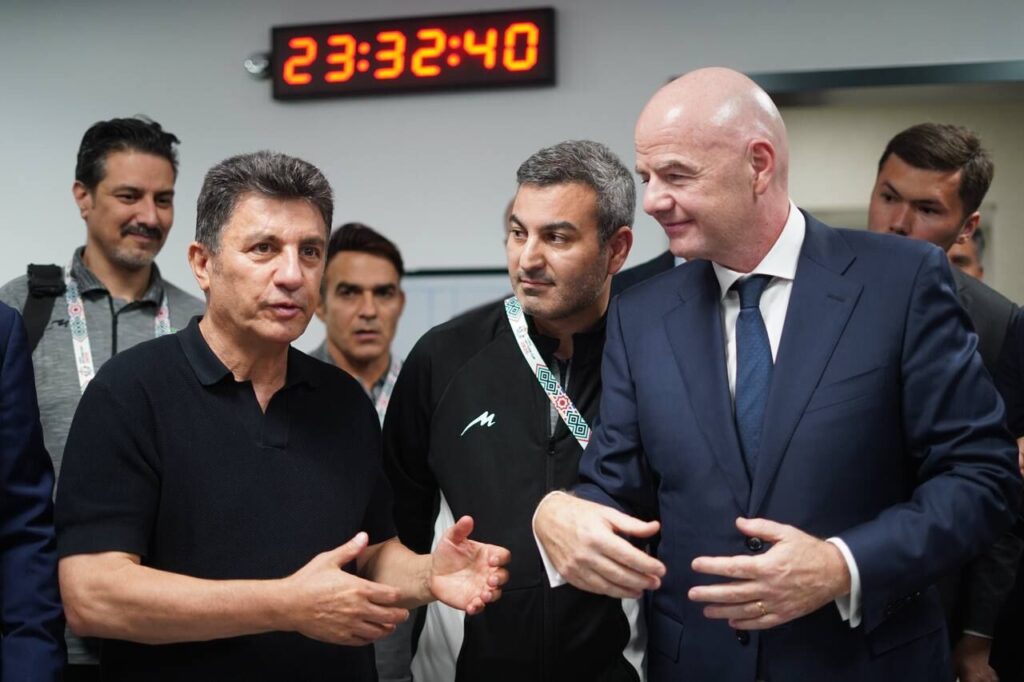
Alavi pointed to a specific precedent that makes the current visa denials particularly jarring. He recalled that during the 2025 CAFA Nations Cup final against Uzbekistan, President Infantino was present in the Iranian national team’s locker room.

“On that occasion,” Alavi recounted, “President Infantino personally assured our players that the presence of the Iranian convoy would be guaranteed from the beginning of the draw ceremony until the last day of the national team’s participation in the World Cup, including all essential workshops and events.”

This assurance now rings hollow, as the logistical foundation for Iran’s participation has collapsed before the tournament draw has even taken place.

A Delegation in Limbo

The practical implications of the visa issue are stark. Alavi explained that even the president of the Iranian Football Federation, who holds official positions within the Asian Football Confederation (AFC) and FIFA, has had his flight ticket issued.

However, the delegation faces a crippling imbalance. “The security director and the executive director, who are indispensable for our participation in the mandatory pre-tournament workshops, have not been granted visas,” Alavi revealed. This creates an untenable situation where the delegation’s leadership could attend, but the operational staff responsible for safety and logistics could not.

“There is no guarantee that the five people scheduled to attend the drawing ceremony will not face problems,” Alavi concluded, underscoring the profound uncertainty that now clouds Iran’s entire pathway to the 2026 World Cup.

A Deeper Conflict Behind the Boycott

However, a different perspective on the visa denials has emerged from sources familiar with the U.S. position. It should be noted that neither the security director nor the executive director, who were denied the visa, are considered essential for Iran’s presence at the drawing ceremony itself. Their roles are primarily relevant for subsequent operational workshops.

In fact, the inclusion of a security director in a delegation for a football draw ceremony has reportedly raised alarms with U.S. authorities. The presence of such a role is unusual for a sporting event of this nature and is understood to be a significant factor in the visa denial. This decision comes as U.S. authorities are in the midst of a broader, heightened crackdown on the activities of non-U.S. citizens within the United States, particularly those affiliated with certain foreign governments.

A Test for FIFA’s Authority

This incident places FIFA in an extraordinarily difficult position, caught between the protest of a member association and the legitimate security and immigration policies of one of its host nations. Iran’s boycott represents a powerful symbolic protest, but the underlying reasons for the visa denials reveal a more complex dispute that extends far beyond the football pitch. The world football body’s next steps will be closely watched as it attempts to navigate this profound diplomatic impasse, which raises serious questions about its ability to insulate the World Cup from international political tensions.

Cape Verde: From Independence Jubilee to World Cup Debut

Cape Verde – A nation of fewer than 525,000 people is celebrating a historic milestone—50 years of independence and its first-ever qualification for the FIFA World Cup. Last month, scenes of unrestrained joy erupted at the Estadio Nacional as more than 15,000 fans, draped in Cape Verdean blue, witnessed their national team secure a place in football’s greatest tournament.

Players from across the globe—Ireland, North America, and Cape Verde itself—embraced, danced, and celebrated together on the pitch, embodying the pride of a nation that has become the second-smallest by population to qualify for the World Cup, trailing only Iceland.

A Footballing Rise Rooted in History

Since gaining independence from Portugal in 1975, Cape Verde has steadily built its footballing identity. The national football federation was established in 1982, and by 1986, the country became a FIFA member. For over two decades, Cape Verde has competed in World Cup qualifiers, gradually emerging as a rising force in African football.

The team first announced its arrival on the continental stage by qualifying for the 2013 Africa Cup of Nations, where it reached the quarterfinals. A decade later, Cape Verde repeated the feat, bowing out in the top eight after a hard-fought penalty shootout loss to South Africa.

Recent Form and Key Players

Cape Verde enters the World Cup on a strong run of form, with recent results including:

  • Cape Verde 1–0 Mauritius
  • Angola 1–2 Cape Verde
  • Cape Verde 1–0 Cameroon
  • Libya 3–3 Cape Verde
  • Cape Verde 3–0 Eswatini

Leading the attack is Ryan Mendes, the national team’s all-time top scorer with 22 goals. A teammate of Sardar Dursun at Turkey’s Kocaelispor, Mendes embodies the global reach of this squad.

While Cape Verde has no players in Europe’s top five leagues, the team relies on a diaspora of talent competing across Slovakia, Portugal, Belgium, Hungary, Ireland, Morocco, Bulgaria, USA, Azerbaijan, Russia, UAE, Greece, Poland, Saudi Arabia, Spain, Switzerland, and Scotland.

Among the standout performers is Ricardo Santos, a commanding defender for Swansea City in the English Championship.

Looking Ahead: Iran vs. Cape Verde

Cape Verde will continue its World Cup preparations in a quadrangle tournament in the UAE, where it is set to face Iran on November 12 in Al Ain. The match offers a valuable test for both sides ahead of next year’s global showdown.

For Cape Verde, it’s another opportunity to showcase how far this island nation has come—on and off the pitch.
Mounting Pressure on Team Melli

While Cape Verde enters their upcoming match with nothing to lose and everything to gain, the stakes are considerably higher for Iran. Despite securing early qualification for the 2026 FIFA World Cup, Team Melli under coach Amir Ghalenoei faces intense scrutiny and growing disillusionment among its fanbase.

Three disappointing losses this year—to Qatar, Russia, and Uzbekistan—coupled with unconvincing game plans, poor finishing, and disorganized defending have fueled widespread criticism. A palpable disconnect has emerged between the team and its supporters, exacerbated by Ghalenoei’s perceived reluctance to address recurring tactical shortcomings.

The decline in public support was starkly evident during Iran’s recent 2–0 victory over Tanzania in Dubai. The match attracted only 1,340 spectators—the lowest attendance in Team Melli’s history—with most present supporting the opposition. This is particularly telling in a city home to one of the largest and most passionate Iranian diasporas, signaling a rapid erosion of faith in the national squad.

Looking Ahead: Iran vs. Cape Verde

As the two sides prepare to meet on November 12 in Al Ain, expectations for a tactical revival from Iran remain low. Ghalenoei is expected to field a familiar lineup and stick to his established approach—a strategy that may offer coaching staff a sense of continuity, but one that could prove costly.

For Cape Verde, the match is another opportunity to build momentum ahead of their World Cup debut. For Iran, it is a critical test of morale and direction. A loss against the African newcomers could sound alarm bells within the Football Federation of the Islamic Republic of Iran (FFIRI), potentially forcing a long-overdue reckoning with the team’s direction under its current leadership.


Team Melli Set for Quadrangular Tournament in November FIFA Window


The Iranian national football team is set for a busy and competitive schedule during the next FIFA international break in November. Following warm-up matches against Russia and Tanzania in October, the Football Federation (FFIRI) has secured Team Melli’s participation in a four-nation tournament hosted by the United Arab Emirates.

The tournament, which promises a high level of competition, will feature Iran, Egypt, Uzbekistan, and Cape Verde. This provides crucial preparation for the teams that have already qualified for the 2026 FIFA World Cup, offering a stern test against diverse playing styles.

Tournament Schedule and Potential Showdowns

According to the tournament format, the semi-finals are scheduled for November 7. Iran will face the Cape Verde national team, currently ranked 70th in the FIFA World Rankings. A victory would see Team Melli advance to the final on November 17, where they would face the winner of the other semi-final between Uzbekistan and Egypt.

The prospect of a final between Iran and Egypt, featuring Mohamed Salah, is a tantalizing one for football fans in West Asia and North Africa, promising an exciting clash of styles and star power. Both Egypt and Uzbekistan, like Iran, have already secured their passage to the 2026 World Cup.

If Iran loses its semi-final against Cape Verde, the team will not be idle, facing the loser of the Uzbekistan-Egypt match in a third-place playoff on November 12.

A Closer Look at Iran’s Opponent: Cape Verde

The upcoming match will be the first-ever international meeting between Iran and Cape Verde, adding an element of the unknown to the fixture.

Cape Verde, known as the “Blue Sharks,” are far from a minor opponent. They are one of Africa’s most respected and formidable teams, consistently punching above their weight. Their recent performance in the 2023 Africa Cup of Nations (AFCON), where they topped a group containing Egypt and Ghana before reaching the quarter-finals, announced them as a serious force.

Despite a recent 2-1 loss to Libya—a match where they were reportedly hampered by a refereeing error that cost them a direct path to World Cup qualification—they remain a dangerous and organized side. Coached by Bubista, their team is built on a foundation of tactical discipline, physical strength, and explosive counter-attacks. They boast talented players such as Jovane Cabral (Sampdoria), Ryan Mendes (Fatih Karagümrük), and captain Stopira, many of whom ply their trade in top European leagues.

For Amir Ghalenoei’s Iranian squad, this match against a motivated and athletic African opponent will be a vital test, particularly in assessing the team’s tactical flexibility and discipline—areas that have recently come under scrutiny.

This quadrangular tournament represents a significant step in Iran’s preparations for the 2026 World Cup, offering two high-stakes matches against quality opposition that will challenge the team and its management.

FIFA President Infantino Visits Iran Locker Room, Congratulates Team on World Cup Qualification

(Tashkent, Uzbekistan) – Following Iran’s narrow 1-0 defeat to Uzbekistan in the CAFA Nations Cup 2025 final, FIFA President Gianni Infantino made a surprise visit to the Team Melli locker room to personally congratulate the players on their recent qualification for the 2026 FIFA World Cup.

According to IRNA, the President’s message was one of unwavering support and admiration for Iranian football. He emphasized the significance of their World Cup achievement, stating, “Congratulations on qualifying for the World Cup; it was not an easy task. You have made your country and your families proud, and you have also made Iranians abroad happy.”

Infantino expressed his personal fondness for the team, revealing, “I am a big fan of Iranian football. One of your players gave me his shirt in 2019, and I still have it. It is very valuable to me.”

He went on to highlight a iconic moment from the team’s recent history, recalling, “I still remember the Qatar World Cup. The Iran-Wales match was unbelievable. This is the feeling that football can give us; the whole stadium was happy at that moment.”

Addressing the immediate disappointment of the CAFA final loss, the FIFA President offered words of encouragement: “You played very well today, but in football, there are always wins and losses. You are a strong team and should be proud of yourselves.”

Looking ahead to the 2026 tournament in the United States, Canada, and Mexico, Infantino provided a definitive assurance: “As the President of FIFA, I say welcome to the World Cup. I guarantee your presence.”

Concluding his address, Infantino reflected on the unifying power of the sport: “With the help of football, we want to unite the whole world. Unfortunately, the global situation is complex, but football can create this unity that politics often cannot. For the sake of your parents and your families, continue on this path so that you can bring joy to your people. I look forward to seeing you at the World Cup.”


Iran Football Federation Denies Approach for Colombian Coach Amid Ghalenoei Criticism

Despite Iran’s qualification for the FIFA 2026 World Cup, the performance of the national team under head coach Amir Ghalenoei continues to draw criticism from experts and pundits, with some calling for his dismissal.

The controversy deepened following a claim by Colombian coach Juan Carlos Osorio, who suggested he had received an offer from the Iranian Football Federation (FFIRI). In response, the FFIRI issued a brief statement: “Following reports of Juan Carlos Osorio’s claim regarding an offer from the Iranian Football Federation, we reiterate our full support for Amir Ghalenoei as head coach of Team Melli. The claim made by this coach is false, and as previously stated, the Federation’s definitive plan is for the national team to compete in the 2026 World Cup under Ghalenoei and his current staff.”

However, such assurances from the FFIRI, particularly under President Mehdi Taj, hold little weight. A similar stance was taken before the abrupt dismissal of Dragan Skočić, who had orchestrated a remarkable turnaround in the 2022 World Cup qualifiers, lifting Iran from third place in their group to secure qualification.

While there is no concrete evidence to substantiate either side’s claims, Osorio’s assertion seems unusual, given his current role as head coach of Mexican top-tier club Tijuana. Nevertheless, the speculation has further fueled debate over Ghalenoei’s suitability for the role.

Critics argue that Ghalenoei lacks the tactical acumen, communication skills, and public support needed to succeed at the highest level. Many within Iranian football, including some Team Melli players, question his ability to compete effectively in a tournament as demanding as the World Cup.

If the FFIRI is genuinely considering a managerial change for the sake of progress, the time to act is now—not months before the World Cup, as was the case with Skočić’s poorly timed dismissal. A decisive move could either solidify confidence in Ghalenoei or pave the way for a more capable successor—before it’s too late.


‘It’s offensive’: voices from Iran as fans face 2026 World Cup travel ban


The Guardian
London.

After Donald Trump banned Iranians from entering the US, one of the co-hosts, there are different views on what should be done

“It’s offensive for any football fan to be prevented from participating in the World Cup, not just Iranians,” Ali Rezaei of Tehran’s Borna news agency says. In March, the national team became the second to qualify for the 2026 World Cup that will be hosted by Canada, Mexico and the United States. In June, Donald Trump authorised the dropping of bombs on Iran and hit the country with a travel ban. As things stand, while the national team will be able to enter the US next summer, fans – and perhaps media – will not.

Residents of Tehran and other cities may have had enough to deal with of late, but still, being barred from entry stings, even if Iranians have long found it difficult to get into the US. “If the US government has issues with the Iranian regime for any reason, it should not result in discrimination against Iranian citizens,” Behnam Jafarzadeh, a writer for the leading sports site Varzesh3, says. “If someone hasn’t committed any illegal activity, why should they be punished? It’s not just about the World Cup – the policy needs to change in general.”

What can Iran do? “Boycotting the World Cup is not a solution,” Siavash Pakdaman, a Tehran-based fan, says. “Refusing to play on US soil would be a dangerous precedent – any host country could start excluding teams it has issues with. Just as the Iranian delegation can and should be present at the United Nations in the US, the Iranian team should also play on American soil if the draw requires it – without relocation.”

There is a feeling that staying away would not make much difference anyway. “It would only deprive the national team of the opportunity to participate in a major tournament and would ultimately hurt Iran more,” Jafarzadeh says. “It might even be welcomed by some American officials. It could make headlines briefly, but once the tournament starts, it will be forgotten and will have achieved nothing.”

Questions have been asked – including in Iran, whose supreme leader, Ayatollah Ali Khamenei, has long banned competing against Israeli athletes – about what the international reaction would have been if Qatar had banned citizens from certain nations from attending the 2022 World Cup.

“If the USA makes it difficult for football fans to attend, then changing the host country is necessary,” Rezaei says. “Doing so would harm the USA’s reputation, not the World Cup’s. If strict entry rules remain, we should focus on protecting football. This is supposed to be a celebration of sport.”

Jafarzadeh is not confident that the competition could be taken away from the busiest of the three hosts. “It is not a challenge Fifa and [its president Gianni] Infantino would want to take on.” Perhaps there is another way. “Fifa should use all of its influence to push for a suspension of this policy at least during the World Cup.”

Fifa may find it easier to place Iran in Canada or Mexico and hope that Iran don’t make it to the latter stages, when there would have to be a game in the US. “Playing in Mexico or Canada is not a real solution – it just ignores the actual problem,” Rezaei says.

Many expect it to happen anyway. “Canada has a large Iranian immigrant population, although some of them are opponents of the Iranian regime and the national team can’t count on their support,” Jafarzadeh says. “Mexico is probably a more attractive and less controversial destination for the team.”

That is another question. The Iranian-American community is more than a million strong yet many of these headed west before, or in response to, the Islamic Revolution of 1979.

“It seems that many Iranians who oppose the government consider the national team to be a representation of the regime – which I believe is wrong,” Pakdaman says. “And since a larger number of these opponents live in the US, the team may face pressure from the audience during the matches. Of course, I hope my analysis is wrong.”

Jafarzadeh, who went to the World Cups in Russia and Qatar and would love to go to the United States, says: “Some see the team as one that represents the regime, and this sentiment is even stronger among Iranians living abroad. Of course, the war with Israel has stirred feelings of patriotism among many Iranians, but I’m not sure if this will translate into support for the national team. We’ll have to wait and see how things unfold in the coming months.”

That there is time is perhaps a small reason for optimism that things could change. Iran is one of 19 countries subject to a full or partial US entry ban. Several of the others retain hope of qualifying for the first 48-team World Cup, including Sudan, Sierra Leone, Venezuela and Haiti.

“Considering that there is almost a year left until the 2026 World Cup, there is a possibility that the situation may stabilise,” says Isa Azimi, a columnist and translator, regarding Iran’s situation, though he is not confident. “Despite claims of separating politics from football, Fifa has shown that it is not particularly independent when facing major political powers.”

Especially when Infantino appears to prize his close relationship with President Trump. “If Fifa considers itself a global body independent of governments, it must stand up to such laws and not allow politics to contaminate the world of sports,” Pakdaman says. “Of course, we all know that, unfortunately, such contamination exists – especially when one side of the issue is a superpower that answers to no one. It is Fifa’s duty to treat all member countries equally, but will that actually happen?”


Iran vs. Chile friendly called off.

The Iran-Chile match was canceled despite the Chilean side having an initial agreement.

“Paylo Millod,” the president of the Chilean Football Federation, announced the cancellation of the international friendly match between the Chilean national team and Team Melli in September, due to the recent hostilities between Israel and Iran.

Apparently, the contract was written in such a way that a final agreement was needed regarding ticket sales, advertising around the field, and the venue of the game. Contrary to the claims made, there is no news of payment or receipt of compensation at this stage, and both parties had the right to withdraw from the memorandum of understanding.

The international department of the Iranian Football Federation is following up on the matter to inform the Chilean side of any assurances regarding the conditions in the region and Iran. They also plan to select another match, which will probably be another South American country, for the friendly match in parallel. It is likely that the Iranian national team will participate in two other quadrennial tournaments after the CAFA nATIONS cUP 2025 tournament and the friendly matches with Russia, in order to prepare itself for the 2026 FIFA World Cup.