Tag: Dragan Skočić

Dragan Skocic reigns from Tractor

Dragan Skočić, the Croatian head coach of Tabriz’s “Tractor” club, has resigned.

The club’s press service released information on this matter.

The 57-year-old specialist left his position at his own request.

D. Skočić had been coaching the “Tractor” club since 2024. The team won the Iranian Pro League under his leadership in the 204/2025 season.

According to the information, Mohammad Rabiei has been temporarily appointed to lead the Tabriz club. A contract with him, valid until the end of the season, has been signed.

Currently, “Tractor” is in 2nd place in the Persian Gulf League with 35 points and has qualified for the Knock out round of the AFC Champions League Elite currently sitting in the third place.
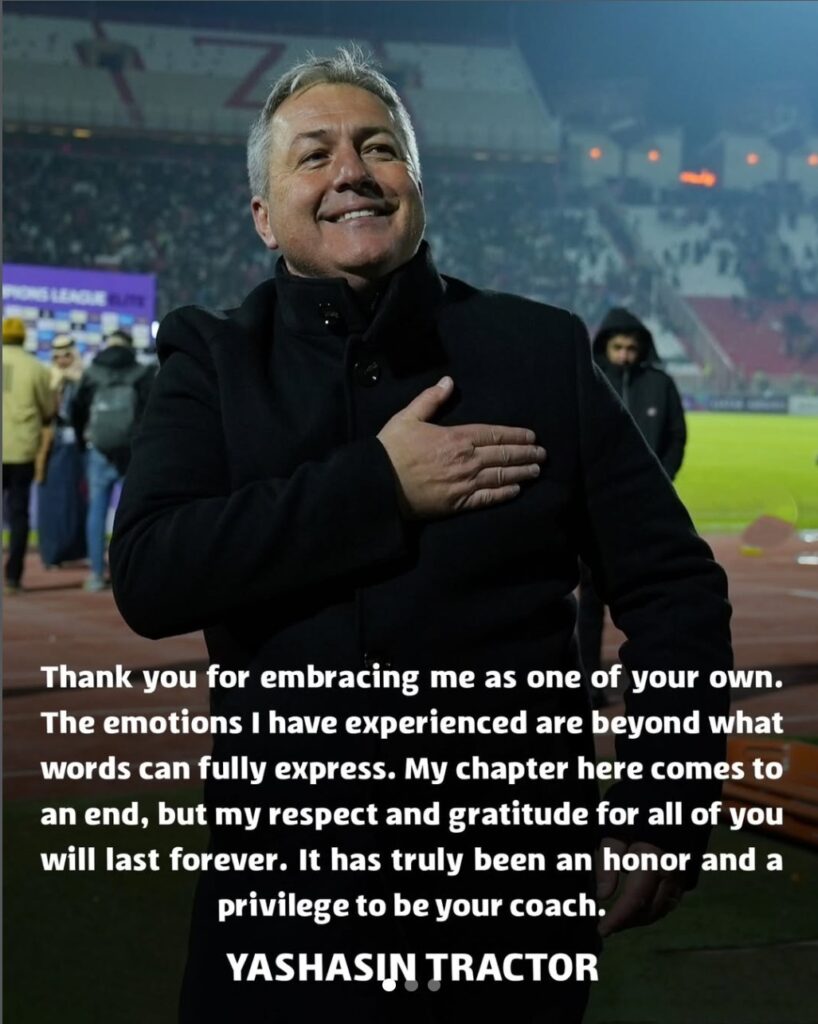
According to inside reports, the dispute erupted between Skocic and veteran defender Shojae Khalilzadeh. Described by insiders as a perennially controversial figure rarely far from discord, Khalilzadeh’s conduct during and after the match is understood to have crossed a line for the Croatian tactician. It is believed that Skocic subsequently issued an ultimatum to the club’s owner: either he remains as coach, or Khalilzadeh stays in the squad, but the two could not co-exist.

While the player in question reportedly issued an apology for his behavior in an attempt to mend fences, the olive branch was not enough. Skocic ultimately decided against continuing in his role, holding firm to his principles despite the club’s efforts to resolve the internal rift.

A Legacy Forged Against the Odds

While his departure from Tractor is mired in conflict, Skocic’s broader legacy in Iranian football tells a story of remarkable resilience and achievement. He leaves behind a narrative defined by an extraordinary rise through the ranks.

Skocic’s journey in Iran began in the lower divisions, where he quietly honed his craft far from the glitz of the Persian Gulf Pro League. His systematic approach and tactical acumen eventually propelled him to the pinnacle of Iranian football: the helm of Team Melli (the Iranian national team).

It was in the national dugout that Skocic achieved the near-impossible. Taking charge under a cloud of administrative chaos and amidst the most difficult of circumstances, he successfully navigated Iran through a treacherous qualification campaign. He ultimately secured the team’s place in the FIFA World Cup 2022, a feat that cemented his name in the memories of Iranian fans and solidified his reputation as a coach who could deliver results when it mattered most.

His time at Tractor may have been brief and ended in discord, but Skocic’s impact on Iranian football—particularly his guiding hand in taking Team Melli to the world stage—will remain a significant chapter in the sport’s history.

Internal Strife Threatens Iran’s World Cup Hopes


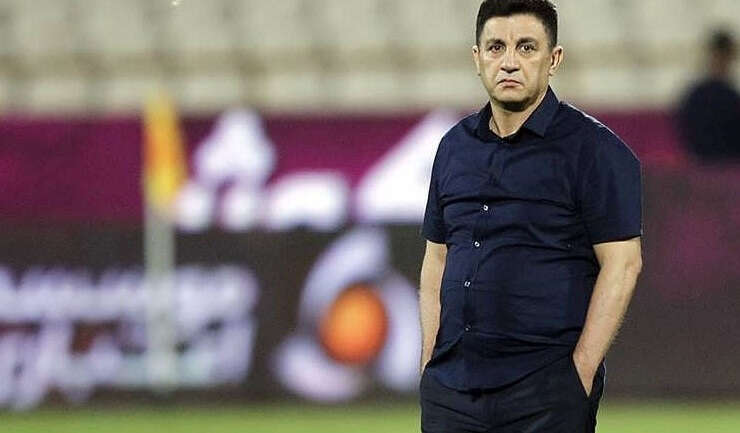
As the 2026 World Cup approaches, with just five months until the tournament kicks off, the Iranian national football team finds itself grappling not only with technical deficiencies but with a deeply concerning lack of unity—a stark contrast to the harmonious picture painted by head coach Amir Ghalenoei.

Despite repeated warnings from experts about persistent performance and management issues, Football Federation head Mehdi Taj has opted for stability, deciding to retain Ghalenoei. This move signals a clear departure from the federation’s previous approach, which saw the sudden dismissal of a successful Dragan Skocic, who led the team to qualification just before the final of the competition in Qatar in the 2022 World Cup. The message is clear: change is off the agenda, and Ghalenoei will remain at the helm regardless of the team’s precarious state.

The coach has consistently lauded the squad’s exceptional unity over the past three years. Recent events, however, reveal a troubling reality. Growing evidence suggests Ghalenoei may be papering over significant rifts within the Team Melli camp, with claims of solidarity appearing to exist only on paper.

A Public Feud Between Defensive Pillars

The simmering tensions erupted into public view following the Persepolis-Tractor match. Key defenders Shoja Khalilzadeh and Mohammad Hossein Kanaanizadegan, once close enough to call each other “brother”, have engaged in a bitter, public exchange of verbal abuses over minor on-field incidents. This discord is not isolated; similar altercations occurred during the match against Mes Rafsanjan. The rift has grown so severe that videos of the two players “unfollowing” each other on social media have circulated online, fanning flames among supporters and poisoning the team atmosphere.

Beyond the Pitch: Players in the Political Fray

The issue extends beyond a personal feud. These experienced players have entangled themselves in the federation’s political battles, notably the ongoing dispute between businessman Mohammad Reza Zenozi and Mehdi Taj. Instead of focusing on defensive coordination, they have each seemingly aligned with opposing factions, a glaring misstep that highlights a severe lack of managerial control and player discretion.

Their conduct is, unfortunately, characteristic. Both Khalilzadeh and Kanaanizadegan have histories of controversy, abusive, and unprofessional behavior, marked by petulance and unpredictability. At the national team level, Ghalenoei has proven to be a poor disciplinarian, a fact underscored after the Uzbekistan match when star forward Mehdi Taremi bluntly walked away from the coach who was attempting to speak with him. This culture of impunity is pervasive, with disciplinary committees at both club and federation levels often acting as mere formalities rather than enforcing regulations strictly.

A Dire Warning with the World Cup Looming

Drawn into a challenging Group G alongside Belgium, Egypt, and New Zealand, Iran faces an uphill battle. The internal disputes, managerial indecisiveness, and the divisive behavior of key players present a serious threat to the team’s World Cup campaign.

Retaining Ghalenoei without addressing these foundational issues—particularly the breakdown of locker room discipline and the dangerous blurring of lines between playing and political roles—risks catastrophic consequences. It threatens not only Iran’s performance on the world’s biggest stage but also the credibility and honor of Iranian football itself.

Persepolis leads Persian Gulf Pro League

Esteghlal Tehran squandered a golden opportunity to claim top spot in the Persian Gulf Pro League after being held to a goalless draw by lowly Zob Ahan in Esfahan during Round 17.

Earlier on Friday, Persepolis secured a crucial 2–1 victory over league leaders Sepahan in a top-of-the-table clash at Shahr-e Qods Stadium. After a goalless first half, Persepolis sprang to life in the second period. Their Uzbek winger Oston Oʻrinov broke the deadlock in the 53rd minute, and compatriot Igor Sergeyev doubled the lead in the 72nd. Sepahan managed a consolation deep into added time, with Ricardo Alves converting a penalty in the 90+13th minute.

Following that result, Esteghlal would have leapfrogged into first place on goal difference had they defeated Zob Ahan, but their lackluster performance saw the chance slip away.

On Thursday, Tractor coaches by former Team Melli coach, Dragan Skocic, delivered an impressive 4–1 victory over Mes Rafsanjan at the Yadegar-e Emam Stadium in Tabriz, lifting themselves into second place ahead of Friday’s fixtures. The goals came from Mohammad Hosseinzadeh (13’), an own goal by Milad Mirzazadeh (56’), Mohammad Ebrahimi Esmaeilifar (76’), and Amir Arsalan Motahari Drodzek (84’).

All matches in the Persian Gulf Pro League continue to be played behind closed doors due to security concerns following recent unrest in Iran.


Iran Football Federation Denies Approach for Colombian Coach Amid Ghalenoei Criticism

Despite Iran’s qualification for the FIFA 2026 World Cup, the performance of the national team under head coach Amir Ghalenoei continues to draw criticism from experts and pundits, with some calling for his dismissal.

The controversy deepened following a claim by Colombian coach Juan Carlos Osorio, who suggested he had received an offer from the Iranian Football Federation (FFIRI). In response, the FFIRI issued a brief statement: “Following reports of Juan Carlos Osorio’s claim regarding an offer from the Iranian Football Federation, we reiterate our full support for Amir Ghalenoei as head coach of Team Melli. The claim made by this coach is false, and as previously stated, the Federation’s definitive plan is for the national team to compete in the 2026 World Cup under Ghalenoei and his current staff.”

However, such assurances from the FFIRI, particularly under President Mehdi Taj, hold little weight. A similar stance was taken before the abrupt dismissal of Dragan Skočić, who had orchestrated a remarkable turnaround in the 2022 World Cup qualifiers, lifting Iran from third place in their group to secure qualification.

While there is no concrete evidence to substantiate either side’s claims, Osorio’s assertion seems unusual, given his current role as head coach of Mexican top-tier club Tijuana. Nevertheless, the speculation has further fueled debate over Ghalenoei’s suitability for the role.

Critics argue that Ghalenoei lacks the tactical acumen, communication skills, and public support needed to succeed at the highest level. Many within Iranian football, including some Team Melli players, question his ability to compete effectively in a tournament as demanding as the World Cup.

If the FFIRI is genuinely considering a managerial change for the sake of progress, the time to act is now—not months before the World Cup, as was the case with Skočić’s poorly timed dismissal. A decisive move could either solidify confidence in Ghalenoei or pave the way for a more capable successor—before it’s too late.


Former Team Melli coach speaks about Iranian football and Compatriot Skočić acheivment.


Branko Ivanković praised his compatriot Dragan Skočić in an interview, emphasizing that Skočić has a winning mentality and stating that various lobbying efforts prevented him from sitting on Iran’s bench during the World Cup.

Many Croatians have left a significant mark on Iranian football, and the championship that Dragan Skočić won this season with Tractor is the latest honor achieved by a Croatian coach in Iranian football.

According to the Croatian site Jutarnji, this is not Skočić’s first major achievement. He previously pulled the Iranian national team out of a crisis and led them to World Cup qualification in Qatar but was dismissed shortly before the tournament. Nonetheless, this is his first national title in his trophy case.

The most prominent Croatian name in Iran in terms of achievements is Branko Ivanković, the current head coach of the Chinese national team. He continues to follow all developments in Iran.

“This championship is a huge result for Skočić and all the Croatian players at Tractor. Croatian coaches have achieved great results in Iran. Tractor is a unique club in Iran that had never won a championship before, but it’s considered one of the big teams alongside Persepolis, Esteghlal, and Sepahan. The city of Tabriz is located in Iran’s mountainous region and its population is predominantly Azerbaijani,” said Ivanković to Jutarnji from China. “They often came close to winning the title but never saw it through to the end. That’s why Tractor’s championship is an unbelievable achievement.”

In the next part, the former Iran and Persepolis coach commented on Skočić:
“Tractor has a good coach who has a clear vision and most importantly, a winning mentality. They were the most consistent team in the league and were strengthened by signing three Iranian national players. Apart from that, the Croatian players did great. Druždek has been outstanding since he arrived. This is once again a big plus for us Croatians—both coaches and players.”

When asked how he has so much information about Iranian football, Ivanković replied:
“I follow all Asian leagues, and in addition, my analyst is Iranian, so I get even more information about Iranian football.”

Igor Postonjski, Tomislav Štrkalj, and Domagoj Druždek, who never played for Croatia’s biggest clubs, have become very important figures in Iran’s Persian Gulf Pro League.

Ivanković continued:
“Tractor performed well even though Persepolis and Esteghlal had enormous budgets—probably the biggest in their history. Coaches there earn around 2 to 2.5 million dollars and many players make close to 1 million per season. They had the opportunity to sign big players, which is why Tractor also made some major signings. Tractor did exceptionally well, and this makes the collective success even greater.”

Tractor is one of the most popular Iranian teams. Reports say that 120,000 spectators attended their match against Esteghlal, setting a record in Iranian club football. On average, they had 42,000 fans per home game and had previously been league runners-up three times. In an AFC poll in 2020, Tractor was voted the most popular club in Asia.

Ivanković added:
“Tractor’s title isn’t that surprising because they were always competing for the top spot. Persepolis with 40 million fans and Esteghlal with 25 million are not happy with the situation. Tractor has always had a large fanbase.”

In conclusion, the Croatian coach said:
“Skočić was also fantastic with the national team. Iran was on the brink of elimination in the 2022 World Cup qualifiers, but Skočić won all the matches and was then dismissed. The same happened to Tomislav Ivić in 1998. There are always various lobbyists playing their own games.”

Branko Ivanković led Iran in the 2006 World Cup in Germany and as Persepolis manager, he won the league three times in a row (2017–2019), the Hazfi Cup, three Super Cups, and reached the AFC Champions League final.
Other successful Croatian coaches in Iran include Ivić, Miroslav Blažević, Zlatko Kranjčar, and Dragan Skočić.

Ivanković concluded:
“Stanko Poklepović was the first Croatian to shine in Iranian football with great results. Today, Tomislav Ivić is still remembered, as is Blažević. Luka Bonačić, Vinko Begović, and Mladen Frančić also achieved notable success.”

Tractor Snatches Up Skocic as New Head Coach

In a move aimed at bolstering the team for the upcoming season, Tractor Club of Tabriz has appointed Dragan Skocic, the former Iranian national team coach, as their new head coach. The announcement follows successful negotiations led by Tractor’s acting CEO, Saeed Mozafarizadeh.

Skocic emerged as the favored candidate after the club considered a number of options for the head coach position. This experienced Croatian manager boasts a distinguished resume, including stints with Croatia’s U-21 national team, clubs across the Middle East and Iran, and most notably, Iran’s senior national team (Team Melli). His trophy cabinet includes two championship titles from Slovenia and Croatia.

Skocic’s tenure with Team Melli was particularly impressive. He compiled a remarkable record of 15 wins, 1 draw, and only 2 losses – a testament to his tactical prowess. However, his successful World Cup qualification campaign with Iran was unfortunately cut short due to reported internal politics within the Iranian Football Federation (FFIRI), who opted for the return of Carlos Queiroz despite Skocic’s achievements.

Skocis was a victim of backstabbing by several senior Team Melli members who were pushing the FFIRI for a return of Carlos Queiroz even though Skocic led Iran to the FIFA World Cup 2022 with relative ease and with three matches to spare.

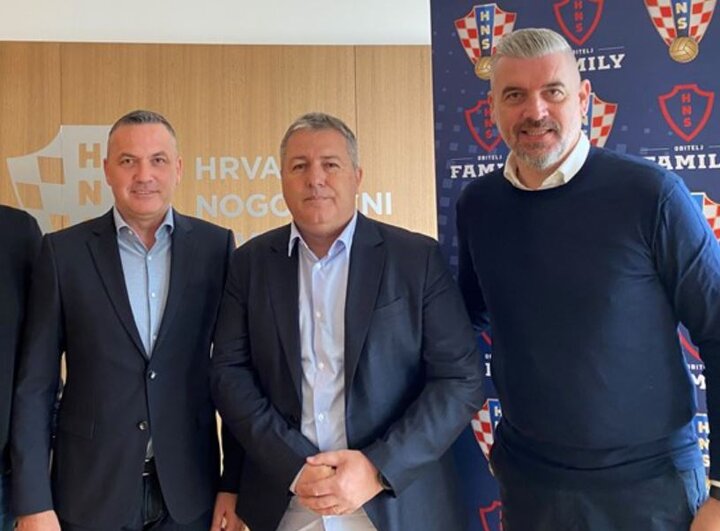
Dragan Skočić, appointed as Croatia’s U21 head coach.

The former Team Melli coach Dragan Skočić has been appointed to Croatia Under 21 Football Team.

According to  Croatian Football Federation officially announced on Friday afternoon that Dragan Skocic’s contract with the under-21 football team has been signed.  The  statement said :

“Skocic’s last work was leading the Iranian national team, which successfully led the team to the 2022 World Cup in Qatar, and by scoring 25 points in 10 games in the third qualifying round of the World Cup, a new record for the national team. Iran registered. Skocic didn’t have the chance to lead Iran to the finals despite the great results. Before coaching Iran’s national football team, Skocic coached Rijeka, Interblock Ljubljana, Al Arabi, Nasr, Malavan, Foolad, Rayka Babol, and Sanat Naft, and his coaching successes include winning the Croatian FA Cup with the Rica team and winning the Slovenian FA Cup and Supercup pointed with Interblock. He reached the final of the Crown Prince Cup with Al-Arabi and led Al-Nasr and Foolad in the AFC Champions League. Skocic was nominated for the 2021 World Coach Award by the IFFHS. Skocic, who has to participate in the European Championship with the Croatian team in less than 70 days, said about accepting the leadership of the Croatian under-21 team: Skočić said: I take on this role with great pride, ambition, and optimism, and to Mr. Kostic, the president of the Croatian Federation. Thank you for your trust.”

He added: Igor (former coach of the Croatian youth team) did a very good job in this team. My wish is to finish the European Cup with the best possible performance and then start gathering and building the new generation. We have really talented and quality players. I look forward to the challenge of using my knowledge and experience to help them realize their potential”

teamelli.com wishes Dragan Skočić the best in leading his country’s youth team.

How is Team Melli under Ghalenoei?

With one win and a draw already under his belt, Ardashir (Amir) Ghalenoei seems to have started well in his second term with Team Melli.  The nucleus of the previous team is still intact as Ghalenoei used most of the players who qualified Iran for the world cup under Dragan Skocic and then briefly in the World Cup finals, under Carlos Queiroz. However, the addition of several new players and the return of previous ones has given a slightly different shape to the same team.

Overall, Team Melli played delightful football in both matches, despite some shortfalls that need to be worked upon by the coaching team. The passing of the ball, finding spaces, defensive coverage, crosses from flanks, and counterattacks were all carried out to acceptable to good standards. The shortfalls were in the poor finishing, final ball delivery, mental agility, and the chronic shortfall of Iranian players, general slowness. While modern football demands quick and swift thinking by footballers, Iranian players seem to take extra seconds to make such moves.


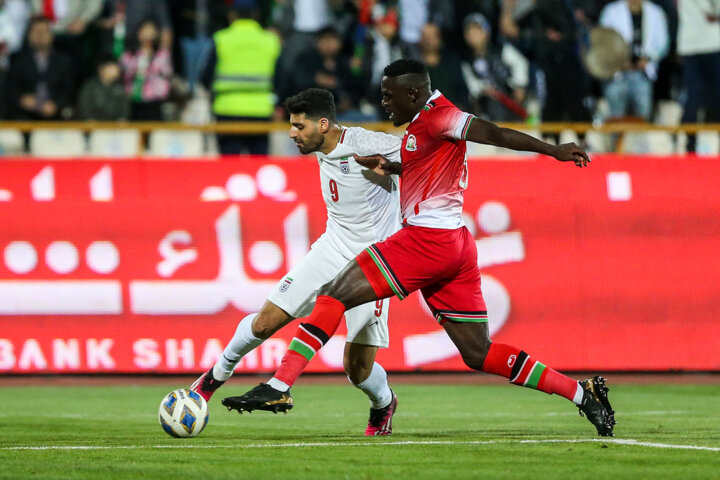
The match against Kenya was particularly worrying in the sense that the Iranian players could not physically match the Kenyan team! The African players won most of the one-to-one tackles which mostly ended up with the Iranian hitting the lawn with both arms raised up in protests to no avail. Physical strength and body build have always been one of the better attributes of Iranian footballers throughout the years. It is important to keep that up, especially against stronger teams. It is also important by Ghalenoei to instill some discipline and discourage play-acting.

Although not much can be read from the two matches, and not much can be presumed from Ghaleoei’s public statements, it seems that a fresh mentality is going to dominate Team Melli’s playing style. Under eight years and something, Team Melli fans were exposed to the dour defensive-minded style of Carlos Queiroz. Ghaleoei has a different mindset and we do hope it is aimed toward more attractive football that appeals to the fan but of course, not to the detriment of results. Offensive footballs require such tools as gameplans with several options and competent skillful players to finish the moves. On the face of it, Team Melli has players up front that play in the highest standard leagues such as Azmoun, Taremi, and Sayyadmanish with the newer generation players such as  Amir Hossein HOSSEINZADEH and Arya BARZAGAR waiting for their chances.

These players have proved time and again their worth.  It is up to the Ghalenoei to utilize the skills of such talents. There is a small problem with finishing for Taremi, perhaps he is experiencing a down in his performance, but he and his teammates cannot be so wasteful and profligate as they have shown in these two matches.

There are no shortages of talent on the defensive line and the goalkeepers, so that is the least of the worries.

The biggest challenge for Ghalenoei remains the midfield. It is the line where the forwards must receive quality and timely service in order to finish the job. The present complexion of the midfield is not so hopeful. Unfortunately, Jahanbakhsh who mainly operates mainly as a winger has been facing form degradation recently with erratic performances. Ezzarollahi seems to have stagnated and his value remains on the defensive side, Ali Gholizadeh is one of the better players that Ghalneoi may focus on for the offensive side, Nourollahi is another player whose value varies between one match and another. Saman Ghoddos came with such promise, but he is yet to deliver consistently. Team Melli has no midfielder that can take the game by the scruff of the neck. There is no such player in the current generation of footballers, unfortunately.

So, the lack of creative, quality, and consistently good midfield players will remain Amir Ghalenoei’s biggest challenge.

One bright side of the two matches was the introduction of Sepahan’s midfielder Mohammas Karimi. Hardly a household name in Iran, the former U20 Team Melli player, performed very well in the first half and was one of the few good players while he was on the field. There seems to be a player that can serve Team Melli well if given the chance. In the contrast, his club teammate Moghanlou was utterly wasteful, out of place, and at times, lost in the lineup of Team Melli in both matches. No doubt he played and scored well with his club, but in the two matches at an international level, he remains way out of place.

Team Melli fans prefer a foreign coach.

The Iranian news agency ISNA conducted two polls online which showed that the majority of Team Melli fans prefer a foreign coach to lead Team Melli after the departure of  Carlos Queiroz.

Under the guidance of the Portuguese head coach, Iran finished third in the group at the FIFA World Cup Qatar 2022 with one win, two losses, and 3 points and failed to qualify for the knockout stage. The credit for qualification to the 2022 World Cup finals is given to Croat Dragan Skocic who was dismissed shortly after the arrival of Mehdi Taj.

Now the national team is without a head coach, and in less than a year, the AFC Asian Cup 2023 will be played in Qatar. Meanwhile, the football federation is still debating the appointment of a coach while its head, Mehdi Taj has implied that the future Team Melli coach will be an Iranian from the domestic league.

Currently, there are some local football experts who consider the appointment of an Iranian coach to be the most suitable, while others disagree and believe that none of the Iranian coaches currently operating in Iran is capable of leading Team Melli. Based on this, the Iranian Students News Agency ISNA conducted two polls on its website and Telegram channel and asked its audience this question, “Which option do you agree with to lead the national football team, Iranian or foreign coach? “

The results of these two polls show that a majority of ISNA’s audience prefers that the helm of the Iranian national football team be entrusted to a foreign coach in the future. 59% of the participants in the Isna site poll voted for the foreign option and 41% agreed with the Iranian option.

Sajjadi accused by Majlis (Parliament) of mismanagement

Story by Mina Aldroubi, Nada AlTaher 

Iran’s Parliament gave a warning on Tuesday to Sports Minister Hamid Sajjadi, accusing him of mismanaging the ministry, the Fars news agency reported.

Mr Sajjadi spoke to parliamentarians in an open session on Tuesday to brief officials on the ministry’s financial problems and expenses, especially regarding the country’s football teams.

It came after the Iranian men’s national team (Team Melli) failed to progress past the group stages of December’s World Cup in Qatar.

“The MPs were not satisfied with Sports Minister Sajjadi’s answer about the mismanagement situation in professional sports, especially football, and he received a yellow card from the parliament,” said the agency.

Yellow cards are the Parliament’s way of holding cabinet members accountable by summoning them for questioning or interpellations, a report by Germany-based think tank Carpo said.

“Depending on the minister’s performance, interpellations can lead to ‘yellow cards’ or impeachments. Even the President can be challenged through this mechanism,” the report said.

At the World Cup in Qatar, Iranians were seen wearing the “Women, Life, Freedom” slogan made famous during months-long protests in the country, sparked by the death of 22-year-old Mahsa Amini in police custody on September 16.

Hamid Sajjadi practically runs Iran’s football federation. He was the force behind the sacking of Dragan Skočić and restoring Carlos Queiroz to Team Melli and hence accountable for the failure of the team in the World Cup 2022. The government of Iran is the largest contributor to the football federation coffer, some claim, the only contributor to the FFIRI budget. Other federation income is mostly from FIFA and AFC for Iran’s participating in international tournaments. The government of Iran always denies interfering in football and claims that FFIRI elections are free from outside interference, however, events in the last general election and the return of the disgraced Mehdi Taj refutes such claims.

In any case, even if Hamid Sajjadi is kicked out of the Ministry, the one that will replace him will continue on the same path and the same objective of using sports, particularly football, as a tool to serve the regime.