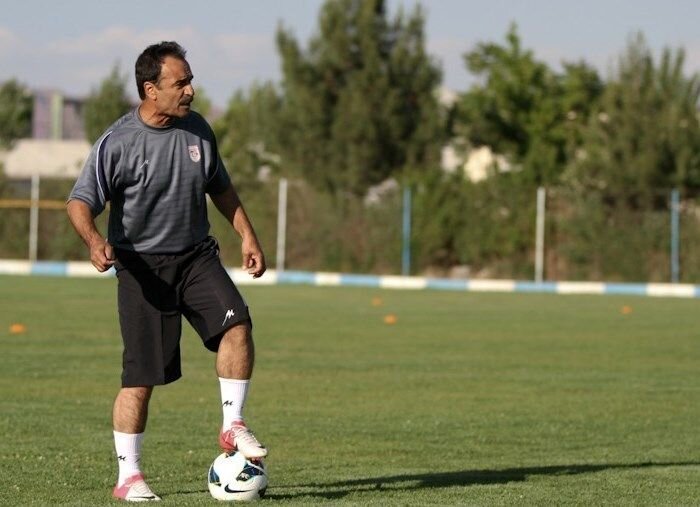
Tag: Jalal Cheraghpour

Framing Failure as Glory: The Dangerous Delusion Behind Iran's World Cup Exit

After Iran’s early exit from the group stage of the 2026 FIFA World Cup, social media has been flooded with criticism aimed at both the team and its head coach. Unsurprisingly, however, the official media and the team’s staunch defenders have framed the failure as a remarkable achievement.

The Minister of Sport, who had previously advocated for Iran’s withdrawal from the World Cup in response to American hostility, has now suddenly praised the team’s performance and fighting spirit. Meanwhile, IRIB commentators have consistently highlighted the positives—pointing out that Iran remained undefeated in all three matches—as if that alone were a triumph, conveniently ignoring the fact that a country with such a rich footballing pedigree has not advanced past the group stage since 1978.

Politics and the antagonistic treatment of Team Melli by the U.S. aside, the squad’s overall performance, coaching standards, leadership, and mentality left much to be desired. The team lacked a winning mindset, often faltered in crucial moments, and was, on the whole, mediocre and inconsistent. Technically and emotionally, Team Melli ranked low compared to its rivals.

Among the many critics is former national team coach Jalal Cheraghpour. Reflecting on Iran’s opening match, he said: “Caution was understandable for our first game, but we were overly cautious against a New Zealand side that grew in confidence precisely because of our passive approach. While it made sense to be wary of an unknown opponent, we took it too far. Every goal we conceded only deepened our fear. After that match, with the strategy apparently set on securing two draws in the remaining games, I knew we wouldn’t progress.”

He continued: “We should have played with more courage and fighting spirit in the next two matches. Moreover, the squad’s high average age meant we lacked the energy needed at this level of competition. On the other hand, if either Egypt or Belgium had won their match, our path would have been easier—but the draw complicated things. Qualification became a matter of ‘ifs’ and ‘buts.’ On the final matchday, none of the three possible scenarios that could have sent us through materialized, and we left the tournament empty-handed.”

Addressing the team’s defensive frailty—one of Team Melli’s Achilles’ heels throughout the tournament—Cheraghpour observed: “A team needs creative, talented players in attack. That kind of flair is innate; no one teaches Mehdi Taremi or Mehdi Ghaedi how to dribble. But defending is a scientific discipline that demands deeper knowledge and familiarity with modern tactics. Look at our games—when we don’t have the ball, we should press, but we don’t. When the opposition dominates, our job is to cover the spaces they can exploit. We failed to do that. We often had three or more defenders converging on the ball carrier in dangerous areas, yet we left gaps elsewhere because players bunched together. That was our undoing. Crowding an area without covering the spaces is like sending a soldier into battle without ammunition—it achieves nothing.”

He cited New Zealand’s second goal as an example: “In that scene, Chris Woods, the veteran Kiwi player, controls the ball, turns, and delivers a precise short pass completely unpressured—while our players simply watched. These defensive weaknesses, evident in all three games, stem from a lack of simulation and practice in training. Defenders must be able to read the game and anticipate an opponent’s next move. These skills are not being taught to defenders in our football, whether at club or national level. They keep making basic mistakes and tactical errors, with no apparent correction or guidance from the coaching staff.”

When asked what path Iranian football should take to move forward, Cheraghpour replied: “These shortcomings need to be analyzed and studied by the Football Federation’s training committee, and then compiled into training manuals and courses.”

He added: “Iranian football needs a major shake-up. Thirteen or fourteen players from this squad should be moved on. We have to move beyond traditional, direct tactics and embrace modern football—only then will we see real progress.”

Iran’s Football Crisis Runs Deeper Than a Youth Team Elimination


By Jalal Cheraghpour, Former National Team Coach

The recent exit of Iran’s national youth team from the AFC U-17 Asian Cup and their failure to qualify for the World Cup has turned into a familiar pattern and raised urgent questions. As someone who has spent decades within this system, I must speak plainly: this is not a one-off failure — it is the result of a systematic failure as the result of a broken foundation in our football education.

I watched closely as our team faced North Korea and Oman. What I saw wasn’t just a poor tactical display — it was a symptom of a deeper illness. The essence of football is being lost in Iran, replaced by outdated methods, poor coaching development, and misguided priorities.

The Football Federation’s Education & Training Committee, which should be shaping the future of our game, lacks both the tools and the vision to do so. They are not teaching our coaches how to truly develop players. They’re bypassing the fundamentals and pushing for results quickly, and at any cost.

This culture has trickled down to our football academies, where the emphasis is on height and strength, rather than creativity and skill. We’re building robots, not footballers. In the 2024 FIFA coaching manual, junior coaches are expected to meet a high standard of holistic development — something we’re not even close to achieving.

Shouting from the sidelines, prioritizing short-term wins, and neglecting proper infrastructure have become the norm. Is it any wonder that agility and technical flair have disappeared from our junior teams?

The question of whether Abbas Chamanian should remain the coach is beside the point. He’s served our football in many capacities. But even the best coach cannot succeed within a system that is fundamentally flawed. Until the Federation revamps its coaching philosophy and invests in true development, we will continue to stagnate and regress, not just in youth football, but across all levels of the game.

Our football deserves better. Our youth deserve better. And it begins with recognizing that the current path leads nowhere.

Team Melli needs a foreign coach at this time says Cheraghpour

A football expert says that Iran's national football team currently needs a foreign coach.

In an interview with ISNA, Jalal Chiragpour, the former Team Melli Head Coach and veteran on Iranian football affairs, commented on the chaos surrounding Team Melli and the status of the bench particularly Skocic by saying " First, we must follow logical reasoning for our conversation so that the reader can understand the situation well. Let us examine the issue from a technical and scientific point of view. In my opinion, the major problem lies with the decisions of the FFIRI Technical Committee which are neither scientific nor technical. This group of people, which now says that the Head Coach of Team Melli is not qualified, where were they in the last two and something years when Skocic took Iran to the World Cup? what criteria have they used to suddenly determine that he (Skocic) is not qualified? Did anyone see what reasoning they used? Did anyone question their logic or motives? Are there transparent and explicit requirements for the Team Melli coach?

He added: "The question remains that on that day when we were third in the group of five teams, we had lost to Bahrain and Iraq and there was a 70% chance of Team Melli being eliminated from Round 2, did this technical committee have the courage to determine right and wrong at that time?  They were nowhere near any type of decision. In any case, Skocic came and took the heavy burden off the ground and managed to lead the team to qualify for the World Cup. Now that the team has qualified comfortably and easily I might add, and is in a position where everyone knows who are the teams of its group, the technical committee raised its head. Those members of the technical committee, do not have the technical authority nor the qualification to say what is right or wrong."

He added: " Now they have decided that Skocic is not qualified!! Doesn't that raise questions about the motives and authenticity of those people? in that scenario and after three games of the World Cup, the results of which are predicted. Who is the technical committee accountable to? They would say that we tried but it didn't work. For these reasons, I say that the technical committee is not competent.  They lack authenticity, in any case, this technical committee does not have the authority to decide whether the Head Coach of the National Team of Iran should stay or leave. It is not in the term of reference and never was".

Criticizing the management of the Football Federation, Chiragpour said: "The Federation should be helping solve national team issues such as preparation friendly games, camps that help improve the quality of the team, but it has failed in this responsibility. Their priority is the elections and who wins a seat. The delay by the Football Federation in determining the assignment of the national team's bench with about 4 months before the Qatar World Cup is an example of their oversight."

He added "It may be said that domestic coaches have the ability to qualify our national team for the World Cup. Well, let's do this for the next World Cup and leave the work from zero to 100 to an  Iranian coach. Beware though, you have all witnessed the performance of the Iranian coach on the national team. "

"When a player was selected for the world team XI by FIFA,  the Iranian head coach of the national team at the time said that he was not convinced by the standard of that player and did not pick him for the national team. After that, that same player played in Europe for another 6 years and became the player of the century for Iran."

Cheraghpour concluded: "the qualities and requirements of coaches differ in different disciplines. Wrestling is different from football. We are the leaders in the world in wrestling, but in football, we are ranked in the 50 countries in the world at best. For this reason, domestic wrestling coaches are considered among the top in the world, but it is not a reason that domestic football coaches have the necessary quality to lead the football team at the top international level. If you want to bring in a local coach, let's do it immediately after the World Cup, when there is plenty of time for the next tournament. We also need to give that coach support moral and otherwise." Chiragpour added: "At that point, you can prepare the team for the Iranian coach and let him work. But right now it is too late for these things. The new coach of the national team has practically only 17 days on the field to work with the team, not 110 or 120 days. On those 17 days, it is supposed to be an hour and a half of training, of which half an hour is warming up. A total of 17 hours are available to the next coach. On the other hand, Iran has a total of 6 players in a position like central defense, and everyone, from Nekonam to Queiroz and even members of the technical committee, will only invite those 6 players to the national team."

Cheragpour calls for action to address shortfalls in Iran's football.

An increasing number of football analysts are concerned with the poor standard of the Iranian football league which was evident in the top of the table clash between Esteghlal and Persepolis in the Tehran derby while also bemoaning the poor discipline and the leniency of the football federation against violations and violent play in matches that are committed without being punished.

In a recent interview, Jalal Cheraghpour the former Team Melli coach and a current football analyst talked to Mehr News and expressed his disappointment with the derby draw between Persepolis and Esteghlal and also discussed Team Melli.

"The derby had everything but football! " Jalal Cheraghpour said.

" I would like to start with this issue, a comprehensive definition of a football game in one sentence; Because we need to know a specific definition of how a match is presented in order to be able to analyze it."

The veteran football expert added: "The comprehensive definition of the '98 derby was war and conflict in a game in which there was no sign of real football! We saw the wastage of football. When we do not observe tactics during the match and do not understand a certain strategy, it means that we are dealing with football waste. All the derby scenes were a football waste. There was nothing technical to rave about or analyze "

" It was like a war, not just small incidents or minor fringes " Cheraghpour, said: "Unfortunately, the incidents were not anything like what happens in a normal football game. Excessive stress should not lead to abuse to others. Pressure to get results and failure to get a win must not lead to what we witnessed,  a war in which happily no real weapons were used! "

Cheraghpour then commented on the various flashpoints in the match and in particular the behavior and misdemeanor of Persepolis coach. : "Golmohammadi's behavior was the result of the same football that we saw. The behaviors were completely amateurish and immature. I am not saying that Golmohammadi was wrong or not, but I am saying that we confused the competition with a football war."

"The Football Federation is going in the wrong direction again " The former coach of the Iranian national team pointed out the need for the federation to pay attention to the non-technical issues and the troubles and side issues that are perpetually created in every match in the league. He said: "I have no doubt that the Football Federation is still being steered in the wrong direction. We need a Human Behavior department. We need psychologists and clubs should be forced to employ psychoanalysts and disorders analysts to control the emotional disorder of players and coaches. The volume of indifference is mixed with false excitement, which is unbelievable. "

"The referees have become apathetic and the teams are behaving unprofessionally. All these wrong behaviors are naturally transmitted to Team Melli"

"The national team list is becoming repetitive" Cheraghpour said about the latest squad list to play against South Korea and Lebanon: "We are still witnessing a repetitive list despite the current disparities. Technical problems remain on the list. In my opinion, now that the qualification Team Melli is assured, we needed to solve some problems in certain positions. Why are we so conservative? " Criticizing some of the old players invited to the team, Cheragpour said: "I think if we were looking for progress, a player who has been in the national team for eight years yet plays the least minutes, would not have been invited anymore. Why Karim Ansarifard and Ehsan Haj Safi are still on the list. I like them both, but their physique and stamina no longer suit the technical requirement of modern football and even the Iranian national team. "

"The list of the national team is not progressive," said Cheraghpour. "This team is again an instrument of the head coach and only fulfills his wishes. With Carlos Queiroz, we also had the same personal selfishness and the objective was to create a successful resume for the head coach. Skocic was selfish like Quieroz. "look at the list, there are eight players that should not be there

The Iranian football expert emphasized:" Eight players of the team have passed their football best. I fail to understand why we do not invite a player who has room to develop, instead. In my opinion, Kamal KamyabiNia does process half of the abilities of three years ago, but he is still present on the list. At the same time, we leave out a player like Mohammad Daneshgar, who still has room for improvement with the national team and who has had an admirable performance in the league with his club."

He was asked whether the Croatian Head coach is also pursuing personal triumph in the games against South Korea and Lebanon? "Skocic position is quite strong," he said. "He is no longer afraid of not being on the bench of Team Melli. If he leaves Iran today, he will still have a good CV with the records he achieved with Iran."

About the strategy that should be deployed in the World Cup 2022, the former coach of Team Melli said "in my opinion, the technical staff must avoid selecting players who keep the ball at their feet longer than 3 seconds or head the ball to pass. They will no longer be useful. Now, world football is moving at a fast pace and momentary decisions of the players are crucial. Unfortunately, our football is much slower than ever. Most Iranian players need twice the time to think and ultimately lose advantage and opportunity"