Category: News

‘Our team is the most oppressed’: Iran coach hits out at FIFA and US over treatment

The Guardian
Story by Alexander Abnos and Ben Fisher at Los Angeles Stadium

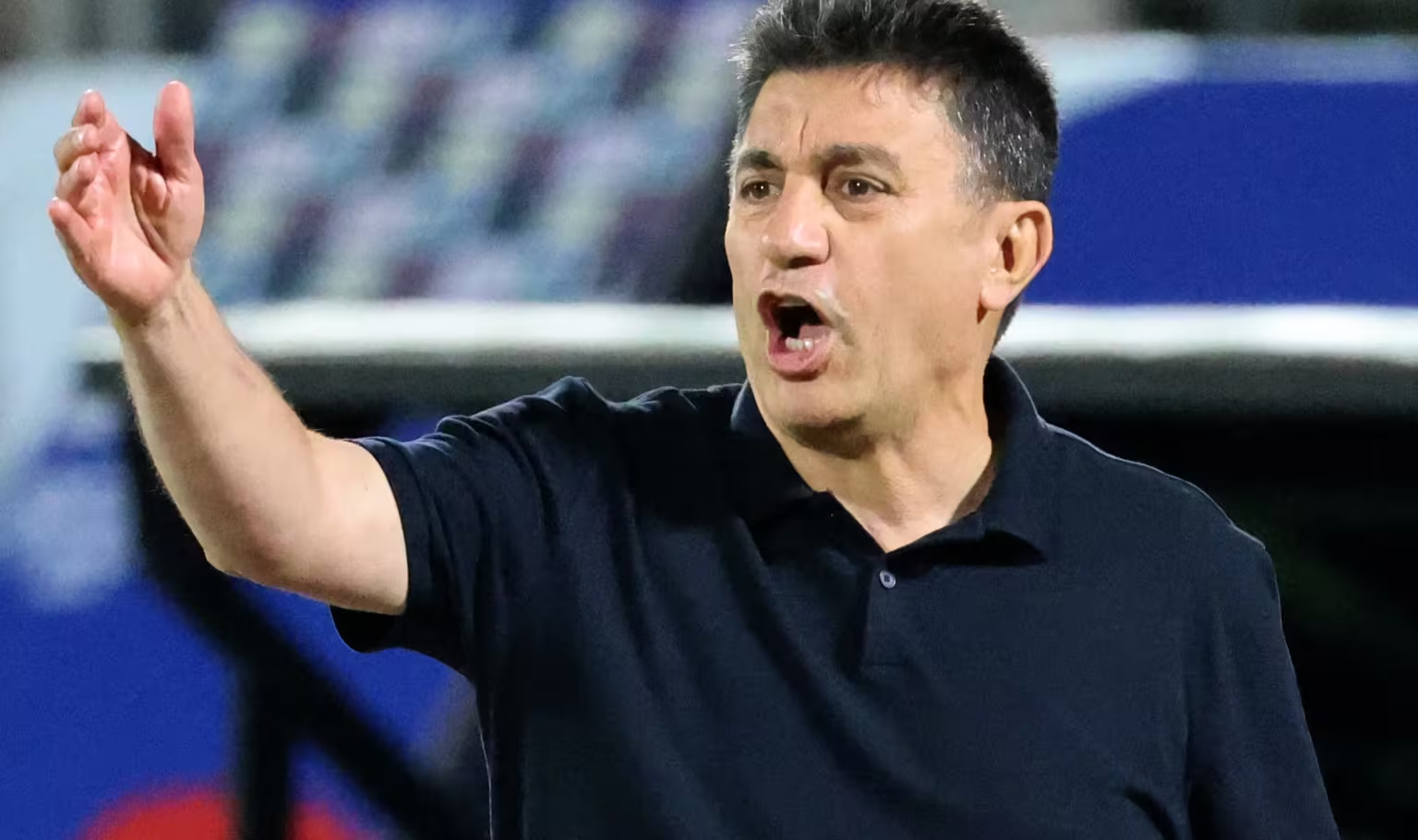
The Iran captain, Mehdi Taremi, midfielder Mohammad Mohebi, and the head coach, Amir Ghalenoei, hit out at Fifa and hinted at resentment toward the US government after being told they needed to leave Los Angeles ­immediately after Monday night’s 2-2 draw against New Zealand.

“Everything is like disaster for us,” said Taremi, who added that the Fifa president, Gianni Infantino, visited the team in the dressing room and they expressed their concerns to him directly.

Related: Iran twice come from behind to claim draw in World Cup opener with New Zealand

Ghalenoei said Iran’s treatment by Fifa makes them “the most oppressed” team at the tournament. “After the game today they said to us: ‘You have to leave immediately.’ Whereas it’s very important for us to have recovery.

“We’ve been asked to get on a plane and return to our camp in Tijuana and we are really troubled by that. They are forcing us to go back early. They are making the situation more and more difficult, more hurdles, but we’re not going to let that stop us from doing our best.

“We don’t know why they’re returning us. It’s very strange. It seems like others are doing the ­planning for us … We were ­supposed to arrive two nights before the game but they didn’t permit [it]. We were supposed to stay here tonight to recover and return tomorrow lunchtime.

“Our team is the most oppressed one in the whole World Cup. Our federation isn’t here, our media isn’t here, our management isn’t here.”

Infantino went into the Iran ­dressing room after the game and a video of his message to the squad was shared online, in which Infantino and Ghalenoei exchanged words, via a member of staff translating.

“You showed to your families, friends, to your people, to the world, that you’re in the World Cup, that you perform and you have two more games to go,” Infantino said. “In these two games you will make again ­everyone in the world proud of what you do. Thank you for being here.

“It is also a big, big emotion. I know what you go through, I understand, but you are stronger than everything. You send a strong message to the entire world. You united the whole stadium here, you united the whole stadium behind you, behind Team Melli. You are sending such a strong message to the world.

“Let me say one more thing: this is just the beginning of the World Cup. You are writing history, the whole world is watching you. Continue to play with your heart, for your ­people, your families, for your fans and for everyone in the world that is ­falling in love with Team Melli. You are stronger than everything.”

Taremi criticised a logistical ­situation that has meant the team was forced to abandon their planned training base in Tucson, Arizona weeks before the tournament, instead training across the border in Tijuana, Mexico and flying in to the US shortly before games.

The team moved its training base to avoid immigration concerns that turned out to be well founded. After arriving in Mexico, 15 of the team’s support staff were denied visas to enter the US, where all of Iran’s group stage games are taking place. That number was later reduced to 11 after some visas were approved.

The team arrived in Los Angeles minus both their media officers, some analysts and the federation ­president, Mehdi Taj. Another analyst for the team served as a stand-in media aide for Taremi and Mohebi’s appearance, which a Fifa official repeatedly attempted to stop as both players ­continued answering questions.

Related: World Cup 2026: Iran begin disrupted campaign with draw against New Zealand – in pictures

“It’s not good for the football,” Taremi said. “In [the] World Cup, you have to prepare [well] for the next game, which is a lot of stress for the players and the staff and everyone. But we don’t have that support and Fifa have to help us more than this. Let’s see what’s going to happen in the future.”

Iran faced delays in their travel from Tijuana to Los Angeles, a short trip that Taremi said took five hours. He did not specify what caused the delays, but it was understood the immigration process was the main cause. Taremi and Mohebi said being forced to leave immediately afterward would negatively affect the players’ performance at the tournament.

“It’s supposed to be: tomorrow morning recovery, then we fly to Tijuana, then we return to LA again, but right now we have to go back,” Taremi said. Mohebi added: “Yesterday we came, started the trip in the morning, and we arrive [in the] afternoon. We directly go to train and we get tired. This kind of deal is not fair … we’re going to get fatigued – hamstring, lower back, glutes …”

In contrast, Ghalenoei praised the warmth of co-hosts Mexico and many Mexicans were in attendance supporting Iran at the Los Angeles Stadium. “The Mexican people, the Mexican government, especially the people in Tijuana, made us feel at home,” he said.


Welcome to America—Now Leave: Torabi's Expired Visa Exposes World Cup Hypocrisy

According to the national team's media department, while most Team Melli players were issued multiple-entry visas for travel to the United States, midfielder Mehdi Torabi received only a single-entry visa. After the team traveled to Los Angeles for the match against New Zealand and that fixture concluded, Torabi's visa expired. The Iranian Football Federation has since initiated steps to have the visa reissued so that the player can rejoin the squad for the remainder of the World Cup campaign.


Torabi sustained an injury during the training camp in Tijuana, Mexico, and was not fully fit for Tuesday's match against New Zealand. The injury, however, was not serious, and he would have been available for selection in Iran's next group-stage encounter against Belgium, also in Los Angeles.

Denying a player re-entry into the United States raises serious concerns and can be viewed as another provocation that undermines Iran's right to compete on a fair and equal footing. Such administrative hurdles, whether intentional or not, disrupt team preparation and cast a shadow over the integrity of the tournament's logistical arrangements.

It is worth noting that Torabi has been a polarizing figure among Iranian fans, particularly in the wake of the nationwide protests following the death of Mahsa Amini in police custody. During that period, Torabi was one of several players who drew public criticism—and in some cases, physical hostility—for his perceived support of the establishment. He was reportedly pelted with stones on multiple occasions in domestic stadiums.

Whether the visa issue is in any way connected to those events remains unclear. The U.S. government rarely provides detailed explanations for visa denials or revocations, typically citing national security or public safety concerns without elaborating further. In Torabi's case, no official reason has been given, leaving the matter open to speculation.

The Draw against New Zealand: Promise and Concerns.

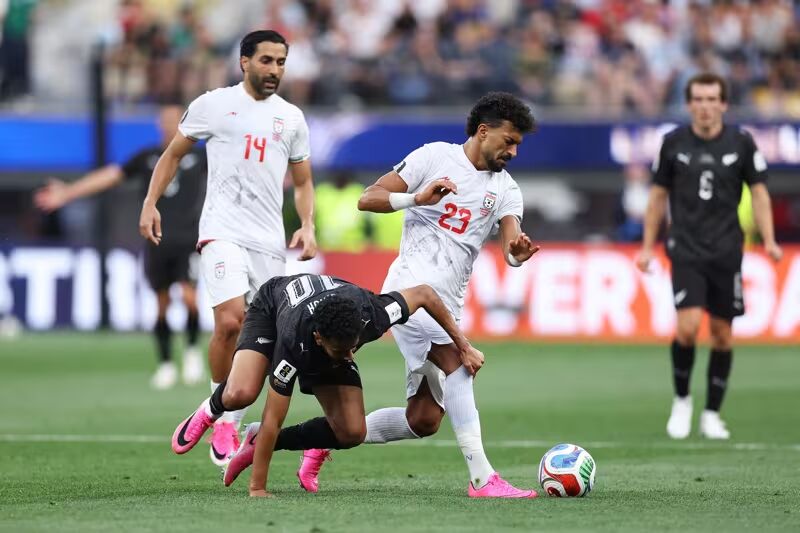
Team Melli began their 2026 FIFA World Cup campaign with a 2–2 draw against New Zealand in Inglewood, Los Angeles, a result that offered both promise and concern for Iranian fans.

The match was notable for several reasons, not least the starting lineup chosen by head coach Amir Ghalenoei. He unveiled a formation rarely seen in public with Team Melli with 5 defenders. The lineup featured right-back Aria Yousefi and striker Shahriar Moghanloo, a late addition to the 33-man squad in Turkey, in the starting XI. Yousefi, deployed out of his natural position, struggled to make an impact. Moghanloo, however, exceeded expectations. Despite displaying some raw technical deficiencies, the forward’s physical presence, work rate, and willingness to press and challenge for duels made him a persistent nuisance for the New Zealand defense. While his inclusion has drawn criticism from some quarters, his performance suggested he could offer a unique attacking option, provided he continues to develop his link-up play and decision-making in the final third.

The undisputed star of the match was Ramin Rezaeian. Just months ago, his place in the World Cup squad seemed uncertain, but a return to form following his transfer to Foolad Khuzestan earned him a recall, and he repaid that faith emphatically. Rezaeian scored one goal and provided a pinpoint assist for Mohammad Mohebi, earning the Player of the Match award. In doing so, he also etched his name into Iranian football history as the first and only Iranian player to score in two separate World Cups.

However, the performance of Iran’s substitutes left much to be desired. Mehdi Ghaedi, Ali Alipour, Ehsan Hajsafi, and Amirhossein Hosseinzadeh failed to inject energy or alter the flow of the game after coming on. More than the players themselves, it was Ghalenoei’s inability to read the match dynamics and introduce timely changes that proved costly against a resolute and physically strong New Zealand side.

Defensively, Iran looked vulnerable, a concern that has been voiced for months, if not years. When New Zealand attacked from deep, the Iranian backline appeared disorganized, with poor covering and a lack of cohesive teamwork. Both goals conceded stemmed from these structural frailties. With Belgium and Egypt looming, this is a glaring issue that Ghalenoei’s staff must urgently address. Given the limited preparation time and squad options, however, a dramatic improvement before the next match against Belgium seems unlikely.

Captain Mehdi Taremi was industrious as ever, covering vast amounts of ground and showing commendable stamina. Yet his technical execution fell short of the high standards expected of a player of his caliber. His best moment came in the first half, when a delightful curling effort struck the post. On that occasion, a pass to either of two better-placed teammates may have been the wiser choice, a decision that could prove critical in tighter matches.

Mohammad Mohebi, despite scoring a brilliant goal and influencing the result, was not without fault. His loss of possession directly led to New Zealand’s second goal, a mistake that must be reviewed by the coaching staff. While his attacking contribution is invaluable, such lapses cannot be overlooked at this level.

Another talking point was the absence of an experienced, high-level assistant alongside Ghalenoei. While Saeed Elhovie, Andranik Teymurian, and Rahman Rezaei possess valuable football knowledge, their experience at World Cup level is limited. In major tournaments, having seasoned support on the bench can be crucial, and this void may have been felt during key moments of the match.

The midfield unit, led by Saman Ghoddos and Saeed Ezzatollahi, struggled under New Zealand’s pressing game. Both made uncharacteristic errors, and the duo lacked influence in building attacks or shielding the defense. Ghalenoei may need to consider alternatives—such as introducing Ghorbani or Amir Mohammad Razzaghinia as a more defensive-minded presence—but the reality is that the squad lacks depth and quality in the middle of the park.

Haste was another recurring issue. Iranian players often rushed their decisions instead of controlling the tempo, leading to wasted possession and disjointed transitions. Ghalenoei must work on instilling greater composure and game management ahead of the remaining group matches.

In goal, Alireza Beiranvand delivered a generally solid performance, making several key saves. However, both New Zealand goals, particularly the second, were stoppable, and the keeper no longer resembles the commanding figure who dazzled the world in previous tournaments. Behind a fragile defense, Iran needs a goalkeeper who can provide security and leadership; Beiranvand remains the best option, but his form raises questions.

Ultimately, the draw against New Zealand was a mixed bag, a result with encouraging signs but also glaring warnings. Team Melli must build on its strengths while addressing defensive instability, midfield coherence, and tactical discipline. Much rests on Ghalenoei’s shoulders, and his tendency toward unconventional tactics and selection choices will continue to invite scrutiny. The road ahead is steep, but with focused preparation, Iran can still make its mark on this World Cup.

Elementor #90041

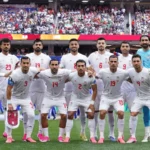
Team Melli's first half result against New Zealand in Group G of the FIFA World Cup 2026 has ended level 1-1

Elijah JUST scored New Zealand's goal while Ramin Rezaeian scored Iran's equalizer.

Starting Line Up
1 Alireza BEIRANVAND
4 Shoja KHALILZADEH
5 Milad MOHAMMADI
17 Arya YOUSEFI
19 Ali NEMATI
23 Ramin REZAEIAN
6 Saeid EZATOLAHI
8 Mohammad MOHEBBI
14 Saman GHODDOS
9 Mehdi TAREMI
20 Shahriyar MOGHANLOO

Team Melli's possible lineup vs New Zealand

The Iranian national football team will face New Zealand (FIFA Rank #85) in its first match of the FIFA World Cup 2026 on Tuesday morning, June 16th, at 04:30 Tehran time in Los Angeles, USA.

After a scare, it seems that Mehdi Taremi is fit enough to start the match for Iran. The number 9 striker, who has played 105 international matches so far, will enter the field with 60 international goals in the main lineup and will try to increase this impressive statistic.

In the attack, Taremi will be supported by two other goal scorers, Mohammad Mohebi and Mehdi Ghaedi; players who have 14 and 10 international goals in their portfolios, respectively, and play an important role in the team’s offensive phase.

However, Team Melli is also facing several injury issues; Alireza Jahanbakhsh, Dennis Eckert ( two players who have not featured in the pre-tournament camp), and Mehdi Torabi are likely to miss the match, while Roozbeh Cheshmi's condition is also uncertain and has been postponed until the final fitness tests.

Saman Ghoddos is likely to retain his place in the starting lineup, while Saeed Ezzatollahi and Amir Mohammad Razaghinia will play in the middle of the field as a central midfield pair. In defense, Ramin Rezaian and Ehsan Hajsafi will cover the flanks on either side of the defensive line, while the pair of Shoja Khalilzadeh and Hossein Kananizadegan will be in the heart of the defense.

This defense will protect the national team's number one goalkeeper, Alireza Beiranvand, a goalkeeper who will undoubtedly be in the starting lineup to ensure Iran has a strong start to the World Cup.

Possible Iran lineup:
Alireza Beiranvand; Ramin Rezaian, Shoja 'a Khalilzadeh, Hossein Kananizadegan, Ehsan Hajsafi;

Saeid Ezzatollahi, Saman Ghoddos Amir Mohammad Razaghinia;


Mohammad Mohebbi, Mehdi Hagedi and Mehdi Taremi

Banned for 20 Days for Exposing What Everyone Knows: The Dadashzadeh Case

Following a temporary order issued by the Ethics Committee of the Football Federation, Behzad Dadashzadeh has been banned from all football and futsal activities for 20 days. The suspension will remain in effect while allegations he made regarding the national team are investigated.

According to ISNA, Dadashzadeh—a former player for Team Melli, Esteghlal, and Persepolis—recently claimed that the process of selecting players for the national football team has been influenced by financial transactions, suggesting that some players pay to receive call-ups. It is these claims that prompted the Ethics Committee’s interim ruling.

In a statement last week regarding the national team squad, Dadashzadeh said: “We must respect and support Ghalenoei’s current squad. I have told the coaching staff and my good friends that we need to give young players a chance to secure their football future. What goes on behind the scenes, however, is another matter. I have heard there have been fights and arguments at the Olympic Hotel over the squad list.

The fact that a few brokers have pressured the national team’s coaching staff to include their own players is questionable, though I cannot make a definitive judgment. Take Ehsan Hajsafi, for example—he is a separate case. He voted for Mehdi Taj in the Football Federation presidential election and, in return, secured his place on the national team. That is, he became a permanent fixture in the squad.

That said, most players invited to Team Melli have not performed badly in the league, to be honest. But Aref Aghasi’s invitation is debatable—given his performances at Esteghlal, it is unclear why he should have been among those called up. Back when we were playing, there was a lot of infighting, and some players resorted to lobbying just to make it to the World Cup.”

Allegations of under-the-table payments, excessive influence of player agents, and political maneuvering within football have persisted for many years. It is an open secret that such practices remain widespread. Dadashzadeh is far from the first person to expose this, but history shows that none of these claims are ever investigated by an independent counsel—for the simple reason that any real inquiry would expose many powerful figures.

Dadashzadeh, as a football veteran, has strong opinions about the state of various teams and the management of Iranian football. He has criticized the performance of the Persepolis team and its management and has emphasized the need for changes in this area. Behzad Dadashzadeh, with a rich history in Iranian football, continues to be recognized as an influential figure in the sport, and his opinions on Iranian football are taken into account.

In hindsight, looking at the current Team Melli squad for the 2026 FIFA World Cup, even casual fans—let alone experts—might find reasons to suspect that Dadashzadeh has a point or two.


Inside the U.S. Decision to Block Iran’s World Cup Delegation

While all 26 players and head coach Amir Ghalenoei have successfully received U.S. entry visas for the upcoming World Cup matches, nearly the entire administrative and a portion of the technical and coaching staff have been denied. In total, 12 team personnel will not be permitted to accompany Team Melli on U.S. soil.

The Iranian national football team departed Turkey today, en route to Tijuana, Mexico, where they will establish their base for the tournament. The travel list notably included Mehdi Taj, the head of the Football Federation of the Islamic Republic of Iran (FFIRI).

Key figures denied visas :

Mehdi Mohammadnabi, Team Manager and Board Member of FFIRI.

Mehdi Taj , FFIRI President

Hedayat Mombini, Secretary General of the Football Federation

Siamak Ghlichkhani, media team member

Mohsen Motamedkia, Communications and Media Director

Mehdi Kharati, Executive Director of the national team


Apart from the top two, none of the above individuals are known to have current or prior affiliations with the Islamic Revolutionary Guard Corps (IRGC). Mehdi Taj and Mohammadnabi have faced previous scrutiny over past connections. It has been suggested that the U.S. visa denials may have been informed by intelligence provided by Iranian diaspora groups in California, many of whom are vocally opposed to the current Iranian government. However, this claim remains unverified.

Additionally, sources indicate that none of the security and intelligence personnel, often accompanying Team Melli as informal minders (known as Herasat), applied for U.S. visas altogether, reportedly fearing certain rejection or even arrest upon arrival in the United States.

Technical Impact vs. Logistical Challenges

From a sporting perspective, the team remains intact. The absence of these 12 individuals is not expected to directly affect game plans, player preparation, or on-field training. However, the loss of key administrative and logistical personnel could severely disrupt operations behind the scenes, potentially handicapping Team Melli’s World Cup campaign through disorganized coordination, travel arrangements, and media management.

All 12 denied individuals are expected to remain in Tijuana, Mexico, for the duration of the World Cup, operating from across the border.

Concerns Over Entry Procedures for Players and Coaches

Despite being granted visas, there are growing fears among the Iranian camp that the team’s actual entry into the United States may not go smoothly. U.S. Customs and Border Protection (ICE) officials retain broad discretionary powers at ports of entry, and there are concerns that players and coaching staff could be subjected to extended questioning or detention for hours, adding unnecessary emotional and physical strain ahead of crucial matches.

Some Iranian officials have alleged that U.S. authorities may exploit procedural measures to pressure the team, with one source quoted as saying, “the Americans will do everything in the book and outside it to hurt Iran.” Such claims remain unconfirmed and reflect the heightened political tensions surrounding the Iranian team’s participation in a U.S.-hosted sporting event.

Uncertainty Over FIFA’s Guarantees

It remains to be seen whether FIFA President Gianni Infantino’s personal assurances of safe and swift passage for all World Cup participants will hold true for Iran. With off-field political pressures already mounting, Team Melli faces the dual challenge of navigating both on-field competition and a complicated, high-stakes logistical environment.

FULL LIST OF TEAM MELLI STAFF

Coaching Staff — Iran

AG

Amir Ghalenoei - Head Coach
Rahman Rezaei - Assistant Coach
Andranik Teymourian - Assistant Coach
Alin Dincă - Goalkeepers Coach
Ali Asghar Ghorbanalipour - Fitness Coach
Alireza Shahab - Physiotherapist
Parhan Khanlari - Team Doctor
Amir Esmaeili - Staff

Team Melli squad has been granted US visas for the FIFA World Cup 2026

By Emily Green

June 5 (Reuters) - Iran's World Cup soccer players have been granted visas to enter the United States, a White House official told Reuters on Friday, just 10 days before their first match in Los Angeles amid a conflict between the two countries.

Iran's ambassador to Mexico, Abolfazl Pasandideh, said late on Thursday the squad had still not received their U.S. visas, but these were granted overnight, the White House official said.
A spokesman for Iran's World Cup federation could not immediately be reached for comment.

The U.S. had not yet issued visas to some members of the Iran team's technical and administrative staff, the semi-official Fars news agency reported on Friday.

"Visas for some members of the national team's technical and executive staff have not yet been issued, and the U.S. embassy has so far refused to issue them," it said, without citing a source.

Iran's Full Squad List: Team Melli Squad FIFA World Cup 2026 Canada, US, Mexico - Team Melli

The Iran war has turned the World Cup – the biggest global sporting event – into a geopolitical contest, with both sides appearing to use the tournament for political posturing.

It is the first World Cup, since its inception in 1930, in which a host nation is set to receive a country it is at war with.

Tehran negotiated a last-minute move of the team's base from Arizona to Tijuana in Mexico due to the visa issues and a growing feeling in Iran that the squad’s presence in the United States should be kept to a minimum.

They are scheduled to land in Tijuana early on Sunday.

Iran are due to play their first Group G match on June 15 against New Zealand in Los Angeles, where they will also face Belgium before taking on Egypt in Seattle.

The U.S. had never formally said it did not want the Iran team to stay on its territory, ambassador Pasandideh said.

However, Secretary of State Marco Rubio told lawmakers on Tuesday that the U.S. would not allow Iran to include in its World Cup delegation individuals linked to the Islamic Revolutionary Guards, a powerful branch of the Iranian armed forces.

Mehdi Taj, president of Iran's soccer federation, was denied entry for the tournament draw in Washington in December. He is a former commander in the Revolutionary Guards.

Iran's desire to compete in the World Cup underscored its efforts to reach a resolution in the war with Washington, Pasandideh said.

"Iran's participation in the World Cup -- even on the soil of what is seen as its enemy -- shows that Iran seeks peace," Pasandideh said, speaking through a Spanish interpreter at the Iranian embassy in Mexico City.

Progress in peace talks between Iran and the U.S. has been slow, with both sides seemingly inching toward an interim agreement even as they continue to carry out military strikes.

Team Melli defeats Mali in the last preparation match before the World Cup

For its last World Cup warm-up match, played this Thursday in Antalya (Turkey), behind closed doors, Iran beat Mali (2-0). Before flying to Mexico on Saturday and returning to their base camp in Tijuana during the World Cup (June 11-July 19), Iran won their last warm-up match against Mali (2-0) on Thursday. This result comes after a first victory against Gambia (3-1), on May 29.
The match was held behind closed doors, without any media, at the Titanic Stadium in Antalya, Turkey, where Team Melli had started its gathering. Both goals were scored by Saeid Ezatolahi (14th) and Ramin Rezaeian (55th).

Amir Ghalenoei made 9 substitutions in a match that saw two of the excluded players given minutes in the match, including a debut match for Hadi Habibinejad, who replaced Arya Yousefi in the 77th minute. Amirhossein Mahmoudi also found playing time

The 21st nation in the FIFA ranking will start the competition on July 15 against New Zealand. In Group G, the Iranians, who have received their visas for Mexico but not yet for the United States, will also face New Zealand and Egypt.

Age of Stagnation: Why Ghalenoei’s Conservative Selections Have Made Iran the Second-Oldest Team at the 2026 World Cup

PERSIAN VERSION
  • پیریِ مرگبار: چرا انتخاب‌های محافظه‌کارانهٔ قلعه‌نویی، ایران را دومین تیم پیر جهان در جام جهانی ۲۰۲۶ کرده است
    با نزدیک شدن به جام جهانی ۲۰۲۶، تمام تیم‌ها لیست نهایی بازیکنان خود را به کمیته برگزاری تحویل داده‌اند. طبق آمار منتشرشده از میانگین سنی هر تیم، تصویری روشن و برای برخی، هشداردهنده به دست آمده است:

Continue reading "Age of Stagnation: Why Ghalenoei’s Conservative Selections Have Made Iran the Second-Oldest Team at the 2026 World Cup"

With the 2026 World Cup rapidly approaching, all participating nations have submitted their official player lists to the organizing committee. Recent data released on the average age of each squad has painted a telling, and for some, alarming picture. According to the records:

  • Panama (30.4 years)
  • Iran (30.3 years)
  • Colombia (30.1 years)

These three nations stand as the oldest teams in the competition. At the opposite end of the spectrum, the Ivory Coast boasts the youngest squad with an average age of just 25.8 years—a full 4.5 years younger than Team Melli.

Iran’s Aging Roster: A Symptom, Not a Coincidence

For Iranian fans and analysts, seeing their national team ranked as the second-oldest in the world is not merely a statistical curiosity. It is a glaring indictment of head coach Amir Ghalenoei’s philosophy, risk aversion, and failure to regenerate the squad since he took over in March 2023, barely three months after the 2022 World Cup in Qatar.

On the surface, relying on experienced players might seem prudent for a team facing the likes of England and European powerhouses. Veterans bring composure, tactical discipline, and big-match know-how. However, the deeper problem is that under Ghalenoei, experience has become an excuse for exclusion, specifically, the systematic exclusion of young, dynamic, and technically gifted emerging talents.

Ghalenoei’s Core Failure: A Closed Door to Youth

The most damning charge against Ghalenoei is his inability, or outright refusal, to introduce a single player of lasting value to the national squad during his entire tenure. In nearly four years at the helm, spanning the AFC Asian Cup 2023, World Cup qualifiers and friendly matches, he has not blooded a promising young star who could credibly claim a starting spot in 2026.

Unlike predecessors who at least attempted transitions (e.g., Queiroz introducing Sardar Azmoun and Saman Ghoddos as youngsters, or even Branko Ivanković giving early caps to Ehsan Hajsafi), Ghalenoei has fallen back on the same core of aging, often injury-prone players. Names like Shoja Khalilzadeh (37), Ramin Rezaeian (36), and Ehsan Hajsafy (36) continue to receive call-ups, while talents such as:

  • Kasra Taheri
  • Mohammad Amin Hazbavi (defensive prodigy)
  • Saeid Saharkhizan (prolific young striker)
  • Javad Hosseinnejad

Are given token minutes that amount to little more than window dressing.

A Culture of Distrust and Fear

Ghalenoei’s selection patterns reveal a deep-seated distrust of youth, often rationalized in press conferences with vague phrases like “they are not ready” or “the pressure is too high.” But this is a smokescreen. The reality is a conservative, fear-driven approach: the coach prioritizes short-term results (avoiding a humiliating loss in a qualifier) over long-term development (giving a 21-year-old 45 minutes against a weaker Asian side).

This fear has paralyzed Iran’s natural footballing cycle. While Japan, Australia, and even Saudi Arabia have lowered their average age and injected pace and energy, Iran has remained static. The result is a squad that, by 2026, will rely on several players past their physical prime, easily exploited by faster, younger opponents in a condensed tournament schedule.

Impunity and Institutional Failure: The Role of Mehdi Taj and FFIRI

Yet, Ghalenoei alone is not the culprit. His job security, despite underwhelming performances and a visible lack of tactical evolution, is underwritten by the blind trust of Mehdi Taj, the president of the Football Federation Islamic Republic of Iran (FFIRI), and a notoriously silent, ineffective board.

The FFIRI has historically oscillated between micromanagement and neglect. Under Taj, the federation has abdicated its responsibility to challenge the head coach. No public questioning of Ghalenoei’s squad selection. No pressure to integrate U-23 players. No performance reviews with clear KPIs regarding player development. Instead, Ghalenoei operates with impunity, knowing that as long as Iran scrapes past Hong Kong or Turkmenistan, his position is secure.

This institutional complacency is catastrophic. It sends a message to every young player in the Persian Gulf Pro League: no matter how well you perform, you will not be trusted until you are nearly 30. That kills ambition, depresses the league’s competitive intensity, and accelerates the exodus of promising talent to Qatar or the UAE merely for playing time.

The Cost of Impunity

The shadow of doubt cast by Ghalenoei’s tenure extends far beyond the 2026 World Cup. Even if Iran manages a respectable performance (e.g., a single win or a draw against top-tier opposition), the underlying structural damage remains. By refusing to build for the future, Ghalenoei and the FFIRI are setting up Iranian football for a hard landing after the tournament.

When the current crop of 30-somethings retires en masse post-2026, there will be no experienced replacements—only a generation of 24-to-27-year-olds with fewer than ten caps and zero big-tournament experience. That is the hallmark of managerial negligence.

Conclusion: A Lost Cycle

The statistic that Iran is the second-oldest team at the 2026 World Cup is not a badge of honor. It is a funeral bell for a lost development cycle. Amir Ghalenoei’s distrust of young players, rooted in a conservative and fearful mindset, has denied a generation the chance to grow. And with Mehdi Taj’s FFIRI offering no oversight, there is no incentive to change.

Iranian football deserves a coach who sees youth as an asset, not a liability. Until Ghalenoei is held accountable, or replaced by someone willing to take calculated risks, Team Melli will remain old, slow, and predictable. And that is a far more dangerous opponent for Iran than any European powerhouse.

Ivory Coast, with an average age of 25.8 years, is known as the youngest team in the competition.

Ranking of the top 10 teams (oldest and youngest) The oldest teams in the 2026 World Cup:

1 - Panama 30.4 years
2 - Iran 30.3 years
3 - Colombia 30.1 years
4 - Cape Verde 29.7 years
5 - Qatar 29.4 years
6 - Brazil 29.2 years
7 - Scotland 29.2 years
8 - Argentina 29.1 years
9 - Congo 29.1 years
10 - Paraguay 29.0 years

The youngest teams in the 2026 World Cup:
1 - Ivory Coast 25.8 years
2 - Bosnia 26.0 years
3 - Ecuador 26.1 years
4 - Morocco 26.4 years
5 - Tunisia 26.6 years
6 - Spain 26.7 years
7 - South Africa 26.8 years
8 - Norway 26.8 years
9 - Algeria 26.9 years
10 - USA 26.9 years

PERSIAN VERSION
  • پیریِ مرگبار: چرا انتخاب‌های محافظه‌کارانهٔ قلعه‌نویی، ایران را دومین تیم پیر جهان در جام جهانی ۲۰۲۶ کرده است
    با نزدیک شدن به جام جهانی ۲۰۲۶، تمام تیم‌ها لیست نهایی بازیکنان خود را به کمیته برگزاری تحویل داده‌اند. طبق آمار منتشرشده از میانگین سنی هر تیم، تصویری روشن و برای برخی، هشداردهنده به دست آمده است:

Continue reading "Age of Stagnation: Why Ghalenoei’s Conservative Selections Have Made Iran the Second-Oldest Team at the 2026 World Cup"