World Cup qualifiers to be changed yet again!

There are strong indications that the upcoming two FIFA World Cup 2022 qualifiers of Team Melli against Cambodia and Hong Kong will be postponed and the possibility of playing all the remaining rounds of matches in a round-robin format in one country. This has made Dragan Skocic’s mission of qualifying that much harder for several reasons.

While some countries have suggested that the remaining matches should be held centrally because of the coronavirus, there are others that oppose that idea and insisting that the matches should be carried out on a home and away basis as normal while strictly observing health protocols and compliance with Covid19 prevention conventions.

Currently, several Asian countries are continuing ahead with football activities behind closed doors. The league competitions are held in this way in most countries and one of them is Iran.

It is natural for the Iranian Football Federation FFIRI to resist holding the games in a centralized venue, because Team Melli is hosting three of the remaining 4 games, and now if it is to play in a centralized venue, it will be deprived of home advantage. According to the Football Federation, the AFC has not yet sent a letter to the member states regarding the manner of holding the remaining games, and as far as the FFIRI is concerned, it would follow the last original schedule. However, it is hardly unlikely that such an arrangement will prevail. If the Asian Football Confederation decides to hold the remaining matches centrally, the Iranian Football Federation will vote for Qatar as the host of the games.
Another country that has announced its readiness to host Iran Group Games is the UAE. Interestingly, if the games are finalized in one centralized venue, the matches will be held at later dates possibly June 2021.

One issue with the single venue is that the matches will be held intensively, and this round of qualifiers will have to be over in less than two weeks. All teams must play 4 matches within 14 days.

In this scenario, the remaining qualifying rounds of FIFA World Cup 2022 matches will probably be held after the end of the league season, which means that Team Melli will not have a program in April.
Without a doubt, these will be stressful times for all the teams in the qualifiers and most of the teams need to go back to the drawing board to reschedule and change their plans. For Team Melli, it is of the utmost importance to arrange friendly matches to prevent the squad from being inactive and stagnant if the matches are to be held in June 2021.

Ali Ansarian passes away. Another Covid19 victim.

Coronavirus took away another Iranian footballer.

The former Persepolis and Esteghlal defender, Ali Ansarian has died today  Wednesday in Tehran at the age of 43 due to contracting coronavirus and subsequent serious health complications.

Ansarian, who has previously played for Fajr Sepasi, Persepolis, Saipa, Esteghlal Tehran, Estil Azin , Esteghlal Ahvaz, Gostarish Foolad,  Shahrdari Tabriz, and Shahin Bushehr contracted the virus a couple of weeks ago. His health deteriorated rapidly and all efforts to save him were lost on Wednesday after he succumbed to the illness.

Kavianpour

Ansarian, who was taken to the hospital about two weeks ago, was being monitored with a ventilator due to his deteriorating condition. There were even reports of his condition improving in the past few days, but his condition worsened in the past two days.

The football veteran has also been active in the field of media and cinema in the past years and has acted in movies and TV series while appearing in several TV shows.

It was only last week that Iran’s football lost a footballing hero in Mehrdad Minavand due to a Coronavirus.

 Team Melli dot com extends its condolences to the Ansarian family and the football community for this loss, May God bless his soul

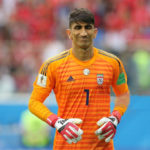
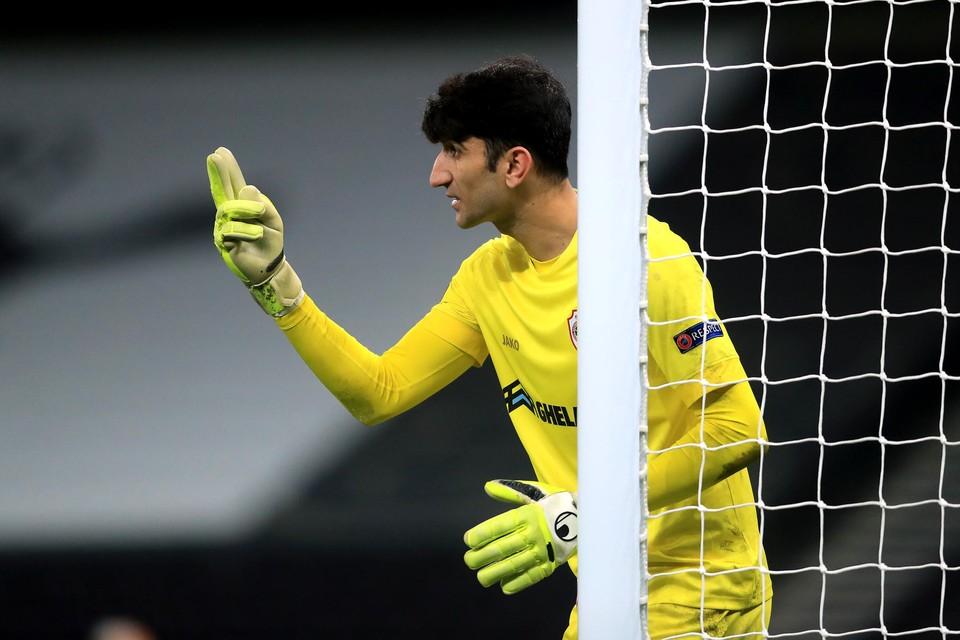
Beiravand in defiant mood

Team Melli and Antwerp’s goalkeeper was in a defiant mood when interviewed by a Dutch website. Here is the excerpt.

And then the sky cleared. He conceded seven goals in his first three matches, but in the past ten days, he collected three clean sheets. Alireza Beiranvand (28) is currently doing so well at Antwerp – last night he was Man of the Match against Eupen – that even an extra goalkeeper is no longer so urgent. ‘All the Iranian people are praying for me,’ he claims.

‘It was so difficult’ we could not describe the first months of Beiranvand near Antwerp any better. Months after his arrival was first announced, he still arrives at the Bosuil behind schedule. At a time when goalkeeper Jean Butez has been training for weeks with the team. Result: Beiranvand is warming the bench. ‘But the fact that I wasn’t playing meant that I had to train twice as hard. Leave? Didn’t think about it for a second. Never. I wanted to do my best to convince the coach.’  ‘You are two months behind,’ the coach told me when I arrived. But it’s not that I hadn’t done anything for two months, huh … It was frustrating that I didn’t get a chance. I was really angry. Watch out, that had nothing to do with Jean. He’s my best friend off the field. But on it, he is my nemesis. ‘


Casillas & Kepa

Ultimately, Beiranvand got his chance. Against Tottenham in the Europa League and afterward at home against Club Brugge. That did not go smoothly. Even more: Ivan  Leko was remarkably hard on Beiranvand after the match. Something Beiranvand and his 3 million Instagram followers could only accept moderately.

‘How could he say such a thing? You do not do that. I was mentally broken by those statements. A coach is like a father, then such a statement is a major mental blow. If a coach talks about you like that, you don’t think you will get a chance anymore of course. Look at the relationship between José Mourinho and Iker Casillas at Real Madrid at the time. He also put it behind him. But those things sometimes happen. Kepa, one of the best goalkeepers in the world, is now also on the bench at Chelsea. And somehow I knew that sooner or later I would get my chance. I’ve never doubted myself. Not a moment. And haven’t regretted signing here for a second, really. Every day I enjoy working more and more in Europe. And all the Iranian people are praying for me. That inspires me even further to work harder. I did not come to Antwerp to stay here for the rest of my life. From here I will go to one of the best clubs in the world, you will see. ”

Mehrdad Minvand Former Team Melli player passes away

Mehrdad Minavand, a former player of Team Melli and Persepolis club, died at Laleh Hospital in Tehran due to coronary heart disease. The Iranian football veteran was hospitalized in Laleh Hospital on the 21st of January. He went to artificial sleep for six days at the diagnosis of the medical staff and underwent surgery. But the efforts of the medical staff to bring Mr. Minavand back to life were unsuccessful. Ali Ansarian, another former Team Melli & Persepolis player who has also played for Esteghlal, was admitted to the ICU (Intensive Care Unit) of Farhikhtegan Hospital in Tehran on the same day.

Ansarian, along with the late Mehrdad Minavand, participated in a special program on the Persepolis Club television network on the 11th of January, commenting on the 94th derby between Esteghlal & Persepolis.

Mehrdad Minavand was one of the most important contemporary players of Persepolis after Hadi Nowruzi, who has passed away at a young age. Nader Bagheri, Kazem Seyed Alikhani, Homayoun Behzadi, and Jafar Kashani, veterans of Persepolis Club, have died last year. But all of them were veterans and over 6 decades old. The death of Mehrdad Minavand, at the age of 45, evoked the first shock he gave to Iranian football. Minavand hanged his boots at the relatively early age of 31. None of the players in Minavand’s team in Persepolis or in the national team hung their shoes at that age. He joined Persepolis in 1996 and played 108 times for the reds in two separate spells. Ali Parvin had called Mehrdad Minavand “the best successor” to Mojtaba Moharremi in the left wing of Iranian football in 1996.

Minavand was invited to Team Melli by Mayeli-Kohan and made his debut against Turkmenistan on 25th Nov 1996. He played in 69 games scoring 4 goals in the process. His last match was in 2003.
Mehrdad Minavand’s first national goal against Thailand. The Iranian national team’s equalizer in the Asian Cup qualifier against Kuwait was scored by Mehrdad Minavand and his accurate cross ended in Ali Daei scoring. At the end of the twentieth century, the Asian Football Confederation selected this goal as one of the five most beautiful goals scored by a header in the history of the Asian Cup. Mehrdad Minavand was highly valued by the coaches of national teams due to his accurate crosses with his left foot and useful play on the left side of the defensive line. He was one of the most prominent players of the Iranian national team in two tournaments, the AFC Asian Cup 1996 in the UAE and the 1998 World Cup in France. Minavand considered the loss of a one-on-one goal against Ivica Crawley, the famous Yugoslav national team goalkeeper at the 1998 World Cup, to be one of the greatest regrets of his sporting life. However, Minavand’s brilliance in the games against the United States and Germany led him to European football.

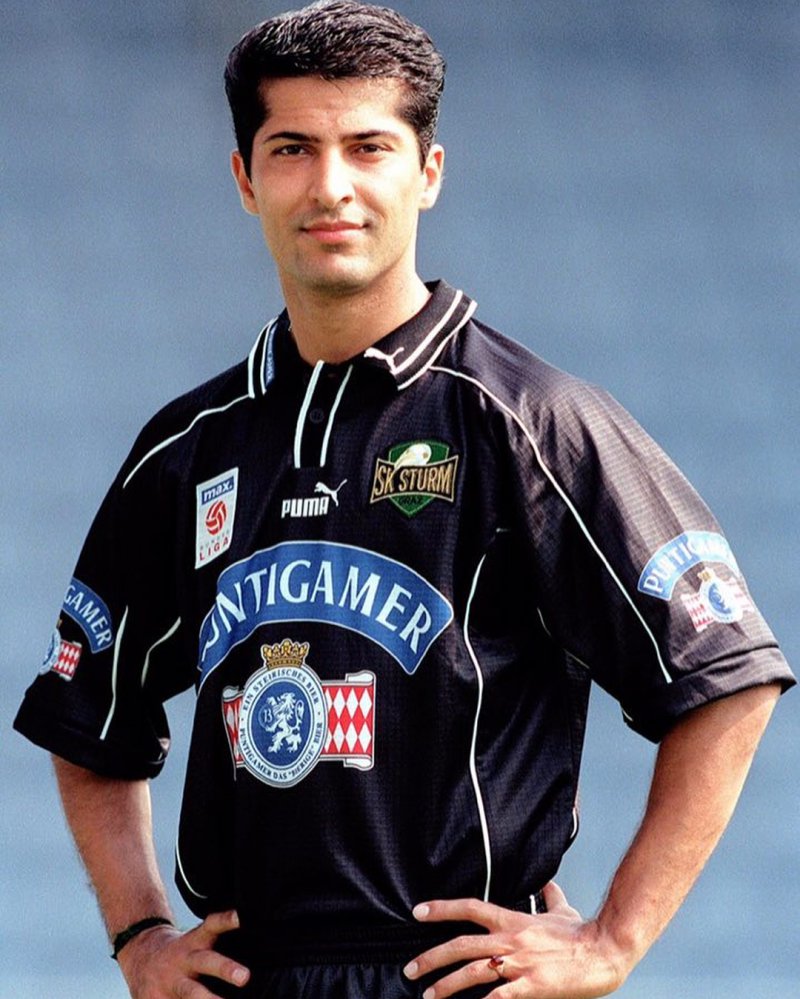
Minavand is the first Iranian player to play in the Champions League when he was in Strum Graz, this is before the likes of Ali Daei, Ali Karimi, Mehdi Mahdabikia and Karim Bagheri, all of whom were his teammates in the 1998 World Cup.

Reza Ghoochannejhad scores a hat trick for PEC Zwolle in the Eredivisie.

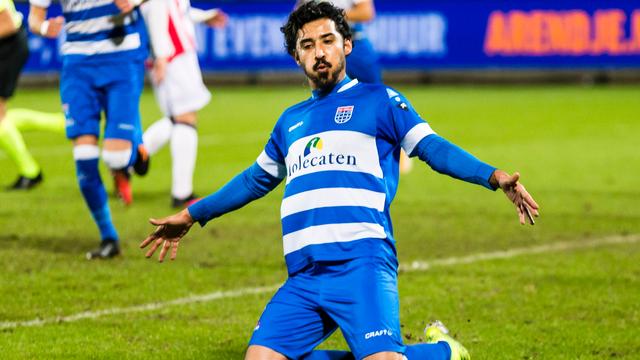
The former Team Melli and current PEC Zwolle forward Reza Ghoochannejhad (33 years) scored a hat-trick in the match against Willem II to lead his team to a 3-1 victory in the Dutch Eredivisie League.

 Ghoochannejhad was substituted in at the start of the second half and scored his opener in the 58th minute to level the match after the first half ended with host Willem II leading by a goal to nil. He scored again four minutes later to put his team ahead 2-1.

On the 70th minute,  PEC Zwolle was awarded a penalty which Reza Ghoochannejhad took and score to complete his hat-trick.

It was a major performance for the Iranian forward whose appearance has been limited for his team. He has scored 5 goals so far and this hat trick should improve his chances for more minutes in the future. PEC Zwolle is ranked 11th in the table. Ghoochannejhad joined PEC Zwolle in September 2019 and has played 26 matches scoring 9 goals in two seasons.

Ghoochannejhad played his last game for Team Melli in a friendly international in Azadi against Uzbekistan. The match ended 1 – 0 for Iran.

Ghoochannejhad played a total of 43 games for Iran scoring 17 goals in a career from October 2012. 

Two Team Melli legionnaires shine for their teams.

It was another sweet week for Team Melli player in Europe.

Yesterday, Mehdi Taremi was the Man of the Match for FC Porto in the 3-1 win against FC Famalicão

Porto got themselves started with Taremi’s first-time goal in the 13th minute before the Iranian’s goal was canceled out seven minutes later through Jhonata Robert’s penalty. Sérgio Oliveira scored from the spot-kick too just moments later, dispatching Porto’s second of the night and giving his side a 2-1 lead going into the break.

Mehdi Taremi once again displayed his quality and added greater comfort to the visitors’ lead in the 57th minute, looping a header into an unattended net to grab a second for himself and make it 3-1.

Famalicão aimed for a final push but, in times of desperation, Porto proved to be ruthless on the counter, adding the finishing touches to a 4-1 victory with a precise drive from João Mário, fresh off Sérgio Conceição’s bench.

Taremi has scored 6 goals in the Primeira Liga so far for Porto.

Today, yet another nearly forgotten Team Melli player made the headlines for his team. Saman Ghoddos, assisted in the first goal while scoring the second and the winner for his club Brentford in the third round of the FA Cup in London.

Ghoddos, who is still not a fixed starter for the Championship side that is aiming to win promotion to the Premier League, has shown enough quality and skill to challenge for a starting place. In today’s match, he was chosen as the Man of the Match, and with this 2-1 win against Middlesbrough, Goddos has helped his team to a place in the FA Cup fourth round draw.

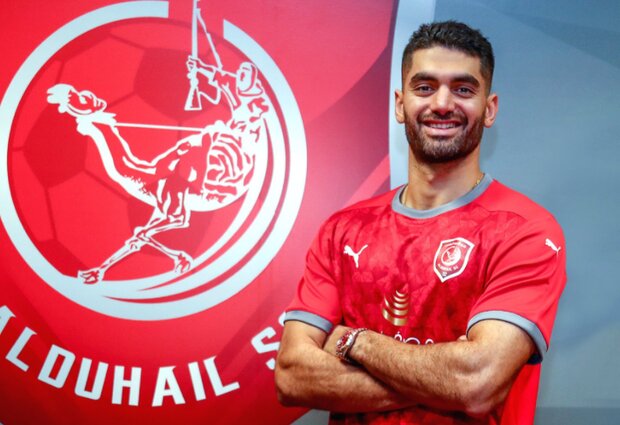
Ali Karimi Joins Al Duhail

 Ali Karimi, Team Melli, and former Esteghlal midfielder who was transferred to the Qatar Star League side, Qatar Sports Club at the beginning of the season, has moved on to Al Duhail. in the winter transfers on loan.

After former Persepolis midfielder Bashar Rasan joined Al-Qatar, the club’s officials removed Ali Karimi from the list and transferred him to Al-Duhail. Al-Duhail team is led by French “Sabri Lamoushi”. Previously, Ramin Rezaeian, Team Melli defender played half a season for Al-Duhail, but he was included in the surplus list and went to Al-Siliyah. Karimi replaces Rezaian in Al-Duhail, with whom he will play in the Club World Cup.

USA v Iran: The historic 2000 friendly match planned to bring countries together

  • By Mani Djazmi
  • BBC Sport

Paris, 11 July 1998. On the eve of the World Cup final, in a first-floor room in a building on the Champs-Elysees, an idea for a football friendly was hatched that would lead to death threats, an FBI decoy and the closure of American airspace.

That night, a media reception by US Soccer to promote the United States’ hosting of the 1999 Women’s World Cup was in full swing.

Mehrdad Masoudi was an Iranian coming to the end of his time working as the Canadian Soccer Association’s communications director. Hank Steinbrecher was the General-Secretary of US Soccer. In football federations and confederations, very little happens without the signature of the ‘GS’.

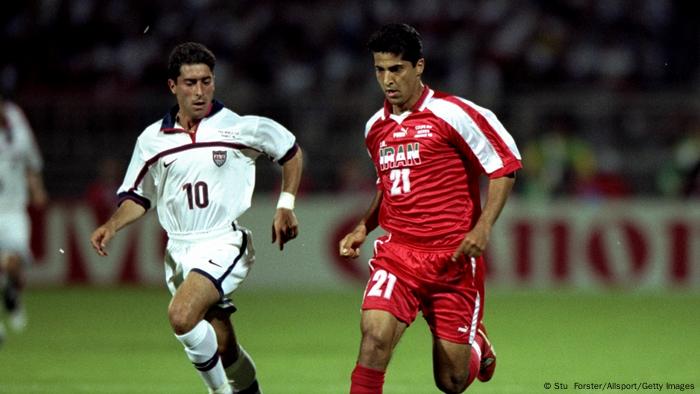
Three weeks earlier, the two men had been in Lyon to watch Iran beat the USA 2-1. This group-stage encounter was one of the most politically charged matches in World Cup history because of the enmity between the nations.

Iran had been under US sanctions since 52 diplomats were taken hostage in the American embassy in Tehran in 1979, the year of the Islamic Revolution that toppled the pro-American Iranian monarch, the Shah.

But on the day of the match, in a US presidential address, Bill Clinton said he hoped it would be a step towards “ending the estrangement between our nations”.

Meanwhile, before kick-off, the American players were showered with gifts from their opponents.

Irrespective of the result, the match had been a diplomatic triumph and the occasion was still fresh in the minds of Masoudi and Steinbrecher when they met, albeit for contrasting reasons.

“I said, ‘Hank, how about repeating that?'” says Masoudi, who was well connected in Iranian football and wanted to help facilitate another match between the nations.

“Home and away games. Iran to come to the US next year, on the anniversary of this match, and you go to Iran the following year.”

Steinbrecher liked the idea. And he saw another opportunity too.

“The World Cup match with Iran was the worst defeat during my tenure,” he says.

“We hit the post three times. We didn’t suffer from bad soccer, we suffered from bad citizenship during that tournament, so I wanted to make it right. They kicked our ass, let’s go kick their ass.”

There was also the optimistic hope of somehow bringing Iran and America closer through sport, as so-called ping-pong diplomacy had brought the United States and China closer in the 1970s.

With a handshake between Masoudi and Steinbrecher, the ball was rolling. Now they had to defy the political forces arrayed against them, and somehow make it roll up a mountain.

Short presentational grey line

“Fate brought the two teams together to play the France 98 match,” says Masoudi.

“This time, one side had to send an invitation to the other, who had to accept, and then both sides had to deal with their governments.”

The first, most sensitive and totally non-negotiable condition set by the Iranians was a waiver that would exempt the delegation from being fingerprinted and photographed on arrival in the United States.

“I have seen 80-year-old grandmothers going through that, I saw my own mother going through that,” says Masoudi.

“For someone who’s not used to it, it feels like they’re being treated like a criminal. I said to Hank, you have to talk to the State Department and US immigration to get an exemption.”

For Steinbrecher, this was the moment of realisation that an idea bounced around among canapes in Paris would have to negotiate an assault course of problems before coming to fruition in California.

“[It felt like] there was a crisis almost every hour,” he recalls. “It ranged from fingerprinting their players to the mullahs saying they’re not going to play the match because of alcohol advertising inside the stadium.

“There were many, many hurdles to jump through and luckily we were naive enough to think we were doing some good for mankind.”

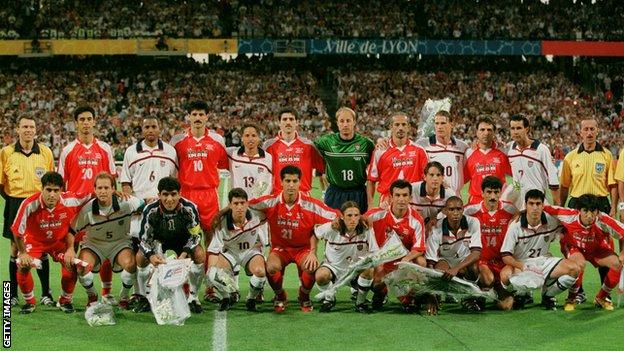
USA and Iran players pose for a joint team photo at France 98

Iran and USA players posed for a joint team photo and exchanged gifts before their World Cup meeting. Germany and Yugoslavia went through from their group

Originally, the first match was set for the summer of 1999 in Washington DC.

But the symbolism of playing in the city of the White House was too significant for the Iranian government, which did not authorise the team to travel to the United States.

Instead, the game was rescheduled for January 2000, at the Pasadena Rose Bowl in Los Angeles, home to more than 500,000 Iranians who have nicknamed it Tehrangeles. It would be the final match in a three-game tour after friendlies against Ecuador and Mexico.

But two months out, in November 1999, the fingerprinting issue had become a seemingly insurmountable crisis. Thom Meredith, who was director of events for US Soccer, called Masoudi with the news that an exemption could not be secured.

Instead, the players would be fingerprinted and photographed in a private area of the airport in Chicago.

“I said ‘Thom, this is an absolute no-no,'” recalls Masoudi. “If I tell Iran they will just cancel the games right now. The contract was signed on this condition and, as an Iranian, I wouldn’t even ask this.

“It would have given the people who didn’t want this to happen the excuse to stop the team from travelling.”

The solution lay with the US Department of State – effectively America’s Foreign Office. It remained intractable until a mysterious intervention saw the Iranians granted an exemption, with just weeks to go.

“I don’t know what the chain of command was at that time, but my opinion is that this went very high up [in the US administration],” says Steinbrecher, who had been so long frustrated by the apparatchiks.

“We got it done, they got it done. But they did not see things through the same prism as our federation. There were not many people in the State Department tasked with international diplomacy through sport.”

However, if Steinbrecher and his colleagues thought they were through the worst, they had reckoned without the complex machinery of the Iranian government, in which the president is not the biggest component.

As the new millennium dawned, and just days before Iran were due to fly, the next political crisis was played out in Tehran.

Hamid Estili (now Iran's Under-23 coach) poses outside his Tehran home after returning from the 1998 World Cup. He scored the opening goal in Iran's 2-1 win over USA
Hamid Estili (now Iran’s Under-23 coach) poses outside his home after returning from the 1998 World Cup. He scored the opening goal in Iran’s 2-1 win over USA

Under pressure from his political masters to pull the trip, Iran’s reformist president, Mohammad Khatami, told the president of Iran’s Football Federation, Mohsen Safaei Farahani, to call it off.

“But Safaei had signed the contract and US Soccer had secured the waiver so Iran was contractually obliged to travel,” says Masoudi.

“The games were against quality opposition, and they were making over $200,000 for [playing] three games. Iran had never been paid this much to play friendlies.”

Safaei Farahani stood firm. It was decided: the tour would go ahead. At this point, Thom Meredith became a key figure.

“I wasn’t the guy who contacted different countries and asked for friendlies,” says Meredith. “I was the guy who was told, hey, we’re playing the Iranians, figure it out.”

Meredith travelled to Frankfurt to meet the Iranian team as it transited en route to the United States. It was there, in the transit lounge, that he came face to face with crises of his own.

“There was an Iranian player who met the team in Germany, where he played,” remembers Meredith.

“He was leaving his club after this tour and he showed me his apartment key. He said, I need to return my key so I get my deposit back.

“I’m like, ‘what the hell am I going to do?’ I wrote on a piece of paper to the head of the delegation, ‘the United States Soccer Federation and Thomas P. Meredith take no responsibility for this player missing the flight.’

“He signed it, I signed it. It basically said, if he can’t get back to where we’re standing right now, in the transit zone, it ain’t Thom’s fault.”

The player did make it, but then, just before boarding the flight to Chicago, Meredith was told that nearly half the delegation had flights that had not been paid for.

“It was around 3am in Chicago. Who was I going to call? If I called somebody, what were they going to do? They’d probably hang up on me anyway,” says Meredith.

There was only one answer. He would have to foot the $13,000 bill himself (worth about £14,600 today), and keep the receipt somewhere very safe.

“My company credit card had a $5,000 limit. My personal credit card had a $30,000 limit. So I’m standing there, flipping the imaginary coin, thinking: ‘I’ve got to do this, but am I going to get my money back?'”

He did, as well as an upgrade to Business Class; reward for getting the relieved desk staff out of a serious hole.

For a few hours, the Iranian team were in the air, out of reach of destructive phone calls and on their way to America.

But when they landed at Chicago’s O’Hare airport, what everyone had prayed would not happen, happened.

“At immigration, we had a separate lane because they knew this was a special deal,” says Meredith.

“The agent started with the first guy, and they brought the ink pad out and said we need a fingerprint and we’re going to take your photo.

“Immediately, the head of the Iran delegation said: ‘We’re going home. We’re done. You lied.’

“I said, ‘Leave it with me, we’ve got this.'”

Like a conjurer, Meredith produced a letter from the head of the Chicago Immigration and Naturalisation Service, saying the Iranians were exempted.

So Iran’s footballers became only the second sporting delegation from the country, after a wrestling squad five years earlier, to set foot on American soil since the 1979 revolution.

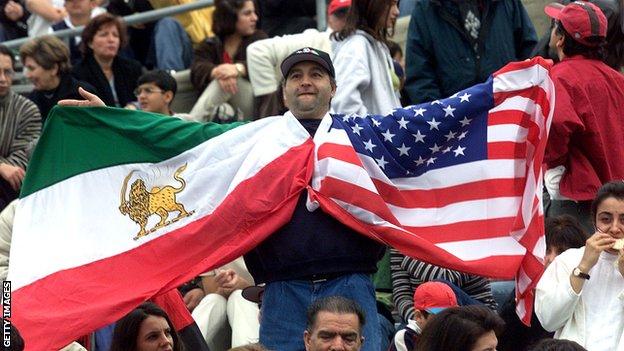
A man holds up the flags of Iran (the flag in use up to the revolution of 1979) and the United States at the 2000 friendly match between the nations
A fan watches on as USA and Iran meet in Pasadena. The Iran flag he’s holding is the one in use before the revolution of 1979

The players’ liaison officer was Iranian-American referee, Esfandiar Baharmast. In 1972, he had joined a growing number of Iranian students who moved to the United States. Despite his academic expertise in chemical engineering, football was his passion.

After his playing ambitions were ended by a serious knee injury, he became a referee and officiated at the 1998 World Cup. By January 2000, he had become director of referees at US Soccer. But as an Iranian football fan, he was living the dream.

“I was with the players the entire time,” he says. “From the moment they arrived to the day they got on the plane to leave.

“We took them on tours, we went shopping with them, anything that needed to be done. We went on a tour of Universal Studios, the Golden Gate Bridge and Lombard street in San Fransisco.

“I just wanted to make sure that they enjoyed themselves, and I have to give a lot of credit to both federations.

“Hank Steinbrecher was a real man of the world. He saw the importance of this thing and did everything possible to make their stay comfortable.

“The games are won and lost, but for me, it’s about humanity and to see that game played with peace and friendship made me more proud than anything. The whole idea was that in 90 minutes of football, we can move the relationship between the two countries years ahead.”

Now that the Iranians were finally on US soil, a covert security operation swung into action.

“We had people who were undercover, watching and knowing where we were at any given moment, but not in an intrusive manner,” says Baharmast.

“If you didn’t know they were there, you wouldn’t have known who they were.”

In their first two games, Iran beat Ecuador 2-1 and lost by the same score to Mexico, both times in front of raucous Iranian-American fans.

But as the match against the USA approached, joyous mingling turned into heightened awareness as danger slinked in the shadows.

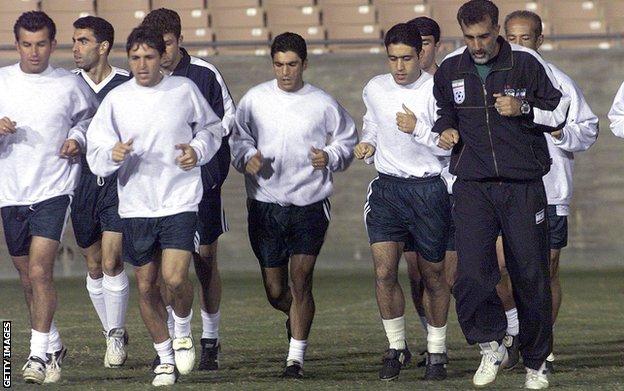
Iran's players training before their 2000 friendly match against USA at the Rose Bowl
Iran’s players training before their 2000 friendly match against USA at the Rose Bowl

The Iranians started receiving phone calls to their hotel rooms from a spurious Islamic group. Offers of bribes not to play and threats if they did were made.

“Two days before the match, the Iran coach Mansour Pourheidari said someone had called him and offered him $1m to pull out,” says Masoudi, who had taken leave from a new job in London to be with the team.

A call to Iranian football president Mohsen Safaei Farahani, claiming to be from the highest authority in Iran, threatened to down the delegation’s flight home if the match went ahead.

“I was there when he received this call,” says Masoudi. “He stood very firm and said: ‘The people you claim to represent know where I am. They have my phone number and they can call me directly themselves.'”

One theory, which was taken seriously, was that alcohol sponsorship at the match had offended the religious sensitivities of the threat-makers. The main match sponsor was due to be Anheuser-Busch, the company that brews Budweiser lager.

At a meeting on the eve of the match, the US Soccer Federation offered to switch to another sponsor.

“I said, well I know the guys at Anheuser-Busch, I’ll make good,” says then US Soccer General-Secretary, Hank Steinbrecher.

“I’ll give them more [advertising] signs another day. Nothing’s worth putting yourself at risk for, or this match.”

But Safaei Farahani adamantly rejected the offer.

“He said, as a soccer administrator, I know how difficult it is to bring sponsors onboard. The loss of an event is the loss of face for you with sponsors,” says Masoudi.

“I was translating and I had to hold back tears to finish the sentence.”

Steinbrecher recalls: “You want to talk about moral integrity? He showed me his colours. I have to tell you, he was a solid man.”

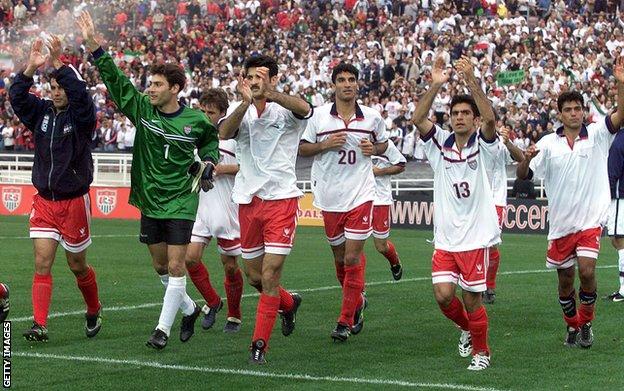
Iran players, wearing the USA shirts they have swapped, acknowledge the Rose Bowl crowd after their 1-1 draw

Nevertheless, steps were taken to protect the Iran players. Roads outside the team hotel were closed, and nobody was allowed to park near the hotel, apart from one vehicle, according to Masoudi.

“To make sure that the team wouldn’t be followed to the stadium, the FBI put a decoy bus outside the hotel, with ‘Iran’ branding,” he says. The actual team bus was kept out of sight in the hotel’s deserted underground car park.

The decoy, with fake footballers onboard, left first. As it began its journey, Iran’s national team was smuggled out through the kitchen and service lifts.

The Pasadena Rose Bowl had hosted two World Cup finals and the final of the 1984 Olympic football tournament. But it is doubtful any of those occasions had the singular atmosphere of this friendly.

In a move that now carries a chilling resonance given what was to come 18 months later on 9/11, the airspace above the stadium was closed in case someone was planning on flying a plane into it.

The tailgate parties that are a pre-match fixture of any American sporting event, when food and beer is served from cars, were all still there, but with a twist.

“Instead of steaks and burgers, it was Iranian kebabs,” says Masoudi.

“Outside the stadium, it looked like a typical NFL occasion. But when you got closer and saw the people and smelled the food, it was clear that this was an American outing organised by Iranians.”

One of the 50,181 fans present was Saeed Mousavian, who had travelled to Los Angeles from Colorado.

“How many times do you get to watch your national team play? There was a feeling that this might not happen again,” he says.

“At that time I had an American girlfriend. She went with me and painted her face with the American and Iranian flags. A blonde girl with the Iranian flag. And I made her wear the Iranian shirt as well.

“After the game, they asked one of the American players if he would like to go to Iran and play a friendly. He said, ‘We don’t need to because we were in Iran today.’

“It was just an awesome atmosphere. Everybody was happy. If the American team made a nice pass or tackle – even when they scored – we were cheering for it.

“I hated that they scored, but at the same time, it was a nice shot.”

It was Iran’s up-and-coming winger Mehdi Mahdavikia who struck first. Iran were then pegged back in the second half through midfielder Chris Armas’s equaliser. A 1-1 draw was the diplomatic result that couldn’t be exploited politically. But it didn’t help to thaw relations between Iran and the United States, as so many people had hoped it might, and tension remains between the nations today.

“We were naive,” says Steinbrecher. “We thought we were doing some really good things for both countries through our sport. But then again, if you’re not going to have a higher calling, you shouldn’t be involved.”

Short presentational grey line

The return fixture that was mentioned as part of the original plan is still to be played. The USA were invited to a tournament called The Civilisations Cup in January 2001, they to represent the new world and Iran, Egypt and Greece the old. Their appearance fee was unaffordable for the Iranian Football Federation.

Still, for its architects, the friendly match that began the new millennium with hope for a better future was not all in vain.

“I have on my floor a prayer rug which was a gift from the [Iranian] delegation,” says Thom Meredith.

“It’s one of my prized possessions. In fact, if I had a fire in my house, I would probably grab that as one of the things to get out the door.

“I’m very proud of being a part of it, as a student of history, geopolitics and sport.”

Everton rumors about Ali Daei

Everton FCIran

Once a Bundesliga goal scorer, soon in the Premier League?  Ali Daei.Once a Bundesliga scorer, soon in the Premier League? Ali Daei.imago images

The former Iranian international and Bundesliga pro Ali Daei is apparently about to return to international football. According to information from kicker, a club from England is interested in working with the 51-year-old current coach. Rumor has it that it is Everton FC. So far it remains unclear in which role Daei could work for the Premier League club.

The World Cup participant from 1998 and 2006 moved to Arminia Bielefeld a good 23 years ago together with his compatriot Karim Bagheri. From 1997 to 2002, the striker scored 19 goals in a total of 107 Bundesliga games for East Westphalia and then for FC Bayern and Hertha BSC. In the Iranian national team, the metallurgy engineer, who was born in Ardabil in northwestern Iran, achieved an unprecedented record: With 109 goals in 149 international matches, the multiple “world scorer” is still at the top of the ranking of all national players. The Portuguese Cristiano Ronaldo is currently hot on his heels as the first European to surpass the 100-goal mark in international matches in November. The Juventus star is currently at 102 goals.

Allahyar Sayyadmanesh scores the winner against in Leicester City Europa League

The young Team Melli striker Allahyar Sayyadmanesh came from the bench and scored the winner for his Team Zorya against a leading English Premier League side Leicester City.

Sayyadmanesh who was subbed in taking the place of Oleksander Galdkiy in the 84th-minute score after three minutes assisted by Denis Favorov.

Leicester tasted defeat for the first time in UEFA Europa League Group G on Thursday evening after the late 1-0 loss to Zorya Luhansk at Slavutych Arena in Zaporizhzhia in Ukraine

The goal from a low cross into the box from Denys Favorov was turned in at the back post by Allahyar Sayyadmanesh, who is on loan to Zorya from the Turkish club Fenerbahce.

Leicester City leads UEFA Europa League Group G on goal difference ahead of Portuguese club Braga. Zorya is third ahead of AEK athens who have Karim Ansarifard on their roster.