Tag: Esteghlal Club

Football and politics in Iran

Mehdi Taremi is the latest player to receive threats from Iran’s regime after criticising the conditions in his home country. Photograph: Anadolu/Getty Images

Mehdi Taremi is the latest player to receive threats from Iran’s regime after criticising the conditions in his home country. Photograph: Anadolu/Getty Images© Photograph: Anadolu/Getty Images

Story by John Duerden

 •The Guardian

Mehdi Taremi did what he does best. On Saturday, the Iranian striker turned inside the area and scored for Olympiakos, a well-taken eighth goal of the season for the 33-year-old that clinched a 2-0 win at Atromitos and a place at the top of the Greek Super League. Usually, millions of people in Iran follow every step of Taremi’s European career, one that took off with Porto and has settled in Piraeus via Milan, but not this time.

The ruling regime in Tehran has cut the internet and all communications, which meant that residents of the football-loving nation also missed the non-celebration that followed. “It actually has to do with the conditions in my country,” Taremi said. “There are problems between the people and the government. The people are always with us, and that’s why we are with them. I couldn’t celebrate in solidarity with the Iranian people. I know that Olympiakos fans would like me to be happy, but I don’t celebrate the goals, in solidarity with what the Iranian people are going through.”

And what they are going through seems worse than at any time since the 1979 Islamic Revolution deposed the Shah and put Ayatollah Khomeini in power. Surging inflation and a collapsing currency have sparked major anti-government protests and unrest across Iran. The response has been brutal. The ruling regime is clinging on to power by dealing out death, more repression and an internet blackout that has lasted for days. WhatsApp messages remain with one tick, emails are undelivered and websites are unreachable. For the millions of people outside the country with loved ones inside, there is fear and worry.

Football has always occupied a central place in Iran, a country where the government, like many authoritarian regimes, is wary of the power of mass gatherings and their potential to turn political but is also ready to use success for its own ends. When Iran qualified for the 1998 World Cup, players were told to delay their return so celebrations could subside, and in a vital 2010 qualifier, several wore green armbands in support of the opposition leader Mir Hossein Mousavi during protests over a disputed election. Mahmoud Ahmadinejad, the declared winner, visibly tied himself to the team, visiting training sessions and lending his presidential plane for World Cup qualifiers, while at home most clubs remain closely linked, directly or indirectly, to the state.

Speaking out is not easy. Ali Daei, like Taremi a cultural icon, backed protests in 2022 and subsequently saw his family prevented from leaving the country. During the last World Cup, which coincided with nationwide protests following the death of Mahsa Amini – a 22-year-old woman arrested for allegedly wearing her hijab improperly – former national team defender Voria Ghafouri was detained for, according to the Fars News Agency, “spreading propaganda against Iran”.

Last week, Ghafouri, the former captain of 10-time champions Tehran Esteghlal, reportedly announced that he was closing his cafes in the capital in solidarity with the protesters. IranWire, a news outlet run by Iranian journalists in exile and citizen reporters inside the country, reported that Fars had warned of repercussions. “These unrests will soon come to an end, but the real test for officials of the football federation will begin afterwards, when they must show that calls for chaos will receive a firm response.”

Threats against Taremi may not work. Few Iranians are better known internationally. Despite once being seen as a supporter of the regime, it seems as though the player has evolved since making a name for himself at Tehran giants Persepolis. Taremi has criticised the state of facilities back home, including the capital’s iconic Azadi Stadium, and has asked why there is a reluctance to allow big crowds to gather. He was the leader of the team at the 2022 World Cup that did not sing the national anthem in the first game with England, an act repeated on 7 January in the Under-23 Asian Cup in Saudi Arabia when the Iranian team kept quiet before their fixture against South Korea.

In Qatar three years ago, the players and head coach, Carlos Queiroz, grew frustrated at what they saw as constant questions from western media on the protests back home, rather than football issues, and demanded to know why counterparts went unquizzed. “Why don’t you ask the other coaches?” Queiroz said. “Why don’t you ask Southgate: ‘What do you think about England and the United States that left Afghanistan and all the women alone?’”

Now there is a desire for more questions and more information with Iran cut off from the world. At the weekend, Queiroz took to social media with a post that included a line attributed to the influential Tehran-born poet Ahmad Shamlou, born 100 years ago last month. “Freedom is breathing in an air where there is no lie.”

“To all Iranian people, My beloved Players, Staff and Friends,” Queiroz added, “I have spent many years among the Iranian people – players, staff, families, friends – and I know their dignity, warmth, and resilience. My heart and thoughts are with the people of Iran during these difficult but challenging days of hope. I am deeply concerned for their safety and well-being.”


Esteghlal out of AFC Champions League !

The never-ending saga of humiliation of Iranian football hit another low when Esteghlal one of the two bipolar clubs of Iran was kicked out of the AFC Champions League competition for the second season in a row after failing to comply with the competition’s regulations and maintaining its professional status.

The club which is owned and managed by the Government of Iran has failed to submit proof of compliance in time plus the failure of the club to settle a dispute with a former Italian coach, Andrea Stramaccioni. In November 2020, The International Federation of Association Football (FIFA) ordered Esteghlal to pay 1,350,000 euros to its former coach Andrea Stramaccioni. The Italian coach had a very brief, but eventful, spell at Esteghlal from June to December 2019.

The AFC’s decision to exclude Esteghlal from this season’s AFC Champions League was a bitter pill to swallow not only among its own huge supporters base but also among the rest of the Iranian fans. Many experts believe it is a warning sign for football in general as incompetent management and the derelict hierarchy at the top have become a recipe for a disaster negatively affecting every corner of Iranian football.

 The main culprit of this event is the Ministry of Youth and Sports, the authority which is directly responsible for Esteghlal and Persepolis including the appointment of their chairmen and board members plus, more importantly, the full financial backing.

Regardless of who was and is the CEO of Esteghlal, the club needed money to be able to solve problems including the payment and contractual obligation to staff members, players, and coaches. Promises were also given to Fathollahzadeh, who was recently appointed as the boss of the club and is reported to have accepted this responsibility on the condition of full financial support from the ministry and the clearing of all debts. That is another regrettable aspect of Iran’s football politics, false promises and outright lies which are quite common all across.

The ministry, however, turned its back on Esteghlal, an organization that has no other means of generating revenue in a country where the official broadcaster refuses to pay broadcast rights on national TV. The ambivalence and procrastination by the authorities in solving the problem have caused the fans to be more upset and more vocal with the officials of the Ministry of Sports. This issue has made them take a stand against the culprits in the stands of Azadi stadium where chants against the ministry and the government were repeatedly and frequently heard.

Currently, Esteghlal is coached by Portuguese coach Ricardo Sá Pinto. The two times winner of the older version of the AFC top club competition is still in the title run with a close contest from Sepahan and Persepolis, however, the Portuguese have not been paid for many months and despite his professionalism, at one stage, he like the rest of foreign coaches, will draw the line and calls it a quit. It is a familiar pattern in Iran’s football.

The coaches then file a case with FIFA and almost all such cases end up with the Iranian sides losing and paying hefty fines on top of all the dues for the coaches.

A vicious circle that, unfortunately, has no sign of ending.

Management issues are slowly but surely destroying the very essence of Iran’s football. A pride footballing nation that has achieved everything in Asian football including an unprecedented three consecutive times winning the Asian Cup, qualification to the Olympics (3+1), and winning four Asian Youth titles. That was all before the revolution though

The last time Iran won the Asian Cup was in 1976 (47 years)

The last time Iran won the Asian Youth Cup (U20)  was in 1976 (47 years)

The last time Iran qualified for the Olympics football competition was in 1980 (43 years)

The saving grace remains Team Melli’s excellent record in qualifying for the FIFA World Cup.

Iranian female fans allowed entry into Azadi Stadium

About 500 Esteghlali female fans were allowed entry into Azadi Stadium in the third week of the Persian Gulf Premier League game.

Esteghlal played Mes Kerman on Thursday in the first match of the third week of the premier football league. This match is the first appearance of women in League games as excited female spectators arraives at the gates of Azadi Stadium as early as three hours before the game’s kick-off. 500 tickets were allocated for the women’s section and were sold on the spot, but over 50 female fans were unable to get tickets. This group gathered around the entrance gate number 21 on the east side of Azadi Stadium in the hope of gaining entry.

It is reported that 30 of the female fans who did not hold tickets, finally managed to sneak in with the help of the gatekeepers and staff. While some lucky ladies were able to enter Azadi Stadium by different means, nearly 20 of them failed despite their efforts. Meanwhile, some crooks took advantage of the women’s desperation to attend the match in Azadi Stadium and sold men’s section tickets, while these tickets were of no use to the women.

Before the start of the game, the female fans strongly cheered Esteghlal players. Also, Esteghlal Head Coach Sapinto and Esteghlal’s bench walked towards the females’ section before the kickoff, where they were greeted by the cheering female fans. During the game, the men cheered on both sides of the stadium with the help of the women. In addition to cheering for the late Esteghlal coach Mansoor Pourheidari in the 22nd minute,

It was a momentous occasion for the female fans of Esteghlal who finally managed to break the ban, albeit thanks to the threat by FIFA to suspend Iran football for breaking its regulation by not allowing women into stadiums.

Although allocating 500 seats for females in a 100,000-capacity stadium seems to be lacking, it is a good start for the passionate Iranian female fans who were colorful and cheering, energizing the stadium despite their small numbers.

FIFA’s ultimate warning to FFIRI on government interference!

The former vice-president of the Esteghlal Club says that all the people who have led the Iranian football for the past four years should be held accountable for their infractions and the damage to Iran’s reputation.

Ali Khatir, former vice-president of the Esteghlal Club and former deputy secretary-general of the FFIRI, in an interview with ISNA, commented on FIFA’s refusal to recognize FFIRI’s statutes and the election results. In 2019 FIFA’s letter referring to paragraphs 14 and 15 of the FFIRI Statute, the world football ruling body warned the Iranian Football Federation that its statute is not in line with the FIFA statute, and referred to paragraph 15. FIFA demanded that all deficiencies and findings which were mentioned by FIFA in the year 2017 after the review of Iranian federations are still not corrected and hence are still not valid and in violation of FIFA regulations and bylaws. Khatir was the Deputy Secretary-General of FFIRI at the time when the FIFA letter was sent.

He added: “FIFA has even given the federation the opportunity to commission a few experts to come and assist FFIRI and amend the statute to be in line with international laws. FIFA meticulously examined our Statute word by word, and even sent its own proposed amendments in 2018, FFIRI management did not respond and there was no follow-up.  Article 15 of the FIFA Statute contains a number of principles such as the independence of the federation, the separation of authorities,  responsibilities n the structure of the federation, financial transparency, and a number of other items that the Iranian Football Federation Statute must include in its statute.

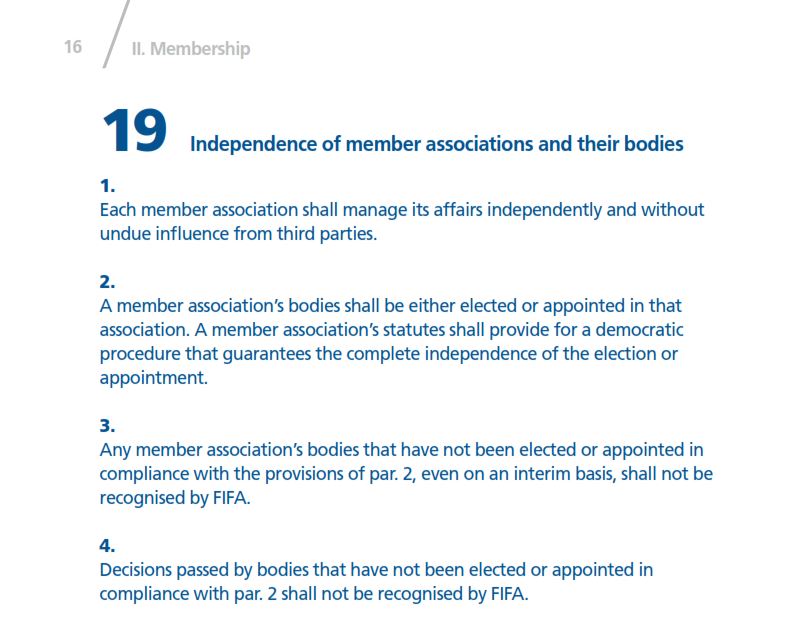
The last letter submitted by FIFA warns FFIRI that if those rules were not followed and applied, FIFA may suspend FFIRI and even withdraw its recognition. The letter even mentions paragraph 19 of the FIFA Statute, which states that a third party (the government or the Ministry of Sport and Youth) should not be influential in the affairs of the federation. The federation must be independent and run directly or indirectly without anyone’s intervention from the state, government or officials of the government. However, in Statute of the FFIRI, there is a clause that allows governments to vote and be members of the Assembly or board of directors. That is a clear and flagrant violation of international laws. The hint had already been given to the Football Federation but they did not respond to FIFA’s directives for reasons they knew best or feared the Ministry of Sports will almost certainly cut all financial support, but now FIFA stands firm and says that if elections are held under such statutes, it will not be recognized by FIFA and possible sanction will follow”.

He continued: “The federation had sent a letter to FIFA on February 9th asking them to hold the election, but FIFA reminded FFIRI of what had transpired before, saying that FFIRI had wasted two years and not replied to our correspondences under the pretext of amending the statute. You didn’t. We even sent a representative to you on August 9 and emailed you five times. Now that you want to hold these elections, we are against it. We must first amend the statute and pass it in an urgent assembly. In this regard, FIFA says that the federation should submit a regular plan and roadmap to the international ruling body”

About the government’s involvement in the sport for the sake of funding the football, Khatir said: “Article 19 of the FIFA Statute explicitly states that the government has no right to interfere in any shape or form in football, even if it wants to provide financial support or sponsor it. We have accepted this, and the government must accept that the Football Federation is an independent public body a non-government organization, subject to the laws of the country but not controlled, influenced or interfered in by the Ministry of Sport. The head of the Football Federation is not an employee of the Ministry of Sports.”


“We have reached a dead-end in football that we need to be able to get out of,” Khatir recalled. “The only way out is compliance and cooperation. I believe that all the people who have led this football for the past four years and who have stumbled into this game should be held accountable for their appalling performance. They need to explain and justify their non-actions.

The former deputy chairman of the Esteghlal Club stated at the end: “Gentlemen of the Federation, you have been at the helm for eight years and you have not been able to make a positive difference to our football. Open the way for the elite and motivated youth to take over. The statute needs to be amended to open the way for the elite in football to benefit football.”