Author: admin

Ali Karimi Joins Al Duhail

 Ali Karimi, Team Melli, and former Esteghlal midfielder who was transferred to the Qatar Star League side, Qatar Sports Club at the beginning of the season, has moved on to Al Duhail. in the winter transfers on loan.
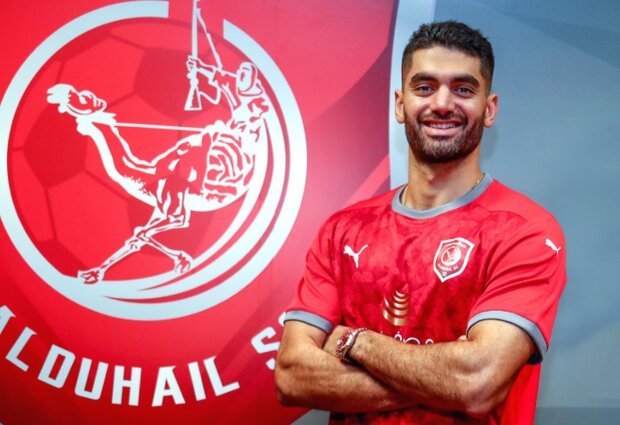
After former Persepolis midfielder Bashar Rasan joined Al-Qatar, the club's officials removed Ali Karimi from the list and transferred him to Al-Duhail. Al-Duhail team is led by French "Sabri Lamoushi". Previously, Ramin Rezaeian, Team Melli defender played half a season for Al-Duhail, but he was included in the surplus list and went to Al-Siliyah. Karimi replaces Rezaian in Al-Duhail, with whom he will play in the Club World Cup.

USA v Iran: The historic 2000 friendly match planned to bring countries together

  • By Mani Djazmi
  • BBC Sport

Paris, 11 July 1998. On the eve of the World Cup final, in a first-floor room in a building on the Champs-Elysees, an idea for a football friendly was hatched that would lead to death threats, an FBI decoy and the closure of American airspace.

That night, a media reception by US Soccer to promote the United States' hosting of the 1999 Women's World Cup was in full swing.

Mehrdad Masoudi was an Iranian coming to the end of his time working as the Canadian Soccer Association's communications director. Hank Steinbrecher was the General-Secretary of US Soccer. In football federations and confederations, very little happens without the signature of the 'GS'.

Three weeks earlier, the two men had been in Lyon to watch Iran beat the USA 2-1. This group-stage encounter was one of the most politically charged matches in World Cup history because of the enmity between the nations.

Iran had been under US sanctions since 52 diplomats were taken hostage in the American embassy in Tehran in 1979, the year of the Islamic Revolution that toppled the pro-American Iranian monarch, the Shah.

But on the day of the match, in a US presidential address, Bill Clinton said he hoped it would be a step towards "ending the estrangement between our nations".

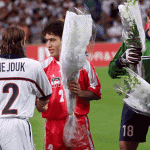
Meanwhile, before kick-off, the American players were showered with gifts from their opponents.

Irrespective of the result, the match had been a diplomatic triumph and the occasion was still fresh in the minds of Masoudi and Steinbrecher when they met, albeit for contrasting reasons.

"I said, 'Hank, how about repeating that?'" says Masoudi, who was well connected in Iranian football and wanted to help facilitate another match between the nations.

"Home and away games. Iran to come to the US next year, on the anniversary of this match, and you go to Iran the following year."

Steinbrecher liked the idea. And he saw another opportunity too.

"The World Cup match with Iran was the worst defeat during my tenure," he says.

"We hit the post three times. We didn't suffer from bad soccer, we suffered from bad citizenship during that tournament, so I wanted to make it right. They kicked our ass, let's go kick their ass."

There was also the optimistic hope of somehow bringing Iran and America closer through sport, as so-called ping-pong diplomacy had brought the United States and China closer in the 1970s.

With a handshake between Masoudi and Steinbrecher, the ball was rolling. Now they had to defy the political forces arrayed against them, and somehow make it roll up a mountain.

Short presentational grey line

"Fate brought the two teams together to play the France 98 match," says Masoudi.

"This time, one side had to send an invitation to the other, who had to accept, and then both sides had to deal with their governments."

The first, most sensitive and totally non-negotiable condition set by the Iranians was a waiver that would exempt the delegation from being fingerprinted and photographed on arrival in the United States.

"I have seen 80-year-old grandmothers going through that, I saw my own mother going through that," says Masoudi.

"For someone who's not used to it, it feels like they're being treated like a criminal. I said to Hank, you have to talk to the State Department and US immigration to get an exemption."

For Steinbrecher, this was the moment of realisation that an idea bounced around among canapes in Paris would have to negotiate an assault course of problems before coming to fruition in California.

"[It felt like] there was a crisis almost every hour," he recalls. "It ranged from fingerprinting their players to the mullahs saying they're not going to play the match because of alcohol advertising inside the stadium.

"There were many, many hurdles to jump through and luckily we were naive enough to think we were doing some good for mankind."

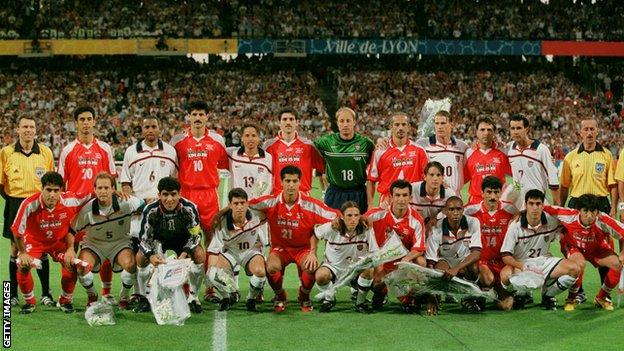
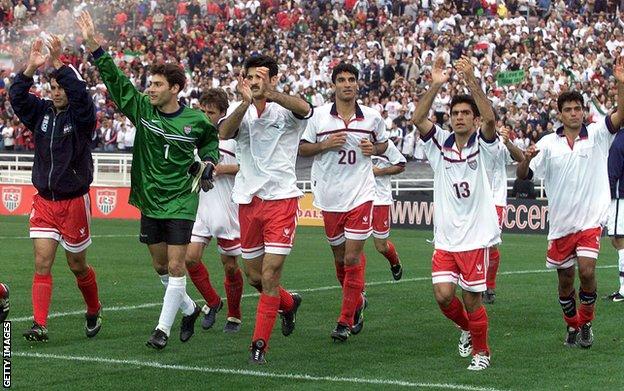
USA and Iran players pose for a joint team photo at France 98
Iran and USA players posed for a joint team photo and exchanged gifts before their World Cup meeting. Germany and Yugoslavia went through from their group

Originally, the first match was set for the summer of 1999 in Washington DC.

But the symbolism of playing in the city of the White House was too significant for the Iranian government, which did not authorise the team to travel to the United States.

Instead, the game was rescheduled for January 2000, at the Pasadena Rose Bowl in Los Angeles, home to more than 500,000 Iranians who have nicknamed it Tehrangeles. It would be the final match in a three-game tour after friendlies against Ecuador and Mexico.

But two months out, in November 1999, the fingerprinting issue had become a seemingly insurmountable crisis. Thom Meredith, who was director of events for US Soccer, called Masoudi with the news that an exemption could not be secured.

Instead, the players would be fingerprinted and photographed in a private area of the airport in Chicago.

"I said 'Thom, this is an absolute no-no,'" recalls Masoudi. "If I tell Iran they will just cancel the games right now. The contract was signed on this condition and, as an Iranian, I wouldn't even ask this.

"It would have given the people who didn't want this to happen the excuse to stop the team from travelling."

The solution lay with the US Department of State - effectively America's Foreign Office. It remained intractable until a mysterious intervention saw the Iranians granted an exemption, with just weeks to go.

"I don't know what the chain of command was at that time, but my opinion is that this went very high up [in the US administration]," says Steinbrecher, who had been so long frustrated by the apparatchiks.

"We got it done, they got it done. But they did not see things through the same prism as our federation. There were not many people in the State Department tasked with international diplomacy through sport."

However, if Steinbrecher and his colleagues thought they were through the worst, they had reckoned without the complex machinery of the Iranian government, in which the president is not the biggest component.

As the new millennium dawned, and just days before Iran were due to fly, the next political crisis was played out in Tehran.

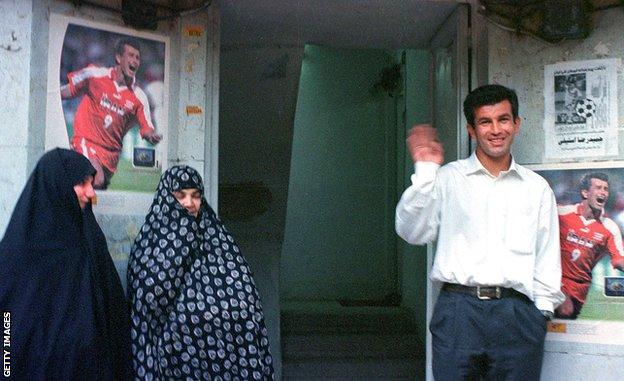
Hamid Estili (now Iran's Under-23 coach) poses outside his Tehran home after returning from the 1998 World Cup. He scored the opening goal in Iran's 2-1 win over USA
Hamid Estili (now Iran's Under-23 coach) poses outside his home after returning from the 1998 World Cup. He scored the opening goal in Iran's 2-1 win over USA

Under pressure from his political masters to pull the trip, Iran's reformist president, Mohammad Khatami, told the president of Iran's Football Federation, Mohsen Safaei Farahani, to call it off.

"But Safaei had signed the contract and US Soccer had secured the waiver so Iran was contractually obliged to travel," says Masoudi.

"The games were against quality opposition, and they were making over $200,000 for [playing] three games. Iran had never been paid this much to play friendlies."

Safaei Farahani stood firm. It was decided: the tour would go ahead. At this point, Thom Meredith became a key figure.

"I wasn't the guy who contacted different countries and asked for friendlies," says Meredith. "I was the guy who was told, hey, we're playing the Iranians, figure it out."

Meredith travelled to Frankfurt to meet the Iranian team as it transited en route to the United States. It was there, in the transit lounge, that he came face to face with crises of his own.

"There was an Iranian player who met the team in Germany, where he played," remembers Meredith.

"He was leaving his club after this tour and he showed me his apartment key. He said, I need to return my key so I get my deposit back.

"I'm like, 'what the hell am I going to do?' I wrote on a piece of paper to the head of the delegation, 'the United States Soccer Federation and Thomas P. Meredith take no responsibility for this player missing the flight.'

"He signed it, I signed it. It basically said, if he can't get back to where we're standing right now, in the transit zone, it ain't Thom's fault."

The player did make it, but then, just before boarding the flight to Chicago, Meredith was told that nearly half the delegation had flights that had not been paid for.

"It was around 3am in Chicago. Who was I going to call? If I called somebody, what were they going to do? They'd probably hang up on me anyway," says Meredith.

There was only one answer. He would have to foot the $13,000 bill himself (worth about £14,600 today), and keep the receipt somewhere very safe.

"My company credit card had a $5,000 limit. My personal credit card had a $30,000 limit. So I'm standing there, flipping the imaginary coin, thinking: 'I've got to do this, but am I going to get my money back?'"

He did, as well as an upgrade to Business Class; reward for getting the relieved desk staff out of a serious hole.

For a few hours, the Iranian team were in the air, out of reach of destructive phone calls and on their way to America.

But when they landed at Chicago's O'Hare airport, what everyone had prayed would not happen, happened.

"At immigration, we had a separate lane because they knew this was a special deal," says Meredith.

"The agent started with the first guy, and they brought the ink pad out and said we need a fingerprint and we're going to take your photo.

"Immediately, the head of the Iran delegation said: 'We're going home. We're done. You lied.'

"I said, 'Leave it with me, we've got this.'"

Like a conjurer, Meredith produced a letter from the head of the Chicago Immigration and Naturalisation Service, saying the Iranians were exempted.

So Iran's footballers became only the second sporting delegation from the country, after a wrestling squad five years earlier, to set foot on American soil since the 1979 revolution.

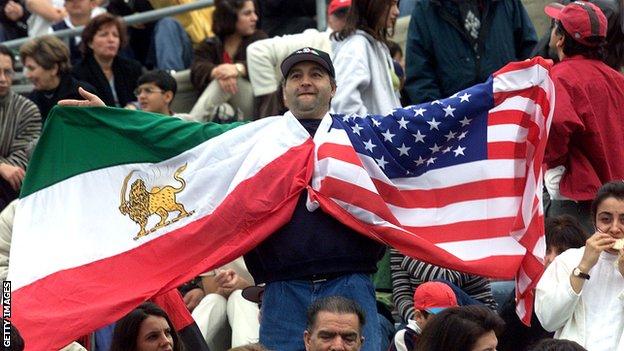
A man holds up the flags of Iran (the flag in use up to the revolution of 1979) and the United States at the 2000 friendly match between the nations
A fan watches on as USA and Iran meet in Pasadena. The Iran flag he's holding is the one in use before the revolution of 1979

The players' liaison officer was Iranian-American referee, Esfandiar Baharmast. In 1972, he had joined a growing number of Iranian students who moved to the United States. Despite his academic expertise in chemical engineering, football was his passion.

After his playing ambitions were ended by a serious knee injury, he became a referee and officiated at the 1998 World Cup. By January 2000, he had become director of referees at US Soccer. But as an Iranian football fan, he was living the dream.

"I was with the players the entire time," he says. "From the moment they arrived to the day they got on the plane to leave.

"We took them on tours, we went shopping with them, anything that needed to be done. We went on a tour of Universal Studios, the Golden Gate Bridge and Lombard street in San Fransisco.

"I just wanted to make sure that they enjoyed themselves, and I have to give a lot of credit to both federations.

"Hank Steinbrecher was a real man of the world. He saw the importance of this thing and did everything possible to make their stay comfortable.

"The games are won and lost, but for me, it's about humanity and to see that game played with peace and friendship made me more proud than anything. The whole idea was that in 90 minutes of football, we can move the relationship between the two countries years ahead."

Now that the Iranians were finally on US soil, a covert security operation swung into action.

"We had people who were undercover, watching and knowing where we were at any given moment, but not in an intrusive manner," says Baharmast.

"If you didn't know they were there, you wouldn't have known who they were."

In their first two games, Iran beat Ecuador 2-1 and lost by the same score to Mexico, both times in front of raucous Iranian-American fans.

But as the match against the USA approached, joyous mingling turned into heightened awareness as danger slinked in the shadows.

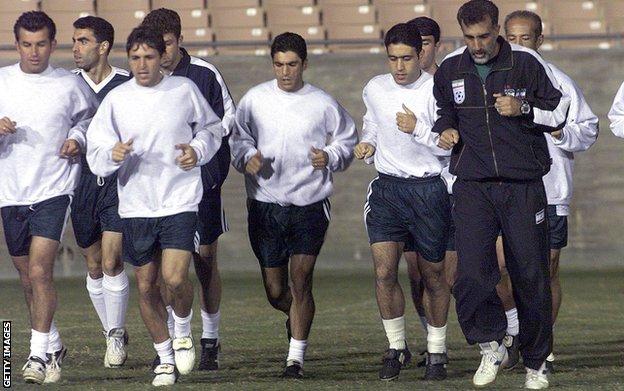
Iran's players training before their 2000 friendly match against USA at the Rose Bowl

The Iranians started receiving phone calls to their hotel rooms from a spurious Islamic group. Offers of bribes not to play and threats if they did were made.

"Two days before the match, the Iran coach Mansour Pourheidari said someone had called him and offered him $1m to pull out," says Masoudi, who had taken leave from a new job in London to be with the team.

A call to Iranian football president Mohsen Safaei Farahani, claiming to be from the highest authority in Iran, threatened to down the delegation's flight home if the match went ahead.

"I was there when he received this call," says Masoudi. "He stood very firm and said: 'The people you claim to represent know where I am. They have my phone number and they can call me directly themselves.'"

One theory, which was taken seriously, was that alcohol sponsorship at the match had offended the religious sensitivities of the threat-makers. The main match sponsor was due to be Anheuser-Busch, the company that brews Budweiser lager.

At a meeting on the eve of the match, the US Soccer Federation offered to switch to another sponsor.

"I said, well I know the guys at Anheuser-Busch, I'll make good," says then US Soccer General-Secretary, Hank Steinbrecher.

"I'll give them more [advertising] signs another day. Nothing's worth putting yourself at risk for, or this match."

But Safaei Farahani adamantly rejected the offer.

"He said, as a soccer administrator, I know how difficult it is to bring sponsors onboard. The loss of an event is the loss of face for you with sponsors," says Masoudi.

"I was translating and I had to hold back tears to finish the sentence."

Steinbrecher recalls: "You want to talk about moral integrity? He showed me his colours. I have to tell you, he was a solid man."

Iran players, wearing the USA shirts they have swapped, acknowledge the Rose Bowl crowd after their 1-1 draw

Nevertheless, steps were taken to protect the Iran players. Roads outside the team hotel were closed, and nobody was allowed to park near the hotel, apart from one vehicle, according to Masoudi.

"To make sure that the team wouldn't be followed to the stadium, the FBI put a decoy bus outside the hotel, with 'Iran' branding," he says. The actual team bus was kept out of sight in the hotel's deserted underground car park.

The decoy, with fake footballers onboard, left first. As it began its journey, Iran's national team was smuggled out through the kitchen and service lifts.

The Pasadena Rose Bowl had hosted two World Cup finals and the final of the 1984 Olympic football tournament. But it is doubtful any of those occasions had the singular atmosphere of this friendly.

In a move that now carries a chilling resonance given what was to come 18 months later on 9/11, the airspace above the stadium was closed in case someone was planning on flying a plane into it.

The tailgate parties that are a pre-match fixture of any American sporting event, when food and beer is served from cars, were all still there, but with a twist.

"Instead of steaks and burgers, it was Iranian kebabs," says Masoudi.

"Outside the stadium, it looked like a typical NFL occasion. But when you got closer and saw the people and smelled the food, it was clear that this was an American outing organised by Iranians."

One of the 50,181 fans present was Saeed Mousavian, who had travelled to Los Angeles from Colorado.

"How many times do you get to watch your national team play? There was a feeling that this might not happen again," he says.

"At that time I had an American girlfriend. She went with me and painted her face with the American and Iranian flags. A blonde girl with the Iranian flag. And I made her wear the Iranian shirt as well.

"After the game, they asked one of the American players if he would like to go to Iran and play a friendly. He said, 'We don't need to because we were in Iran today.'

"It was just an awesome atmosphere. Everybody was happy. If the American team made a nice pass or tackle - even when they scored - we were cheering for it.

"I hated that they scored, but at the same time, it was a nice shot."

It was Iran's up-and-coming winger Mehdi Mahdavikia who struck first. Iran were then pegged back in the second half through midfielder Chris Armas's equaliser. A 1-1 draw was the diplomatic result that couldn't be exploited politically. But it didn't help to thaw relations between Iran and the United States, as so many people had hoped it might, and tension remains between the nations today.

"We were naive," says Steinbrecher. "We thought we were doing some really good things for both countries through our sport. But then again, if you're not going to have a higher calling, you shouldn't be involved."

Short presentational grey line

The return fixture that was mentioned as part of the original plan is still to be played. The USA were invited to a tournament called The Civilisations Cup in January 2001, they to represent the new world and Iran, Egypt and Greece the old. Their appearance fee was unaffordable for the Iranian Football Federation.

Still, for its architects, the friendly match that began the new millennium with hope for a better future was not all in vain.

"I have on my floor a prayer rug which was a gift from the [Iranian] delegation," says Thom Meredith.

"It's one of my prized possessions. In fact, if I had a fire in my house, I would probably grab that as one of the things to get out the door.

"I'm very proud of being a part of it, as a student of history, geopolitics and sport."

Everton rumors about Ali Daei

Everton FCIran

Once a Bundesliga goal scorer, soon in the Premier League?  Ali Daei.Once a Bundesliga scorer, soon in the Premier League? Ali Daei.imago images

The former Iranian international and Bundesliga pro Ali Daei is apparently about to return to international football. According to information from kicker, a club from England is interested in working with the 51-year-old current coach. Rumor has it that it is Everton FC. So far it remains unclear in which role Daei could work for the Premier League club.

The World Cup participant from 1998 and 2006 moved to Arminia Bielefeld a good 23 years ago together with his compatriot Karim Bagheri. From 1997 to 2002, the striker scored 19 goals in a total of 107 Bundesliga games for East Westphalia and then for FC Bayern and Hertha BSC. In the Iranian national team, the metallurgy engineer, who was born in Ardabil in northwestern Iran, achieved an unprecedented record: With 109 goals in 149 international matches, the multiple "world scorer" is still at the top of the ranking of all national players. The Portuguese Cristiano Ronaldo is currently hot on his heels as the first European to surpass the 100-goal mark in international matches in November. The Juventus star is currently at 102 goals.

Allahyar Sayyadmanesh scores the winner against in Leicester City Europa League

The young Team Melli striker Allahyar Sayyadmanesh came from the bench and scored the winner for his Team Zorya against a leading English Premier League side Leicester City.

Sayyadmanesh who was subbed in taking the place of Oleksander Galdkiy in the 84th-minute score after three minutes assisted by Denis Favorov.

Leicester tasted defeat for the first time in UEFA Europa League Group G on Thursday evening after the late 1-0 loss to Zorya Luhansk at Slavutych Arena in Zaporizhzhia in Ukraine

The goal from a low cross into the box from Denys Favorov was turned in at the back post by Allahyar Sayyadmanesh, who is on loan to Zorya from the Turkish club Fenerbahce.

Leicester City leads UEFA Europa League Group G on goal difference ahead of Portuguese club Braga. Zorya is third ahead of AEK athens who have Karim Ansarifard on their roster.

Azmoun hat tricks for Zenit again.

Team Melli central forward, Sardar Azmoun has scored a hat trick for his club Zenit St. Petersburg in today's Russian Premier League match against Ural. The match ended 5-1 to Zenit with Sardar adding an assist and winning a penalty on top of scoring the hat trick.

Sardar Azmoun scored two goals in the first half, the first from a power header (17th minute) and the second goal five minutes later with a beautiful flick to the far side of the keeper. He also won a penalty after dribbling his marker and being illegally stopped by the second defender.  Artem Dzyuba scored the spot-kick in the 30th minute.

Just before halftime, Azmoun provided an assist to Douglas Santos who slotted from close range.

In the second half, there were a few chances created for Azmoun that were cleared by the Ural defenders before a penalty was called after a foul on Douglas Santos. Sardar took the penalty and wrong-footed the keeper to score his second hat trick in Zenit's colors. Sardar was substituted on 81" and was picked up as the Man of the Match with a near-perfect score.

Azmoun has suffered a long absence from football since October due to a positive COVID19 result. He has featured in recent matches including the UEFA Champions League vs Club Brugge.

This was by far the most productive match that Sardar Azmun has played in his career. He is now heading the top scorers of the Russian Premier League with 9 goals. The Iranian international is breaking all sort of records set up by his compatriots in Europe including those of legends like Ali Daei and Mehdi Mahdavikia.

BOSNIA vs IRAN 0-2 :perfect record for Skocic

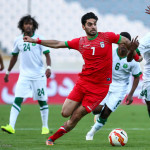
Team Melli defeated Bosnia & Herzegovina 0-2 in Asim Ferhatović Hase Stadium, Sarajevo. The first half ended goalless. In the second half, Kaveh Rezaei scored the first in the 46th Minute, While in the dying minutes 90+2, the substitute Mehdi Ghayedi scored Iran's second.  

 Bosnian star player Miralem Pjanic was supposed to be given a rest to prepare him for the crucial match against Italy, but it seems that the coach had cold feet and needed the Barcelona midfielder to inject some experience and creativity against Iran,

Both teams played open football with Iran having a slight advantage over the host in ball keeping. In the second match under Dragan Skočić, the Croatian picked a well-balanced team in the absence of at least half a dozen regular Team Melli starters.

Despite the pre-match statement of the Bosnian coach, who reckoned that Iran's defense was vulnerable,  this match proved otherwise. Shoja'a Khalizadeh and Hossein Kannanizadegan formed a sold wall in the center while Mohammadi and Sadegh Moharrami were excellent on the flanks. Team Melli hardly worked to their maximum and managed to easily thwart the Bosnian offensive moves. Whatever filtered from the defenders, Abedzadeh masterly controlled his goals with perfect timings and solid catches. The Maritimo keeper is certainly becoming a serious contender for the number one spot in goal ahead of Beiranvand.

Iran played a balanced game and was clearly better prepared than the host. In the first 15 minutes, Team Melli could have been at least 2 goals up if it was not for the brave Bosnian keeper Jasmin Buric who saved Kaveh Rezaei from a close-range shot after Kaveh robbed the ball in the penalty area and was face to face with the keeper. Minutes later, Ali Gholizadeh had just one defender to beat for a clear shot of the gaping goal, in a similar situation but could not dribble past his marker. And finally, Vahid Amiri was beaten in a split of a second when he also was face-to-face with the Buric.

In the second half, Team Melli started unchanged. IN the first minute, Amiri, who robbed the ball on the right flank from the Bosnian defender, found Rezaei just outside the box and he squared the pass to him. After taking a couple of steps, Kaveh Rezaei picked his spot on the opposite end of the gaol and sent a delicious curler that beat two defenders and the keeper into the net. It was a world-class strike by Chreloi forward. Several changes in the team and the same with Bosnia changed the rhythm and the pace slightly, but both continued the offensive gameplay in what was an entertaining encounter. Saeed Ezatolahi made the team after a long absence and his presence was felt. He could have made a much better pass for Team Melli to score on the counter, but his poor pass was intercepted robbing Iran of a goal. Otherwise, his towering presence and energy were quite refreshing for the team. Mehdi Ghayedi was introduced late, and the Esteghal tiny forward scored Iran's second with another cracking half volley on the far side of the keeper to make it 2-0 for Team Melli in the dying minutes

It was a very good performance by Team Melli. The defense line quite assuring, while u front, Gholizadeh, and Rezaei, teammates in Chareloi were quite a threat and made Bosina defenders work hard against them. The only concern about the excellent team arranged by Dragan Skocic was the midfield. which was ineffective and lacked depth the skills to be effective. In big games, that lack of creativity could bite back badly. Omid Noorafkan and Ezatollahi's introduction improved the midfield, Noorallahi was a disappointment.

In reality, there was no midfield as the balls traveled directly to the forwards from the keeper or defenders to utilize the speed of the flanks and Rezaei limiting the effectiveness of the midfield.

Overall, it was an excellent performance and a perfect record for the Croatian head coach who is assisted by Vahid Hashemian. This performance augurs well for the team in the qualifiers that will start again in March 2012.    

FIFA World Cup 2022 qualifiers date agreed upon.

Kuala Lumpur: The dates for the Asian Qualifiers for the FIFA World Cup Qatar 2022 and the AFC Asian Cup China 2023, were approved by the AFC Competitions Committee at their third meeting for the 2019-2023 cycle, which was held online and chaired by Dr. Tran Quoc Tuan. It was agreed that all the Asian Qualifiers Round 2 matches should be completed by June 15, 2021 with Match Day 7 and 8 in March 2021 and Match Day 9 and 10 in June 2021 with the Final Round of the Asian Qualifiers beginning in September 2021. FIFA Matchdays in March 2021 is from 22nd to 30th March, while the June window starts from 30th May to 8th June. Team Melli has 4 matches left, away to Cambodia and home to the other 3 teams. It is currently in third place with 6 points behind Iraq and Bahrain. It was agreed, in collaboration with FIFA, that the 10 matchdays of the Asian Qualifiers Final Round should be finished by the end of March 2022 with the Asian and Inter-Continental Play-offs proposed for the FIFA Window May/June in 2022. The Asian Play-off for the FIFA World Cup Qatar 2022 is proposed as a single match. The AFC U23 Asian Cup 2022 bidding process was also agreed upon. The tournament was originally scheduled for China PR in 2022 as a preparatory competition ahead of the AFC Asian Cup 2023 but the Chinese Football Association (CFA) has now informed the AFC they are no longer able to stage the tournament. Now the Committee has agreed that the hosting process for the 2022 and 2024 AFC U23 Asian Cup editions will be reopened to Member Associations in the West with the intention of the 2026 tournament again providing preparation for the AFC Asian Cup in 2027. It is intended that all future AFC U23 Asian Cups in non-Olympic years will be hosted by the Member Association staging the subsequent AFC Asian Cup while the competition dates for the AFC U23 Asian Cup 2022 will be further discussed.   The Competition Regulations for the AFC Champions League 2021 and the AFC Cup 2021 were approved. The new calendar for the AFC Cup 2021 was also approved while there would be further discussions on match dates and competition formats for the AFC Champions League 2021 with all stakeholders in the coming days. The Committee also agreed that the previously postponed AFC U-19 Championship will be staged in Uzbekistan between March 3 to 20, 2021 and they also accepted changes to the eligibility rules for the AFC U-16 Championship Bahrain to allow players born on or after January 1, 2004 to play in the tournament. The dates for the AFC U-16 Championship, also postponed from 2020, are to be further discussed.

Iran - Bosnia; Without key players.

The national teams of Iran and Bosnia will face off in an international friendly match this evening in Sarajevo. Both teams will be without key players in the lineup.

The match is the first since that memorial encounter in the 2014 FIFA World Cup in Brazil.

The match (Thursday) at 20:30 Tehran time (18:00 local time) at Asim Farhatovic Stadium is held on FIFA Day allowing many countries the chance to test their players. For many football fans, this match is a reminder of the one between the two teams in the 2014 World Cup in Brazil, where the game ended with a score of 3 - 1 in favor of the European rival, but in the end, neither team managed to advance from the group.

In the latest FIFA rankings, Iran is 29th while Bosnia-Herzegovina is 51st. Continentally, Iran is the second-ranked team in Asia while and Bosnia is ranked 30th in Europe. The most crucial point of this game is the absence of many Bosnian key players either enforced due to injuries but mainly due to an attempt by the coach to give more opportunities to domestic young players and several players playing in Eastern European countries. In this match, the Bosnian coach will give a rest to stars such as Miralem Pjanić, Sead Kolašinac, etc. in preparation for the game against Italy and the Netherlands.

Ehsan Hajsafy

The biggest absentee of the game is Edin Dzeko, the star of Italian AS Roma, who is absent due to Coronavirus. Also, three players and two members of the Bosnian technical staff are in the same situation as Dzeko and lost this game. In Team Melli, the illness of Mojtaba Najarian and Sasan Ansari prevented them from joining the squad hence missing the match. Mehdi Shiri and Ali Karimi are the replacement players.

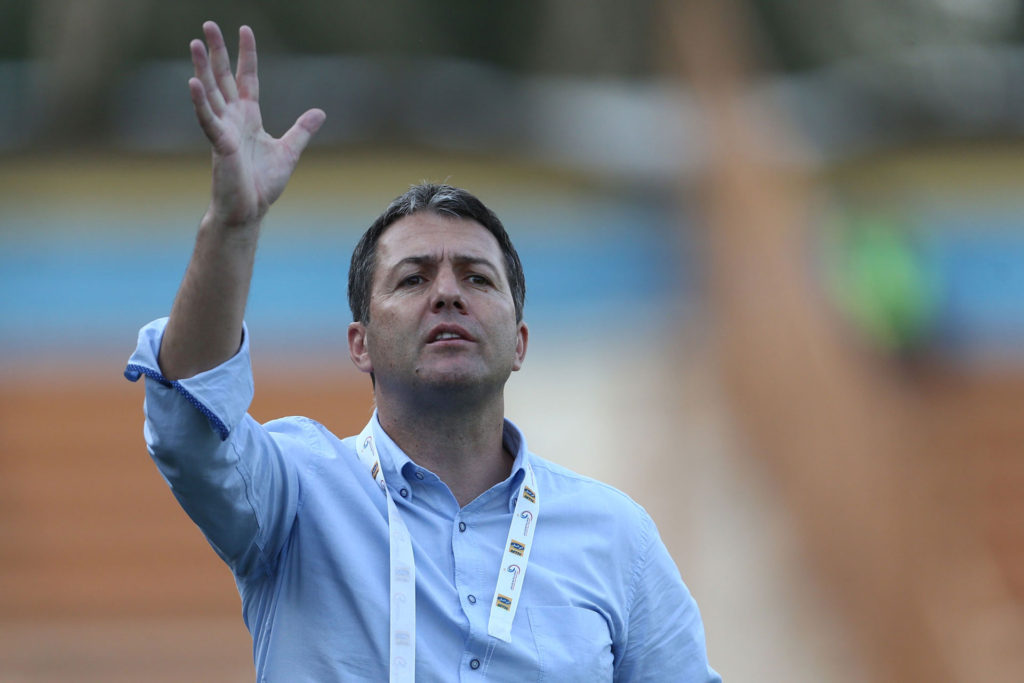
The team coach Dragan Skocic, who is going through his second camp with Iran, has invited a list of domestic league players to the squad. There is a significant list of key players who will miss this match such as Azmoun, Taremi, Ghoddos, Jahanbakhsh, Beiranvand, Mohebbi, Torabi, Ghafouri, Rezaian, and so on.

However, despite being criticized, the national team coach hopes to win this friendly: "I know Bosnia well and I am aware of the strengths and weaknesses of this team. We want to win against them on and off the field. I wish Bosnia success in his next games, but we want to beat this team in the next game."

In the first game since Dragan Skočić, took over, Team Melli defeated Uzbekistan 2-1 away from home to mark a positive start and hope for an impressive run for the Croatian coach's tenure. Team Melli will be in Bosnia from Monday night and will return to Tehran after Thursday's match and will not have any more friendly matches, which is due to the perpetual weakness of the Iranian federation in arranging friendly matches.

The Bosnian national football team suffered a recession after the 2014 World Cup and could not qualify for Euro 2016 or even the 2018 World Cup. Bosnia did not qualify for Euro 2021 recently, so the trail of failure is still hanging around Bosnia disappointing its fans. However, in the second round of the Europa League, they reached the highest level of competition and are in a group consisting of the Netherlands, Italy, and Poland. Bosnia collected 2 points only from its first 4 games. However, with several of the squad members playing professionally in European leagues, they are still a serious benchmark for Iran.

 "In the game against Iran, we want to give some players a chance, specifically those who do not normally get playing time. This game is an opportunity to learn about the technical quality of the young and newly invited players," Dušan Bajević said of his team's condition before the friendly against Iran and Italy in the Europa League.

"They are playing in the Bosnian league, but they are not at the level of the players who play in the European leagues. However, the national team player must always be serious." The Bosnian coach also called Iran a strong team in the offensive line, but considered the national team's defensive line to be weak: "The Iranian national team has not been able to achieve the desired results in the past few years. They changed their coach. Skocic has taken over the reins of Iran and now he has only played one game while he was in charge on the bench. We analyzed Iran's friendly against Uzbekistan. They have good players in attack but weak in defense."

Iran vs. Bosnia: Historic lookback

The “A” national team of Bosnia and Herzegovina will play a friendly match with Iran national team in Sarajevo on 12th November.

B&H and Iran have met 6 times so far. Five matches were friendly, while the only competitive match was played at the 2014 World Cup in Brazil.

Iran is more successful in head-to-head matches, as it recorded 4 victories, while one match ended in a draw. The BH team achieved its only victory against Iran at the World Cup in Brazil.

These national teams met for the first time on 22nd July 2001 in Bihać, when they played a tie 2:2. Goals for Bosnia and Herzegovina were scored by Sead Seferović in the 7th, and Miroslav Dujmović in the 10th, while Sirous Dinmohammadi in the 16th and Iraj Fatemi in the 90th minute scored for Iran.

In the next 4 matches, Iran won. First at the Azadi Sports Stadium in Tehran on 10.08.2001 with the result 4:0 (Hasheminasab 5th and 90th, Karimi 65th, Daei 87th minute), then on 02.02.2005 at the same venue with 2:1 (Daei 38th, Borhani 74th – Elvir Bolić 18th minute).

The Azadi Sport Stadium hosted the fourth meeting between B&H and Iran on 31.05.2006. Iran won 5:2. The national team of Bosnia and Herzegovina had a 2:0 advantage in that match with goals scored by Zvjezdan Misimović in the 4th and Sergej Barbarez in the 17th minute, but the Iranians reversed the result through Mehrzad Madanchi (26th), Rahman Rezaei (45th), Vahid Hashemian 46th), Reza Enayatia (89th) and Rasoul Khatibi (90th minute).

The fifth match was played at the Asim Ferhatović-Hase Stadium in Sarajevo on 12.08.2009. And then Bosnia and Herzegovina took the lead with 2:0 with scored goals by Edin Džeko in the 52nd and 65th minute, but in the end, they were defeated with 2:3. Goals for Iran were scored by Masoud Shojaei in the 79th, Arash Borhani in the 86th, and  Andrenik 'Ando' Teymouriian in the 90th minute.

The last match of these teams was played on 25.06.2014 at the Fonte Nova Arena in El Salvador (Brazil) in the 3rd round of Group F of the World Cup. Bosnia and Herzegovina won 3:1, and the goals were scored by Edin Džeko in the 23rd, Miralem Pjanić in the 59th, and Avdija Vršajević in the 83rd minute. The only goal for Iran was scored by Reza Ghoochannejad in the 82nd minute.

The match will be played behind closed doors without the spectators at the Asim Ferhatović-Hase Stadium in Sarajevo on 12.11.2020.


Iran vs. Bosnia & Herzegovina Matches records

   
Venue Matches W D L Goals Goal Diff.
H 4 3 0 1 12 - 6 +6
A 2 1 1 0 5 - 4 +1
N 1 0 0 1 1 - 3 -2
Total 7 4 1 2 18 - 13 +5
 
Date Comp. H / A / N Final score Stadium Attendance
25.06.2014 FIFA World Cup / Group F N 1 - 3 Arena Fonte Nova, Salvador 48,011
12.08.2009 Friendly A 3 - 2 Asim Ferhatovic Hase Stadium - Sarajevo 20,000
31.05.2006 Friendly H 5 - 2 Azadi Stadium, Tehran 40,000
02.02.2005 Friendly H 2 - 1 Azadi Stadium, Tehran 10,000
10.08.2001 Others / LG CUP H 4 - 0 Azadi Stadium, Tehran 75,000
22.07.2001 Friendly A 2 - 2 Stadion NK Jedinstvo podno Boriæa , Bihac 5,000
12.09.1993 Friendly H 1 - 3 Azadi Stadium, Tehran

Skočić invites 23 player for the friendly vs Bosnia-Herzegovina

Iran will play Bosnia-Herzegovina on Nov. 12 at the Asim Ferhatović Hase Stadium in Sarajevo as part of the preparation for the 2022 World Cup qualifiers, where Iran are currently third behind Iraq and Bahrain.

The ‘Persian Leopards’ defeated Uzbekistan in the last friendly international 2-1 on Oct. 8 in Tashkent. The 2022 World Cup qualifiers scheduled this year were postponed to 2021 due to the coronavirus pandemic.

The major absentees from the list are Sardar Azmoun, Mehdi Taremi, Saman Ghoddos, and Ashkan Dejagah.

Meanwhile, the captain of Bosnia and Herzegovina Edin Dzeko will miss the friendly against Iran after he tested positive for the coronavirus. The AS Roma forward will miss coming matches against Iran on November 12 and the Netherlands on November 15. The 34-year-old player opened Iran’s goal in the 2014 FIFA World Cup, where the Dragons beat Iran 3-1.

Team Melli Squad

Goalkeepers: Amir Abedzadeh (Maritimo), Payam Niazmand (Sepahan), Rashid Mazaheri (Esteghlal)

Defenders: Majid Hosseini (Trabzonspor), Hossein Kanaani-zadegan (Persepolis), Shoja Khalilzadeh (Al Rayyan), Aref Gholami (Esteghlal), Sadegh Moharami (Dinamo Zagreb), Milad Mohammadi (Gent), Mojtaba Najarian (Foolad), Morteza Pouraliganji (Shenzhen)

Midfielders: Ehsan Haji Safi (Tractor), Ahmad Nourollahi (Persepolis), Omid Noorafkan (Sepahan), Ali Gholizadeh (Charleroi), Vahid Amiri (Persepolis), Siamak Nemati (Persepolis), Akbar Imani (Tractor), Saeid Ezatolahi (Vejle Boldklub)

Forwards: Kaveh Rezaei (Charleroi), Mehdi Ghaedi (Esteghlal), Karim Ansarifard (AEK Athens), Sasan Ansari (Foolad)