Year: 2013

European scouts show interest in Iranian young talents.

The corridors of Dubai and Abu Dhabi hotels where the U-17 teams stayed for the FIFA U-17 World Cup was littered with European scouts and talent hunters in a bid to discover the next Messi or Christiano Ronaldo. The scouts, whose covert operation resembles the work of Major spy agencies and their reconnaissance always shrouded with secrecy, have been seen monitoring Iran’s U-17 camp.

Despite the secrecy, it was apparent that one or several Iranian youngsters are under the microscope. Dutch, German and French scouts have been asking questions and attending matches while preparing reports and dossiers about potential player that can be recruited at this age and trained professionally in Europe.

 Despite our best efforts, there was no firm indication on which of the Iranian players has been focused on or raised the interest of the Europeans.    Speculation was rife about one or two players that have attracted the interest of the scouts as potential recruits. The two players are Majid Hosseini  and Saeid Ezzatolahei. In fact , a British TV commentator was confident that the latter player has been approached by scouts , although he did not  disclose the source of his information.

The fact that young Iranians players are on the radar of the European clubs, is quite a motivating factor for the others to excel. Despite the sad loss to a much better team and technically accomplished Nigerian team, and the elimination from the championship, there were some sterling displays by the Iranian players in the 4 matches played. Individual skills, physical strength and some delicate footwork by the Iranian young players, impressed many observers.

Presence of Mehdi Mahdavikia amongst the Technical cadre of Iran’s U-17 team was also an attraction to the German scouts particularly. Mahdavikia a veteran of German football who played in the Bundesliga for the majority of his professional career was a popular star in Hamburg SV while playing for VfL Bochum and Eintracht Frankfurt  as well. Mahdavikia was a grat ambassador for Iranian football in Germany.

Saeid Ezzatolahei who was born in Anzali , is a member of Malavan Anzali club. His father Nader , was one of the senior Malavan players.
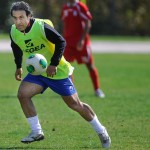
Mahdavikia: “the Nigerians were tremendous, Our team was shocked.”

Iran nigeria FIFA U-17


Mehdi Mahdavikia said the Nigerian team was tremendous  while our team was shocked in matter of few minutes .

After the crushing 4-1 defeat of Iran’s U-17 team in the FIFA U17 World Cup by Nigeria . Mahdavikia who was accompanying the team as an advisor admitted that the African team was way stronger than Iran. “in matter of minutes, the way the Nigerians played made our team fell apart. Nigeria had a very strong team. Their No. 11 player managed to run havoc on our defenses, and we had no answer for that. They were very professional and it was a deserving victory for the better team.” Mahdavikia said.

“Our players were not successful in playing a neat passing game and many of their passes fell short or intercepted by the opponents who created swift counterattacks and scored goals. Our players fell victim to their inexperience. We should accept that our opponents played much better than us. Their Height and figures looked like players above 17 years category .”

The former Captain of Team Melli : “I played soccer for many years but I do not know how can some of these Nigerian players can be less than 17 years !. There are a number of crucial factors at this level of football; stress and lack of experience are at the top. In this level, the young age and lack of experience sometimes makes it difficult for players to make the right decisions in time-critical situations.”

Mahdavikia in an interview with ISNA said that “the fact that the players reached the World Cup and qualified from group stage is in itself an achievement that we need to commend them and the coaching staff.  I believe congratulation is due. We need to face reality, our young players do not have a lot to offer and that is probably the most they could achieve at world level. Football in Iran does not pay much attention to the grassroots. Considering this, Doustimeher , his coaching team and his colleagues  did a marvelous and commending job creating this team in such adverse situations , to build a team to the World Cup after hard work lasting for three years “.

“After long consideration, I don’t think that Team Melli U-17 performed badly. We qualified from the group stage but faced a team like Nigeria which has the potential to reach the final. I believe that our team created an achievement under these circumstances. We tried our best to qualify but faced a strong team that we could not beat. Hopefully in the future our grassroots football is taken more seriously so that we can build better national teams. Again though, I believe that the work of the coaching staff to reach that far in the World Cup was a masterwork.”
Iran was eleimnated from the FIFA U17 World Cup in the 1/16 round by losing to Nigeria 4-1 in Al Ain.

Iran bid farewell to the FIFA U-17 World Cup

Iran U-17 bid farewell to the FIFA U-17 World Cup after losing 4-1 to Nigeria in Al Ain today.

The African champions scored 3 times in the first half and added a fourth in the second while Iran scored a consolation late in the second from a beautiful; volley bi Gholozadeh.

The Nigerians began the match very strongly and stamped their authority on the game from the first quarter of the match. It took Iran some time to settle. The consistent attacks by the skillful Nigerians resulted in two quick goals on the 23 and 25th minutes scored by   Samuel OKON (23′) and   Kelechi IHEANACHO (25′)  before   Musa MUHAMMED (42′) put the game beyond Iran’s reach with the third goal.

Iran was hopelessly outclassed in this half with the Nigerians showing some beautiful touches, lethal finishing and surprising stronger physical strength.

The second half started with Iran looking for a quick responses, but the erroneous passes and some route one football failed to make any inroads towards the Nigerian goal. The Africans however , looked like they were satisfied by the result and conserving energy for the next round , preferring to see the Iranians doing the attack.

However , Iran could not score and only one serious chance was created which was saved by the extended arms of the Nigerian keeper. TO make the matters worst for Iran , Musa YAHAYA  score Nigeria’s 4th in the 76 minute.

Iran scored the consolation by Ali GHOLIZADEH (84′) however, it was not enough to threaten the superiority of the Nigerians who were one class above Iran in every department.


Iran latest to feel Nigerian heat

© Getty Images

Three-time champions Nigeria had no trouble with Iran at the Khalifa Bin Zayed Stadium in Al Ain racking up three goals in the first half en route to a 4-1 scoreline. The result sets up a quarter-final date for the Nigerians with Uruguay, a game in which they will likely be missing two of their best attackers – Kalechi Iheanacho and Success Isaac – through injury.

Nigeria came out all guns blazing in the opening seconds. Iheanacho, who scored four goals in the opener on this very pitch, fired a vicious shot from the corner of the penalty area inside the first minute that only just flew over the bar. It wasn’t long after that Chidiebere Nwakali raced through midfield on the end of an elegant heel flick from Zaharaddeen Bello. His shot from way out, however, also went over the goal.

The pressure was mounting on Iran, who’d been so sturdy up to this point in the competition. Nigeria were attacking up both flanks and crossing dangerously, but the storm subsided and Iran began to get some touches on the ball. And when Nwakali tried to dribble the ball out of defence, he was stripped by Mohammad Bazaj, whose effort from a tight angle after 21 minutes was the Iranian’s first chance of the half.

All that did was make the Nigerians angry. The Eaglets were into the lead just seconds later when Musa Yahaya pulled off an outrageous move to leave his man for dead at the edge of the penalty area. He sent in a low diagonal ball to Samuel Okon, who sliced in from a tight angle. Two minutes later it was 2-0 for the Africans. Taiwo Awoniyi, on for the injured Success Isaac, pulled the ball across the 18-yard line for Iheanacho, who dispatched his fifth goal of the tournament. It would be the impressive No10’s last action, as he pulled his hamstring shortly after and signaled for a substitute.

Captain Musa Muhammed grabbed a third goal for Nigeria five minutes from the interval, taking advantage of some slack marking to burst into the area and score to make it 3-0 at the break.

The second half lacked the total attacking sparkle of the first, but the Nigerians remained in full control. In the 78th minute, Yahaya dropped his shoulder brilliantly again – pulling out his signature move – before firing low into the corner from 25 yards. Iran managed a consolation goal six minutes from time. Substitute Ali Gholizadeh scored from the edge of the box with the Nigerian defenders suffering from a bit of understandable complacency. It was clearly too little too late for Iran though, as Nigeria’s dominant performance will likely send a chill up the spine of Uruguay, who they will meet in the last eight.

Doustimehr “The match against Nigeria is an early final”

Al Ain (UAE)

After leading his team to the last 16 of the FIFA U-17 World Cup , Ali Doustimehr said that the match against Nigeria is an early final for them “We have not come here to this championship to leave empty handed. Our goal is to win and and make it all the way to the finals.”

In the pre-match press conference , Iran U-17 coach said “Nigeria is a strong team from every aspect , be it physical , mental and tactical. They have won several titles at this level and will be aiming to continue their championship trail. We will be facing a tough task , but that does not mean much to us as we have to give it our best regardless to whom we face.”

Asked whether there was any request by Iran to double check the age of the Nigerian players as many reports have indicated the possibility of Nigeria fielding over-aged players, Doustimehr said “That is FIFA’s duty. These championship is held every two years and FIFA has the necessary tools to control the validity of players’ ages. As far as I am concerned , the result of the match is the pitch not in the corridors of power. We will leave FIFA to decide on any outcome in these matters”

Mano Gabra, the Nigerian coach warned his team against complacency against Iran. “If we we make such mistake , we might end up stunned like Argentina found out playing against Iran.”

“Nigeria has won 3 titles and were runners up 3 times. The people of Nigerian are expecting a lot from us and we have to deliver.

Iran and Nigeria will be p[laying in Al Ain today for a place in the quarter finals of the FIFA U-17 Championship. Iran will be wearing their white Jersey while Nigeria is wearing their traditional green outfit.

FIFA has announced that the knock out stages will not have extra time in case of a tie in the regulation time of 90 minutes, a draw will lead to penalty kicks without the extra 30 minutes being played. FIFA attributed this change of rule to the possibility pf physical exhaustion of players at this age level.

Iran’s Hosseini on the defensive

(FIFA.com) Monday 28 October 2013
Share
Iran’s Hosseini on the defensive

© Getty Images

Iran’s road to the Round of 16 here at the U-17 finals in UAE was paved with defence. Scoring only three times in their three section games, the Persians have a clear tactical scheme. “We do everything we can to make sure we don’t let the opponents in,” captain and centre-back Majid Hosseini told FIFA.com about his side’s stingy stance.

But Hosseini knows better than anyone what awaits him in the first knockout round in Al Ain City: free-scoring Nigeria, a team as obsessed with attacking as the Iranians are with defending. “My attack is blistering,” was what the Golden Eaglets’ coach Manu Garba had to say before even kicking off here in the Emirates. And their 4.6 goals per game average shows he wasn’t just boasting. “We can destroy any team on our day.”

We know that they only need one second to hurt you, to score a goal from nothing.

Iran centre-back and captain Hosseini knows all about Nigeria

Iran undoubtedly have one of the best defenders of the tournament in Hosseini. Tall and quick of mind, the Saipa FC man is the general of a team that keeps it tight at the back and only rarely, at specific and carefully chosen moments, raids forward. He is vocal on the pitch, pivoting nimbly to adjust to situations as they arise, and he inspires his mates with his actions and his bravery in the danger-zone. He plays like a leader and he talks like one too.

But his forehead wrinkles when Nigeria’s 14 goals so far are mentioned. Hosseini’s face turns from that of spotty teenager to a worried and wizened old man when he considers the west Africans, three-time U-17 world champions. “It will be the hardest game so far for us; we can have no illusion about it,” he said of the Nigerians, who are rivalled only by Brazil for their attacking ability and, in Kalechi Iheanacho and Success Isaac, have two of the best strikers in the world for their age.

“Nigeria are a very strong team,” the Iran captain added, looking intently at his translator who turned his Persian into English. “We know about their attack. We know that they only need one second to hurt you, to score a goal from nothing. We know all of this,” he said, before pausing and putting a hand on the translator’s shoulder, looking into his eyes and making a point clearly and slowly: “But we have our strengths too.”

Switching the conversation from Nigeria’s varied attack, their dizzying brand of Total Football that’s been a delight for fans and a nightmare for opposition defenders, the Iran captain speaks of his team as a unit. And while Mostafa Hashemi and Yousef Seyyedi have scored two of the best goals at these these finals, individuals are spurned for the collective in the Iranian cause.

“Everybody in the team acts as a defender and when we do go forward we go forward as one,” said the 17-year-old, who led Iran when they were crowned champions of Asia earlier this year. “This is one of the secrets of our success. Our defenders, all of us, are close friends and we support each,” he added about the esprit de corps in the side. “When we get into trouble, there’s always someone to help out.”

Freedom meets form in desert duel
And while Nigeria’s coach gives his players what he calls “a special freedom,” Iran’s stern-looking boss Al Doustimehr gives his team orders. “We listen to our coach because by listening to him we have arrived here at the World Cup, and now into the knockout rounds,” said Hosseini, his mates waiting for him in a pack near the team bus. “Our coach will look at the Nigeria tapes and he will tell us what to do. And if we’re smart, we’ll listen.”

Few who have seen Group F toppers Nigeria in action will hold out much hope for Iran, who’ve never gone past the last 16 at a U-17 World Cup. But captain Hosseini isn’t bothered by being underdog and his confidence in his own ability – and his team-mates – is strong. His thoughts even go beyond the Nigerians. “Our goal is the last four,” he said. “We outlined this before the tournament started and we can still do it.”

First they will have to find a way to neutralise one of the best attacking teams the U-17 World Cup has ever seen. The captain’s mind turns to his home country for the kind of backing-up he preaches in his team, but on a larger scale. “We’ve felt positive energy coming from home,” he said, his eyes turning glassy with emotion. “We want to make the Iranian people happy and we’ll give everything we have against Nigeria to do it.”

Whether that will be enough for the brave Iranians will be only be known at the Khalifia bin Zayed Stadium on Tuesday night, when two contrasting styles and temperaments collide in the desert.

3rd place for Futsal Team Melli in Brazil’s Grand Prix 2013

Iran won the third place play off against Paraguay in the 2013 Grand Prix. While Brazil won the title after defeating Russia in the final match on penalty kicks. The match ended 2-2 in regular time , and 3-3 in the extra time.


Team Melli did not have much problem winning 6-2 against the South Americans who have earlier given Brazil a tough time in the semi finals.

Iran finished the first half comfortably ahead with a 3-0 result.

Ghodrat Bahadori , one of the stars of Iran futsal team in this championship scored 4 goals for Iran , while Farhad Fakhim and Javad Asghari scored the other two.

Richard Mendoza and Gabriel Ayala scored Paraguay goals.


Grand Prix 201327/10/2013 – 07.00 Local Time
Maringá (Brazil)

Iran Paraguay
6 – 2  (3 – 0)
Match details:

Hall: Ginásio Chico Neto

Futsal Team Melli fails to make it to the final.

Maringá (PR)

Iran’s Futsal Team Melli failed to make it to the final after losing the semi final match against Russia.

In the second semifinal of the Brazil Futsal Grand Prix 2013 , Russia beat Iran by 4-2 and qualified to the final match against host Brazil . The Russians went ahead in the 13th minute of the first half goal from Milovanov after pass from Brazilian-born Russian Cyril . Six minutes later , Shayakhmetov extended Russia’s lead , closing the halftime score at 2-0 .

In the second period , Hassanzadeh played for Iran as line goalkeeper to pressure the Russians and look for a goal to recover the two goals deficit. An  oversight by advancing Iranian goalkeeper allowed  Gustavo kick to find the Iranian empty net at 12th minute to score Russia’s third – the ball has touched the crossbar before entering . At 15th minute , Iran came back into the game when Tayebi  scored to make it 3-1 and the match was on again, however a minute later , Fakhrutdinov scored again for Russia , throwing a bucket of cold water in the reaction of the Iranian players who were looking good. In the final minute , Bahadori scored for Iran to make it 4-2 but it was too late .

Russians celebrating a goals against Iran in the semi-fnal mach of 2013 Futsal Grand Prix.

Iran will play Paraguay for the third place against on Sunday at 7pm . On Friday , Argentina and Guatemala competed for  fifth. est The Argentines , won 2-1 . In the match for the seventh place , Serbia beat Japan by 7-4 .

Lineups :
Russia: Gustavo , Romulus , Milovanov , Cyril and Antoshkin . Entered : Pereverzev , Fakhrutdinov , Shayakhmetov , Shisterov , Eder Lima .

Coach: Sergey Skorovich .

Iran : Nasirniae , Vafaie , Hassanzadeh , Tavakoli and Tayebi .

Entered : Bahadori , Hasannejed , Asghari Moghadam , Shafiee , Fakhim , Daneshvar and Kiaei .

Coach: Jesus Candelas .

‘There is no better ambassador than football’: Meet the US soccer coach in Iran


By Alexander Smith, NBC News contributor

One American enjoys a unique view of life in Iran – from the sidelines of Tehran’s main soccer stadium typically packed with more than 100,000 screaming fans.

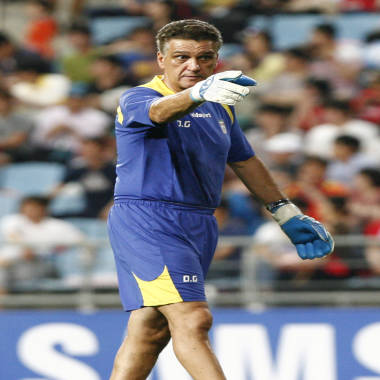
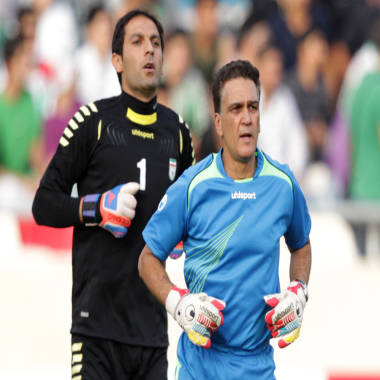
Dan Gaspar, 58, is the assistant coach of the Iranian national soccer team.

“My experience is not one I’ve seen on TV or read in a newspaper. I live here, it’s real life,” said Gaspar.

“It may sound strange to most people, but I’ve worked on four continents and Iran is one of the safest places I’ve worked in,” he said. “When I read and hear and see things through the media and then go out to the balcony of my apartment and look into Tehran that is not what I see.”

‘No negative reactions’ 
Gaspar, who spends all but six weeks of the year living in Tehran, says the typical American representation of Iran as an isolated place does not resemble his experience.

“You would be surprised, it is very multicultural, far more than I had anticipated,” he said. “In the apartment complex I live in you often see lots of other internationals.”

Socially, Gaspar says he spends time with the other staff on the soccer team, cooking meals for each other at home. Although, he did speak highly of Tehran’s restaurant scene.

“I have eaten Mexican food, I have eaten Italian food, French food,” he said. “There are no bars and no night-life, publicly, so going out to restaurants is a big part of the way people socialize. Their restaurants are of a high standard, compared to any other country in the world.”

While conceding that the universally warm reception he has received may have something to do with his involvement in the increasingly successful national team, he said he’s generally had a positive experience.

“Out and about in the city, when people discover that I’m an American they are interested by it,” he said. “It opens up a discussion, in a positive way.  I have had no negative reactions.”

Winding path to Tehran 
Gaspar took a winding path to Tehran. He began coaching in the 1970s in the amateur soccer leagues in Connecticut. From there, he went on to several roles in Portugal — Gaspar has duel Portuguese-American citizenship and is multilingual — before returning in 1996 for a stint on the staff at the New York Metro Stars, where he reached the MLS playoffs.

He has also worked in Japan’s J-League and in South Africa. But it was working under head coach Carlos Queiroz on the Portuguese national team which offered his unusual avenue to Tehran.

Queiroz is something of a legend in coaching circles, having won trophies at Real Madrid and Manchester United. But he was fired as head coach of Portugal in 2010 after allegedly insulting an anti-doping team attempting to take samples at his training ground.

In April 2011 Queiroz was announced as Iran’s new head coach — quite a coup for a relatively small soccer nation — and he asked Gaspar to come with him as his assistant and goalkeeping coach.

“Professionally I felt this was an incredible and interesting challenge. It’s a unique opportunity,” Gaspar said.

While in the U.S., soccer takes a back seat to the pigskin, baseball mitt, and basketball hoop. In his new home, the world’s biggest sport is firmly center stage.

“Iran is a passionate country about football,” said Gasper, using the term for soccer outside the U.S. “There is no doubt that the Iran fans are one of the most passionate fans in the world — they love their football.”

“It’s not uncommon to have 120,000 fans attend our matches at the Azadi stadium, in Tehran. The atmosphere is electric with a sea of green, red, and white flags filling the stadium, along with the most intense noise-levels I’ve ever heard from the crowd, supporting their football heroes,” added Gaspar, who has been in the job as assistant and goalkeeper coach since 2011.

Gaspar claims his “expertise is not politics,” but he has met both the recently elected President Hassan Rouhani and his predecessor Mahmoud Ahmadinejad – who he said had an impressive knowledge of soccer.

A moment of ‘national optimism’
Rouhani’s election on June 15 came at a particularly interesting time. It was followed three days later by Gaspar helping guide the Iranian soccer team to victory in Ulsan, South Korea — and with it, to qualification for next year’s World Cup in Brazil.

He said these two events created a “perfect storm” which created an “incredible feeling of national optimism.”

“There was a happiness among the people and you could sense there was this hope that things would improve,” he said.

He described helping Iran to qualify for the World Cup as the happiest moment in his career.

“Imagine this: You have the pressure of 75 million people on your shoulders, with the hopes and aspirations that we qualify their nation to the 2014 Brazil World Cup, and we delivered that mission,” he said.

“The celebration after in the locker room after the South Korean match, when we qualified for the tournament, was very emotional. There were tears of joy, hugs, singing, and plenty of high fives.

But he said even he was surprised when the Iranian ambassador to South Korea brought a ballot box to the team’s hotel where they were staying in the run-up to the qualifier, just so players and staff could vote in the election even though they were out of the country.

“I don’t think anyone from the outside world would believe that kind of thing would take place,” he said.


Soccer diplomacy
Gaspar’s role could take on increased significance next year, if U.S. plans bear fruit to host Iran in a World Cup warm-up game on U.S. soil.

“Talks are only at a preliminary stage at the moment, but there appears to be a genuine interest on both sides to make this match to become a reality,” he said.

The two countries have only played twice before. Iran beat the U.S. 2-1 at the 1998 World Cup in a game of historic significance, both in terms of sport and diplomacy. This was followed by a non-competitive game in Pasadena, Calif., 18 months later.

Gaspar realizes the how important playing another match next year could be, coming at a crucial diplomatic stage between the nations.

“For 90 minutes it will be an ideal gesture towards diplomacy,” he said “Who knows, football may be a launching pad towards respectful, honest and peaceful solutions between nations?

“Certainly the world would benefit from such discussions.  History has demonstrated that football has proven to bridge nations. The power and influence of football is amazing. There is no better ambassador than football.”

Both the USSF and U.S. government have refused to confirm or deny they are in talks with Iran about the game.

But U.S. State Department spokeswoman Marie Harf told a briefing earlier this month: “We’ve always said we were open to direct negotiations and talks with the Iranians, so where a better place than on the soccer field, right?”


[divider]

At schools, in shops, and on the streets of big cities and small towns, daily life plays out in Iran.


Masoud : “I played one of the worst games of my life “

Las Palmas midfielder blames the 18 HOURS RETURN JOURNEY AFTER PLAYING FOR TEAM MELLI

Team Melli’s midfielder Masoud Shojaei complained about what he referred to as “ten days of  training to play a single game!” and the differences of style and training regime between country and club (Team Melli and UD Las Palmas ) . “The training sessions we conducted back home were all in the afternoon  with a football style more direct and physical than I am used to, while on return to Gran Canaria it is completely different style & ENVIROMENT hence it is sometimes difficult to adapt “. Shojaei, however,   admitted that as a “professional football player“ he must adapt to such differences and make the necessary adjustments.

Masoud Shojaei has acknowledged that he played last Sunday “one of the worst games of his life”. The UD Las Palmas midfielder was referring to the match against Real Murcia which ended goalless despite the visitors were a man short from the 25th minute.

The Iranian international explained the possible reasons for his poor form. “ I did not feel comfortable , but I assure everyone that I will play a lot better. Perhaps it was the long journey of nearly 18 hours after playing for Iran and the different mentality and tactics used by Team Melli under coach Carlos Queiroz .

Masoud was complaining of the ten days training camp to play a single game! Practicing in the afternoons, with a football style more direct and physical.  “There is no hiding that UD should improve in the finishing and next Sunday the team has a good chance in Gijon , against Sporting “ Masoud said about the next match. “We can win that match.” Masoud believes that ” not much difference exists between teams from the Liga Adelante, but how you play the Asturian team , very different from the last opponent, but admits it will be ” a difficult game ” .

Masoud Shojaei , had a dreadful season in which he had great difficulty reaching form since he recovered from his long term injury. Despite all the weak performances, Queiroz obstinately insisted on including him in the squad and going one better by playing the Midfielder as a fix starter to the detriment of other much better and in form players.  For his poor form displayed in all of Team Melli matches, the fans in Azadi singled him out for boos and shouting vulgarities while demanding his exclusion from Team Melli.   While Carlos Queiroz is the accountable person for consistently allowing an under-performing player with fitness and form issues to play, the coach was hardly questioned about his reasons, leaving the player getting the wrath of the fans.

Carlos Queiroz , who time and again has shown little tolerance for any criticism from the press & media, he has been even less tolerance for complaining players. After standing by the lackluster Shojaei , as  it seemed that he (Queiroz) was the only one believing that shojaei is capable to deliver while the ex-Osasuna player never reproduced any of his pervious form in TeamMelli games, it will be interesting to see the reaction of the Portuguese coach on reading this short interview and the complaints by Shojaei.

Will he join Rahmati and Aghili in his black book or not is interesting for many observers.

Team Melli qualifies for the next round by defeating Austria.

Iran edge Austria to stamp ticket

© Getty Images

Iran booked their place in the Round of 16 of the U-17 finals in UAE after a 1-0 win over Austria in Al Ain saw them finish second in Group E. Their opponent in the first knockout round will be none other than Nigeria, who return to their home-base in the desert after topping their section. Austria and Canada are both eliminated after the night’s results, while Argentina win Group E and move on the next stage.

Playing in their first game at a new venue, Iran and Austria didn’t look uncomfortable at all in the early minutes from the Khalifa Bin Zayed Stadium. After 16 minutes, an Austrian corner-kick was headed powerfully by David Domej from six yards out. The effort went just over the bar and the no-nonsense captain simply turned around and ran back to his defensive post.

Three minutes later and it became clear that the Europeans’ most dangerous weapon was the set-piece. Adrian Grbic looked like he would float in a cross from 25 yards out, but he went for goal with his free-kick instead. It had Mahdi Amini beaten at his near post, but it slammed off the crossbar rather than ending up in the back of the net.

There was a similar free-kick up the other end in the 27th minute, but Ali Hazimi’s effort could only fly up and over the bar. It was a hint of things to come, however, as the Iranians took the lead in the 36th minute. Yousef Seyyedi had nowhere to go, with his back to the goal and swarmed by defenders, but his quick turn left Dominik Baumgartner for dead. He zipped past two more Austrians before toe-poking home from close range.

Daniel Ripic pulled off some dazzling moves in the Iranian penalty area as the Austrians – needing a win – pushed for an eqauliser in the second half. The Red Bull Salzburg man turned, swiveled and shimmied, and looked to be dragged down in the area near the hour mark. But the Bolivian referee waved away his protests dismissively.
The Austrians were pressing hard at this point and in the 66th minute Michael Endlicher, on as a substitute, fired a wicked shot in from the edge of the box that had Amini scrambling. The more the Europeans pressed, the more they were exposed, and twice in the last quarter-hour Amir Mazloum threatened to extend Iran‘s lead on the break.

In the end, the 1-0 result was enough to see Iran through behind Argentina in Group E, while Canada and Austria board the early flights home from UAE 2013.


[divider]

FIFA U17 WORLD CUP UAE 2013
CANADA vs. IRAN vs. AUSTRIA

1-0 (1-0)

Goals:
Yousef SEYYEDI (36′)

Venue Khalifa Bin Zayed Stadium , Al Ain City
Referee:  Raul OROSCO (BOL)

Attn: 8,000
IRAN
1 Mahdi AMINI (GK)
2 Mostafa HASHEMI
3 Sasan JAFARI
4 Komeil HAGHZADEH
5 Majid HOSSEINI (C)
6 Saeid EZATOLAHI
8 Mohammad BAZAJ (18 Sadegh MOHARRAMI 63′)
9 Amir MAZLOUM (14 Ali GHOLIZADEH 84′)
10 Amirhossein KARIMI
17 Ali HAZAMI
19 Yousef SEYYEDI (11 Reza JAFARI 71′)

AUSTRIA

1 Alexander SCHLAGER (GK)
3 Stefan PERIC
5 Michael LERCHER
7 Adrian GRBIC (9 Tobias PELLEGRINI 46′)
8 Sascha HORVATH
10 Valentin LAZARO
11 Petar GLUHAKOVIC
15 David DOMEJ (C) (16 Marko KVASINA 68′)
17 Nikola ZIVOTIC (2 Michael ENDLICHER 56′)
18 Dominik BAUMGARTNER
19 Daniel RIPIC