
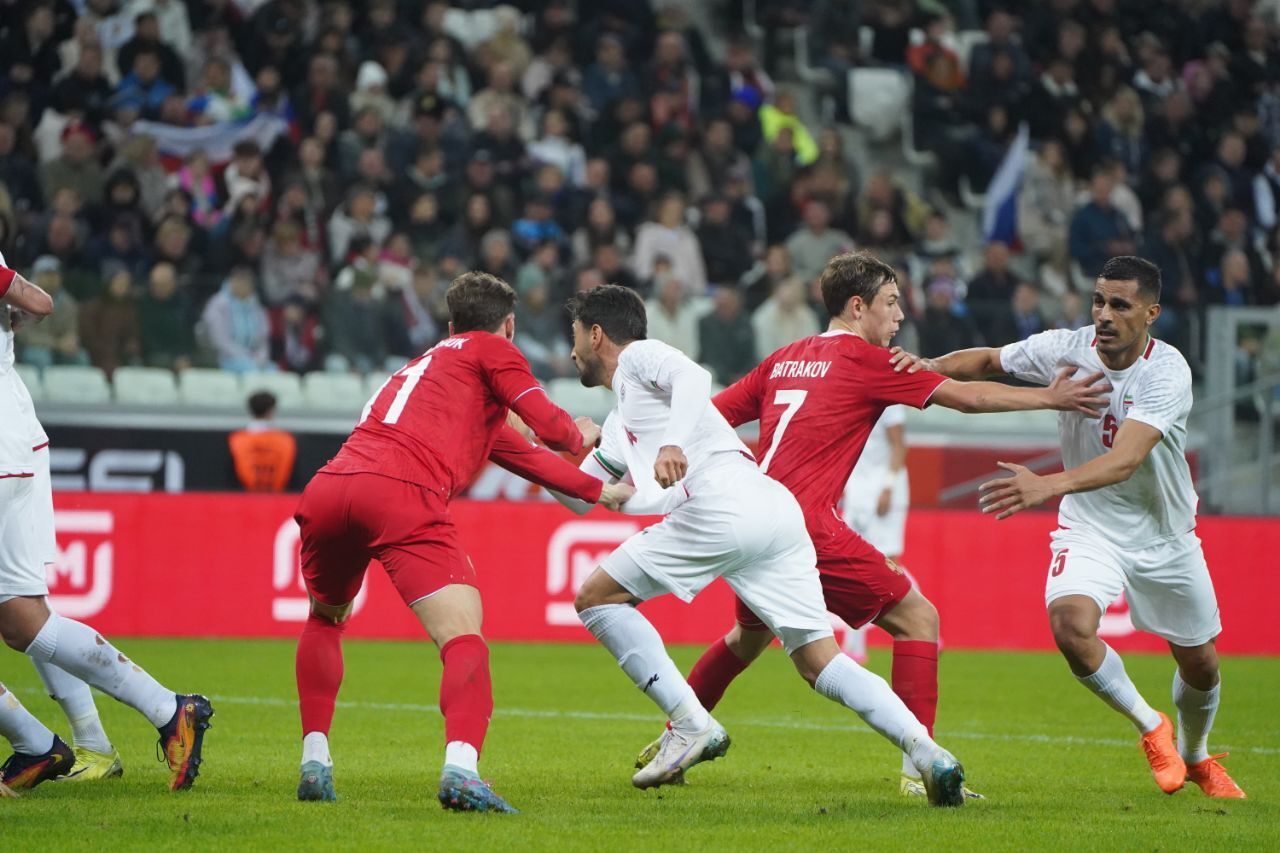
Team Melli will meet Russia in Kazan in a friendly match this evening (Tuesday) at the Ak Bars Arena, kick-off at 19:00 Moscow time (19:30 Iran time).
After the disappointing 3-1 defeat against Uzbekistan in Fergana, which was followed by mass criticism of the team and the coach, this match is supposed to be a chance for Team Melli to redeem itself. In reality, it looks more like another opportunity for Amir Ghalenoei’s limitations to be exposed. Little improvement can be expected from this over-age team unless the coaching staff finally confronts the horrendous defensive errors that have become routine. And that responsibility lies squarely with Ghalenoei.
His failures are not new. The defence lacks organisation, the midfield lacks ideas, and the attack depends on isolated moments rather than a coherent plan. The defeat to Uzbekistan was not simply a bad night; it was the logical result of poor selection, stale tactics, and an inability to react. Yet Ghalenoei is expected to do what he always does: stick with his old faithfuls, avoid drastic changes, and hope that familiarity somehow produces a different result.
The massive anti-Ghalenoei protests, especially on social media, may persuade him to make cosmetic changes to appease the fans and critics. He is good at that—offering the appearance of change while preserving the same failing core. A new face here, a tweaked formation there, and the critics are told to be patient. But cosmetic adjustments cannot hide tactical bankruptcy. Ghalenoei’s game plans remain below the standard required for a team with Iran’s talent, and his stubbornness has turned rebuilding into a permanent delay.
Tactics: Karpin’s 4-3-3 vs. Ghalenoei’s low block
September is Karpin’s first gathering since June. In their last match, Russia beat Trinidad and Tobago 3-0. Their 2026 record so far: victories over Nicaragua (3-1), Burkina Faso (3-0) and Trinidad and Tobago (3-0), a 0-0 draw with Mali, and a 0-1 defeat to Egypt.
Karpin has a clear plan:
- A 4-3-3 core, a departure from the cautious schemes of 2025.
- Pressure on the ball from the first minutes, aimed at a team accustomed to conceding possession and absorbing pressure.
- A defensive line of Adamov, Vakhaniya, Beveev and Diveev gives Karpin options: he can push the defenders wider to stretch Iran’s block, or send the full-backs forward.
- Miranchuk and Glebov operate in the creative zone between the lines.
- Golovin, as captain, sets the tempo and initiates attacks.
Iran Team is expected to make changes in the defensive line, with Hajsafy possibly remaining on the bench; Arya Yousefi and Khalilzadeh are possible starters. Up front Sardar Azmoun is expected to start alongside Mehdi Taremi.
Iran, by contrast, will likely set up a compact low block and look to attack the flanks of Russia’s defence. That is a reactive plan, not a proactive one—a reflection of Ghalenoei’s cautious and increasingly outdated approach. Russia’s task is to prevent the game from becoming a scrappy battle in the centre. If Iran score first, they will have to open up; if they concede, there may be an episode, because they know how to keep the scoreline respectable.
Prediction
The first half will be cautious, with set pieces important for both sides. The first goal will be decisive: Iran’s recent games have rarely produced an early breakthrough. Our assessment: a Russia victory, but not a crushing one. Karpin’s scheme is stronger than Iran’s one-on-one defending, though a compact block is difficult even for the hosts. The most likely scenario is a one-goal Russia win after the break. The last meeting between the two teams ended 2-1 to Russia.
For Ghalenoei, a narrow defeat would probably be spun as evidence of resilience. But it would be another mask over the same failures. Until Iran’s coach accepts that loyalty to old players and cosmetic tweaks are not a strategy, Team Melli will continue to survive matches rather than build a team.