
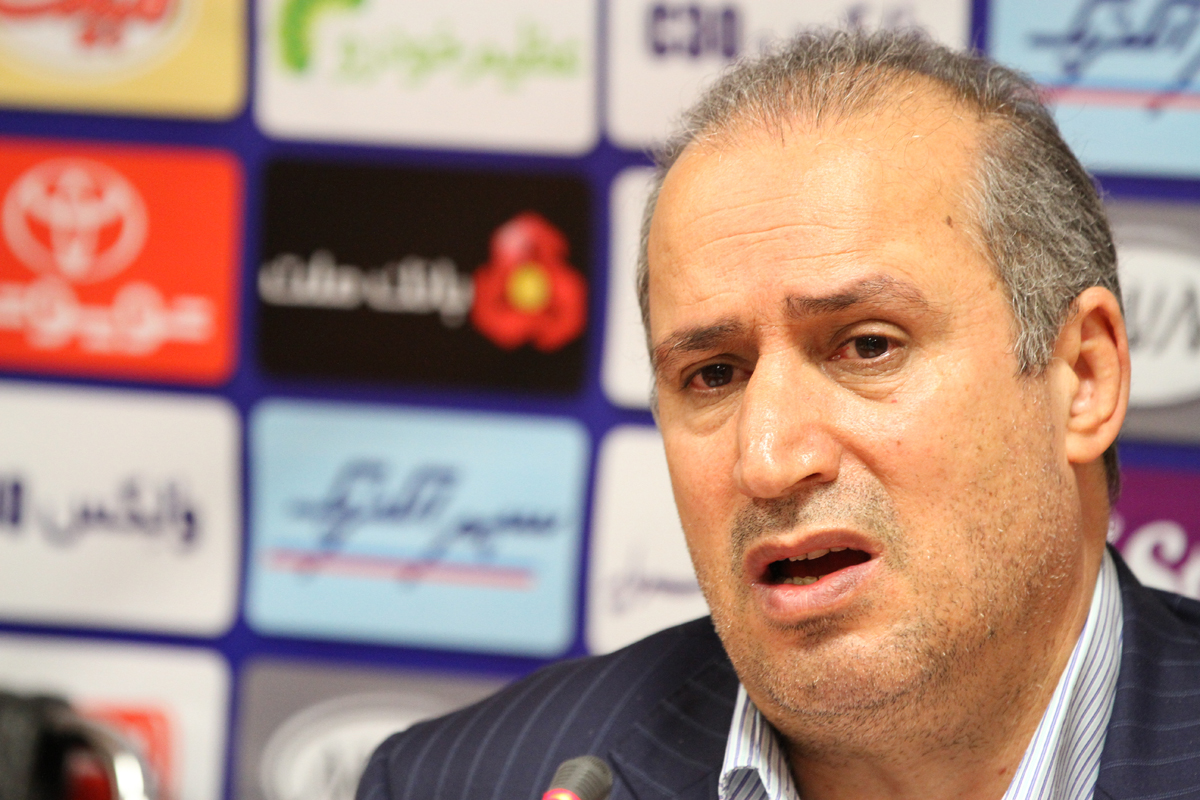
Several media outlets have reported that the judiciary has summoned several Football Federation of the Islamic Republic of Iran (FFIRI) managers and personnel over alleged embezzlement and misappropriation of government funds. The dispute concerns bonuses of about US$20,000 per person awarded to FFIRI managers after Iran qualified for the 2022 World Cup. The funds were intended to support FFIRI activities, including grassroots football development and daily expenses; instead, reports allege, they ended up in the pockets of federation president Mehdi Taj, his deputy Mohammad Nabi, and several other officials and board members. Mehr News Agency questioned the FFIRI and sought clarification.
It is worth noting that the bulk of the FFIRI’s expenses comes in the form of government handouts intended to sustain the operation of football activities—a fact that makes questions about the classification, oversight, and disbursement of such funds particularly sensitive.
“Case remains preliminary”
In response to the issuance of an indictment against Mehdi Taj and certain former members of the Board of Directors, the head of the Football Federation’s legal department stressed that the case remains at a preliminary stage.
According to a Mehr News Agency reporter, Mohammad-Ali Ghoddousi addressed the controversy surrounding the indictment of the federation president and former board members, saying: “Regarding the reports published in the mass media concerning the indictment of football officials and figures associated with the Federation, I feel it is necessary to highlight a few points.”
He continued: “The first and most obvious point is this: how does the media proceed to publish news about this matter before the individuals and stakeholders involved have even been formally notified? In other words, while the football officials have received no official or legal notice regarding the case, reports that an indictment has been issued are already circulating in the media. This matter warrants serious consideration.”
Legal status of the FFIRI
Referring to the Federation’s legal status, Ghoddousi stated: “Another significant point concerns the legal status of the Football Federation. The Federation is a non-governmental organization; based on the binding precedents set by the General Board of the Court of Administrative Justice, it falls outside the scope of executive agencies and public non-governmental institutions, and is recognized as a non-governmental institution with an independent legal personality.” He added that this distinction is important for the fundamental nature and legal consequences associated with the operations of the FFIRI and its officials.
The $20,000 bonus
Elaborating on the details, he said: “The sole issue in this case—and I emphasize, solely and exclusively—concerns the $20,000 bonus awarded to the Football Federation’s Board of Directors members. Following the successful qualification for the 2022 World Cup in Qatar, the then-senior official at the Ministry of Sport and Youth had allocated this sum to the Board members in recognition of their services and as a reward.”
The head of the FFIRI legal department continued: “All administrative and legal procedures regarding this matter within the Football Federation, a non-governmental entity, including the preparation of financial statements, the Board’s resolution, and the General Assembly’s approval, were carried out with precision, clarity, and transparency.”
Return of funds
Ghodousi clarified: “Despite all this, due to objections raised by the General Inspection Organization—and the subsequent complaint filed with the Culture and Media Prosecutor’s Office alleging that the Board members could not receive these funds because they were in a position of conflict of interest—the members proceeded to return the exact amount received to the originating account. They did so out of an abundance of caution and to absolve themselves of any potential accusations; thus, the matter is fully resolved in this regard.”
Indictment is preliminary
Regarding the issuance of an indictment, he added: “However, the complaint filed by the General Inspection Organization has—apparently, and I emphasize apparently, based on media reports—resulted in the issuance of an indictment.” Ghoddousi continued: “Naturally, an indictment is a decision that commands respect but is entirely preliminary; it is subject to review at the trial stage—specifically in Criminal Court No. 2—and, like other legal cases and complaints, is open to adjudication in both the court of first instance and the court of appeal. Therefore, for the time being, the matter has—apparently—only reached the stage of indictment issuance within the prosecutor’s office.”
Which law applies?
Addressing the legal basis of the case, the head of the FFIRI legal department remarked: “It appears that when the law is cited in this interview, one must ask: which law? The specific law is not identified. We ought to ask the interviewee: ‘Are you well-versed in the law—specifically the law pertaining to this matter?’”
He added: “If the reference is to Note 5 of Article 5 of the Law on Intensifying Punishment for Perpetrators of Embezzlement, Bribery, and Fraud, I must point out that this note applies to government organizations or institutions managed with continuous state aid; furthermore, Note 5 specifically employs the term ‘Minister.’”
Ghoddousi continued: “This implies that the provision applies to a government employee. Moreover, I emphasize that under Note 5, the Minister may act—meaning the necessary authority is granted to the Minister—yet the Minister is under no obligation to do so.” He clarified: “However, given the Football Federation’s legal status as a non-governmental institution—falling outside the scope of executive agencies or public non-governmental bodies—it appears that this provision and its subject matter should not, and cannot, extend to the Football Federation or its officials.”
Concluding the first part of his remarks, he said: “I remain at the service of the dear people of Iran. Good day.”
Audit and ethics findings
Continuing, Ghodousi noted: “There is another important point I must raise: the State Audit Court has examined the matter and, based on legal grounds and reasoning, found no evidence of any violation.” He added: “Similarly, the Football Federation’s Ethics Committee investigated the issue and, finding no violation, issued a ruling of acquittal.”
It also bears mentioning that the FFIRI—at least as a matter of ethics and transparency—has never publicly disclosed this case at any point since 2022. It was investigative journalism that brought the matter to light, which raises the question of why the FFIRI and its legal department failed to disclose both the incident and the subsequent investigation.