

Team Melli travels by road to Van , Turkey.
As Iran continues to face relentless Israeli/American military aggression, including direct strikes on its territory, civilian targets such as a Girls school and the assassination of its leaders, military commanders, and nuclear scientists, the national football team is preparing to navigate a complex path forward.
Head coach Amir Ghalenoei has announced a 35-man preliminary squad for the upcoming March training camp and two high-profile friendly matches against Nigeria and Costa Rica. The camp, set to commence in Turkey, represents a crucial step in Team Melli’s preparation for the future, even as the nation endures one of the most volatile periods in its modern history.
The announcement comes as Iran remains under sustained attack, making logistics quite a complicated task. Economic and military sanctions have further strangled infrastructure, and the sports sector has not been immune to these pressures.
In this context, Team Melli’s activities abroad are not merely logistical exercises; they are acts of resilience. The decision to hold the camp and matches in Turkey is a direct result of the security situation. With the nation under bombardment and airspace frequently compromised, hosting international teams inside Iran is currently impossible. The federation’s ability to arrange fixtures, secure flights, and guarantee the safety of players and staff has been severely tested by the twin pressures of war and sweeping sanctions.
The Squad: A Blend of Veterans and a High-Profile Debut
Ghalenoei’s roster reflects a strategy of continuity, veteran players, and the integration of some fresh talent. The squad is headlined by the return of out-of-favor Mehdi Torabi , Ehsan Hajsafi and the introduction of a dual citizen Iranian. Dennis Eckert.
There are several significant talking points in this squad, the most important of which is the exclusion of top scorer Sardar Azmoun for allegedly posting a picture with the ruler of Dubai in his social media post. Also, the first-ever call-up for Dennis Eckert, the 29-year-old Iranian-German forward currently plying his trade for Standard Liege in Belgium. Eckert, who is eligible to represent Iran through his heritage, has been granted the necessary permits from FIFA to switch his international allegiance. His inclusion is seen as a major coup for the federation, adding a powerful, physical presence to the forward line. Eckert’s ability to operate as a central striker or on the wing provides Ghalenoei with tactical flexibility against physically robust opponents like Nigeria.
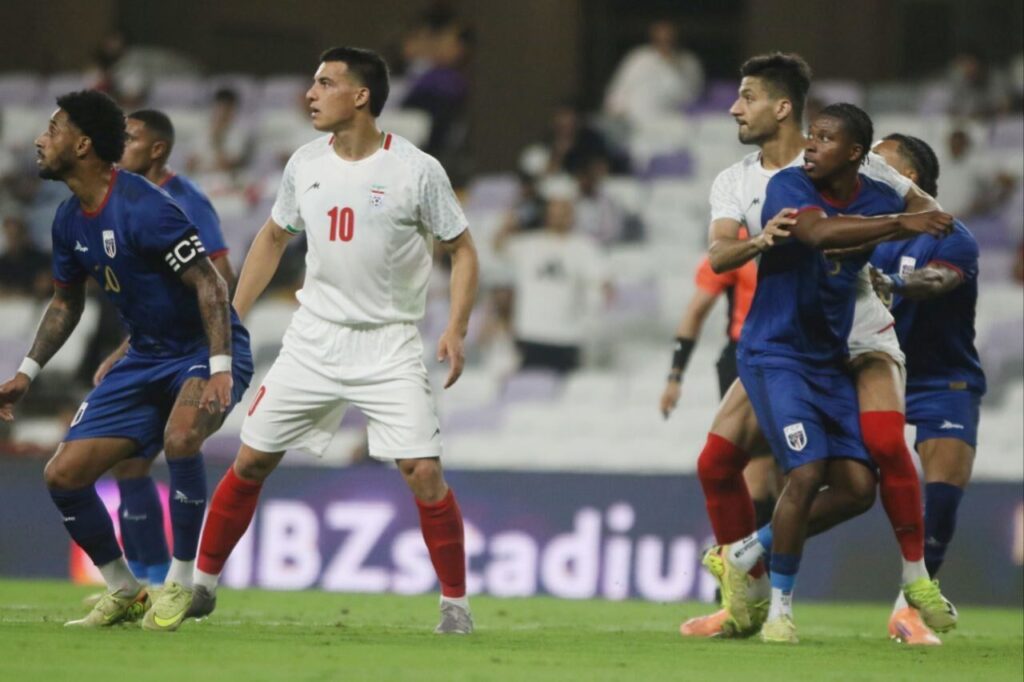
The full 35-man squad is as follows:
- Goalkeepers: Alireza Beiranvand, Seyed Hossein Hosseini, Payam Niazmand, Mohammad Khalifa.
- Defenders: Ali Nemati, Hossein Abarghouei, Shoja Khalilzadeh, Saman Fallah, Mohammad Hossein Kanaanizadegan, Danial Iri, Ehsan Hajsafi, Milad Mohammadi, Abolfazl Jalali, Saleh Hardani, Ramin Rezaeian, Danial Esmaeilifar.
- Midfielders: Saeid Ezatolahi, Mohammad Ghorbani, Omid Noorafkan, Saman Ghoddos, Amir Mohammad Razzaghinia, Mohammad Mohebi, Mehdi Ghayedi, Mehdi Torabi, Hadi Habibinejad.
- Forwards: Mehdi Taremi, Amir Hossein Mahmoudi, Alireza Jahanbakhsh, Ali Gholizadeh, Mehdi Hashemnejad, Ali Alipour, Shahriyar Moghanlou, Ehsan Mahrougi, Amir Hossein Hosseinzadeh, Dennis Eckert.
The Matches: A Litmus Test Amidst Isolation
Team Melli is scheduled to face Nigeria (March 27) and Costa Rica (March 31) in Antalya, Turkey. These fixtures are considered a significant upgrade in opposition quality compared to many of Iran’s recent friendlies, which have been difficult to arrange due to the country’s political isolation.
The match against Nigeria, one of Africa’s powerhouses, will serve as a physical and tactical litmus test. The Super Eagles possess blistering pace and individual brilliance, mirroring the style of some Asian opponents while presenting a higher intensity. The game against Costa Rica, a team renowned for its defensive organization, will offer a different challenge, simulating the type of low-block defenses Iran often struggles to break down in Asian competitions.
For Ghalenoei, whose position is often a subject of intense public debate, these matches are an opportunity to demonstrate progress against top-tier opposition. The results, while secondary in friendlies, carry psychological weight for a nation seeking moments of pride and normalcy amidst the chaos of war.
Logistical Challenges Under Fire
The decision to hold the camp in Turkey is a pragmatic necessity born of crisis. Due to the ongoing bombardment of Iranian territory, the constant threat of further Israeli airstrikes, and the stringent enforcement of American-led sanctions, hosting international teams in Iran has become impossible. Turkey serves as the only viable logistical hub, allowing Iranian players based in Europe—such as Taremi, Ali Gholizadeh and Jahanbakhsh- to join the camp with minimal risk.
FFIRI has confirmed that news and images of the team’s preparations and departure will be disseminated through official media channels, attempting to maintain transparency and connect with a fan base eager for distraction from the relentless news of military strikes and regional escalation.
Conclusion: A Selection Defined by Caution, Not Courage
Ghalenoei's 35-man squad lays bare the conservative philosophy that has come to define his tenure. Rather than using these friendlies—played under exceptional circumstances—as an opportunity to inject fresh blood into the national team, the head coach has doubled down on familiarity, leaning heavily on a core of aging veterans whose best years are behind them.
The inclusion of Shoja Khalilzadeh (37) , a controversial figure whose presence has often divided fans and pundits alike, alongside the returns of Ehsan Hajsafi (36) , Ramin Rezaeian (36) , and Alireza Jahanbakhsh (33) , speaks volumes. In the case of Jahanbakhsh, the call-up is particularly difficult to justify; he has been far from impressive while playing for a struggling club at the bottom of the Belgian league. These selections reflect a coach who prioritizes experience over form and familiarity over potential.
To be sure, Ghalenoei will have excuses at the ready. The suspension of domestic league matches has deprived him of a meaningful rhythm to evaluate younger talent. The broader dearth of high-quality options within the league, exacerbated by the suffocating geopolitical situation and the ongoing war that has disrupted every facet of Iranian life, has undoubtedly limited his pool. These are not trivial obstacles, and they will serve as convenient justifications should the team's performances in Turkey fall short of expectations.
And yet, even accounting for these constraints, the squad reveals a deeper issue: a chronic lack of ambition from the coaching staff. Where a more daring manager might have used the chaos as cover to experiment and build for the future, Ghalenoei has clung to his policy of continuity regardless of circumstances. The result is a selection that feels safe to the point of stagnation.
More than a handful of players in this 35-man list have done little to earn their place on merit alone. Their presence suggests that Ghalenoei is content to ride or die with the old guard, using the league suspension and the regional crisis as a shield against criticism rather than a challenge to innovate.
In sum, this is a disappointing selection—not merely because of the geopolitical nightmare the nation is enduring, but because it reflects a coach whose perennial fear of risk continues to hold Team Melli back from the evolution it so desperately needs.