
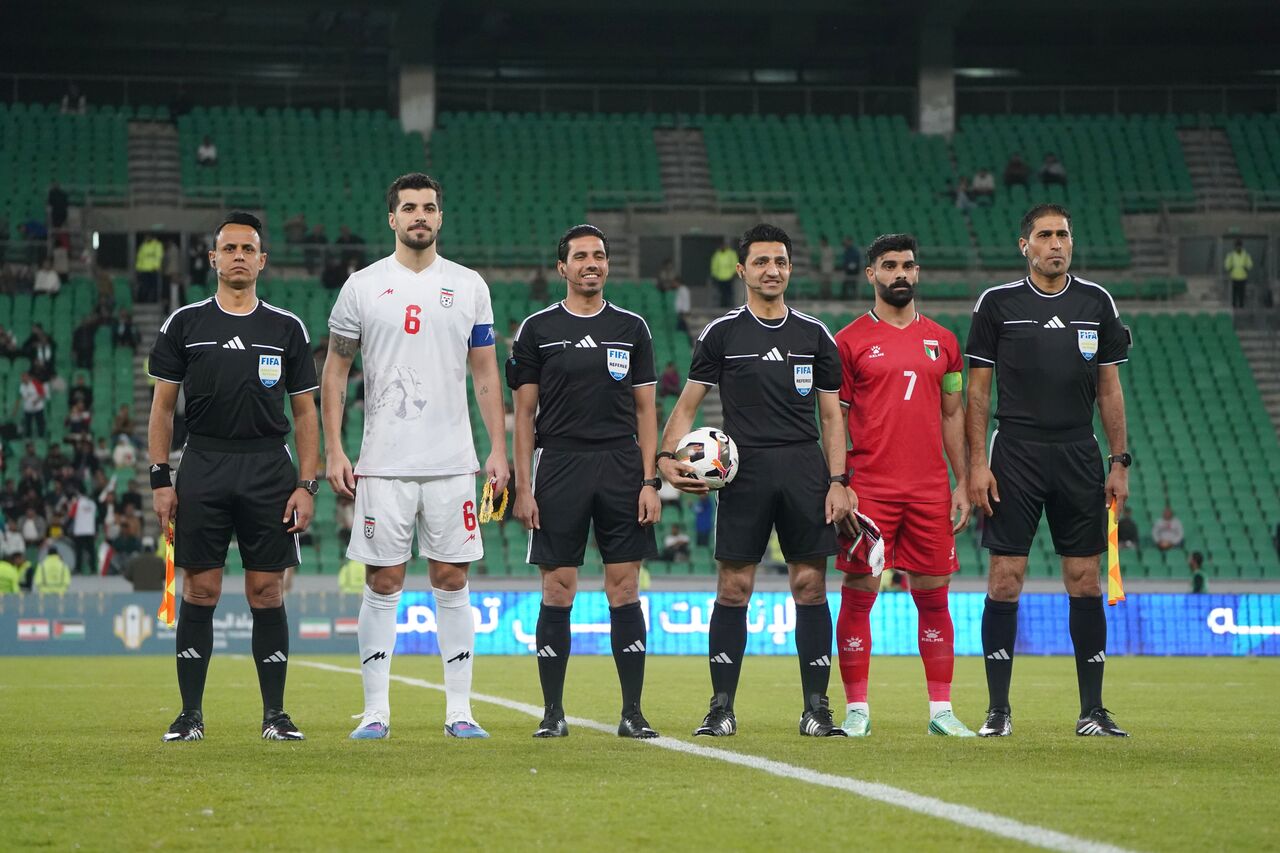
Team Melli secured a 2–0 victory in Basra after a goalless first half. While the win—achieved after months of waiting for head coach Amir Ghalenoei—was a welcome result, it raised serious questions about the quality of the squad's performance rather than serving as an indicator of technical progress. This marked Ghalenoei's first victory since a 2–0 friendly win against Mali on June 3, 2026; however, the team struggled significantly to find the back of the net for much of the match against Palestine.
During the game, Ghalenoei utilized two almost entirely different lineups for each half—with the exception of Mohammad Mehdi Zare, Payam Niazmand, Abolfazl Razzaghpour, and Mehdi Limouchi, who did not see any playing time. These extensive changes suggested that the head coach was looking to evaluate various players, yet the rotation failed to mask the team's glaring technical and tactical shortcomings. Japan versus Brazil; Iran versus Palestine! Perhaps comparing the performance of the Iranian national team with that of Japan on the same evening offers the clearest illustration of the gap between the two nations' football standards. Just hours before the Iran–Palestine match, Japan defeated Brazil—the most decorated team in World Cup history and a five-time champion—by a score of 3–2, with Brazil fielding their star players. This result serves as further proof that Japan's position at the top of the Asian FIFA rankings is no fluke; the team possesses a clear strategy and a solid technical foundation to sustain its standing in continental football. It also highlights the quality of the coach, Hajime Moriyasu, who is leaving the post he has held since 2018.
A Win Built on Circumstance, Not Cohesion
Meanwhile, Team Melli faced a Palestinian side that, according to sources, was missing eight key players due to injury, while seven others had declined to join their national team for this FIFA international window. Consequently, Iran played against a squad grappling with significant challenges in preparation and squad selection, with 15 players absent. This fact further diminishes the significance of the result achieved. An opponent's sending-off paved the way for goals! A notable aspect of this match was the inability of Ghalenoei's men to score against Palestine before the opposition was reduced to 10 men.
Despite their technical superiority and a roster featuring more experienced players, the Iranians could not find a way past the opposing defense until the 65th minute. It was only after the dismissal of Sawafta that the pressure intensified, allowing Iran to score twice.
The Tactical Void: No Plan Beyond the Flank
This episode once again exposed the poverty of Ghalenoei's attacking blueprint—or rather, the absence of one. Throughout the match, Iran lacked any clear, structured, or varied approach to reaching the opponent's goal. There was no discernible pattern of play, no coordinated movement in the final third, no attempt to break Palestine's defensive block through central combinations, quick one-twos, or intelligent off-the-ball runs. Instead, the team's entire attacking repertoire consisted of hopeful crosses from the flanks—a one-dimensional formula that any organized defense can neutralize with ease. Ghalenoei's men did not probe, did not vary the tempo, and did not ask questions of the Palestinian backline until numerical superiority gifted them space.
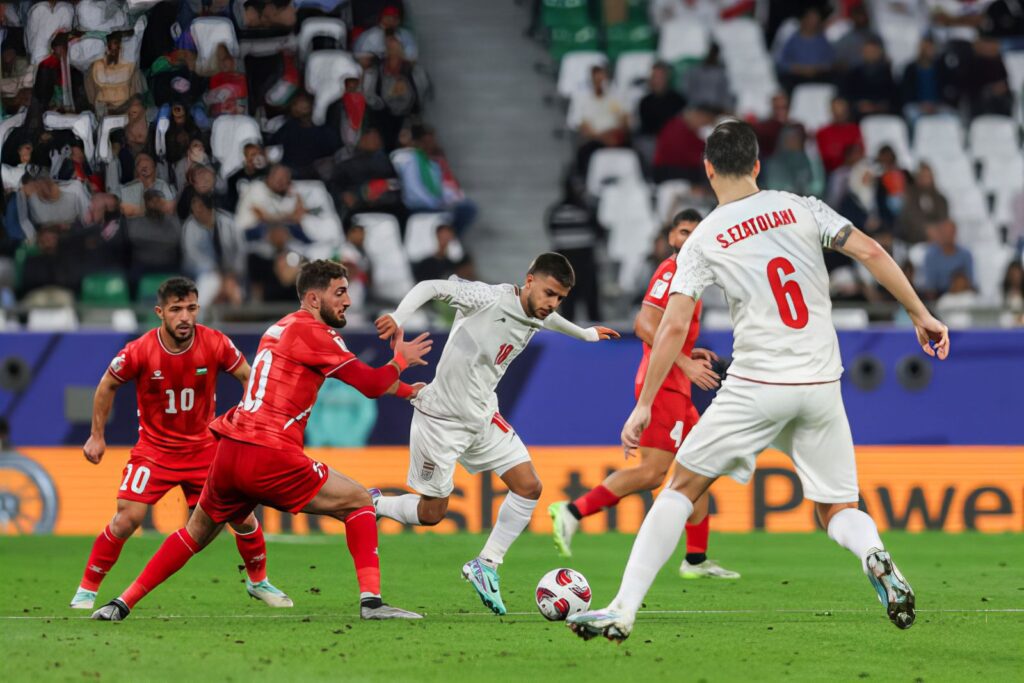
The fact that both goals arrived only after the opposition was reduced to ten men is damning. It suggests a coach incapable of devising a Plan B, a tactician who relies on circumstance rather than invention. Against a full-strength, well-drilled opponent, the kind Iran will inevitably face in the knockout stages of the Asian Cup, such tactical naivety will be ruthlessly punished. Hossein Goudarzi, the in-form Esteghlal defender, played a pivotal role in the second half by providing two assists—for Sardar Azmoun and Saleh Hardani—underscoring that crosses from the wings remain one of the few effective methods Iran has for scoring goals. But when a defender is your chief creative outlet, the attacking strategy is already bankrupt. Ghalenoei's persistence with this predictable, cross-heavy approach—without any discernible adjustment or innovation—raises serious doubts about his ability to construct a coherent attacking identity for a squad of Iran's caliber.
Amid all this, a few words must be said about the quality of Javad Hosseinnejad. The midfielder delivered a commanding performance, displaying flair, skill, and vision—the hallmarks of a genuinely quality player. His display raises an unavoidable question: why has Ghalenoei left a player of this caliber out of several squads while including players who are far less capable??
The "Rejuvenation" Narrative: What Has Actually Been Achieved?
Team Melli is participating in the Basra tournament holding the highest FIFA ranking (23rd) among the four competing nations—Iraq, Lebanon, and Palestine—and boasts a superior international standing and higher-caliber players on paper. Yet, alongside the team's actual results, the coaching staff and the Football Federation's media channels have consistently emphasized a "rejuvenation" (youth-oriented) strategy. This propaganda serves as a defensive mechanism—and, in some measure, betrays the federation's and the head coach's guilt over neglecting youth and other better players than the ever-present seniors.
The average age of Iran's starting lineup against Palestine was 26 years and one month—a figure that hardly aligns with the narrative of a sweeping rejuvenation of the national team. It seems that every time a new squad list is announced, the term "rejuvenation" becomes a central theme in the coaching staff's statements and the Federation's official communications. A casual observer following these reports might easily assume that the national team's roster consists primarily of players under the age of 23. While the inclusion of a few young players is noteworthy, simply swapping out a few names and marginally lowering the average age does not constitute a serious "rejuvenation project"—especially considering that the opponent, Palestine, is neither a major contender in Asia nor a significant force in global football.
Interestingly, on that very same night, the Japan, with an average age only one year higher than Iran's starting lineup—managed to defeat Brazil 3- 2, even with Brazil fielding its full-strength squad. Ultimately, the issue is not merely whether players are young or experienced; what truly matters is the quality of football displayed, the technical planning, and the ability to effectively harness the players' potential. This is a feature clearly evident in Japanese football, whereas the Iranian national team continues to struggle to establish a reliable attacking structure under a coach who has shown little appetite for tactical innovation.
Diminished Expectations
Is merely advancing from the group stage—rather than winning the championship—considered an achievement? Amir Ghalenoei recently stated that the Iranian national team would perform better in the AFC Asian Cup than it did in the World Cup; however, he stopped short of promising a top-four finish or a spot in the final. Given the team's current state and what was observed in the match against Palestine, one must ask: does the head coach's notion of "better performance" simply mean getting past the group stage of the Asian Cup? If this is indeed the goal set for the national team, it highlights just how significantly expectations for Iranian football have diminished—especially for a squad that boasts both domestic and legionnaire players.
What is more disturbing is the confidence with which Ghalenoei speaks about the next Asian Cup. It seems that the FFIRI has already decided that Ghalenoei will be the coach for a long time to come—a prospect that, on the evidence of this performance, should alarm anyone who cares about the future of Iranian football.