
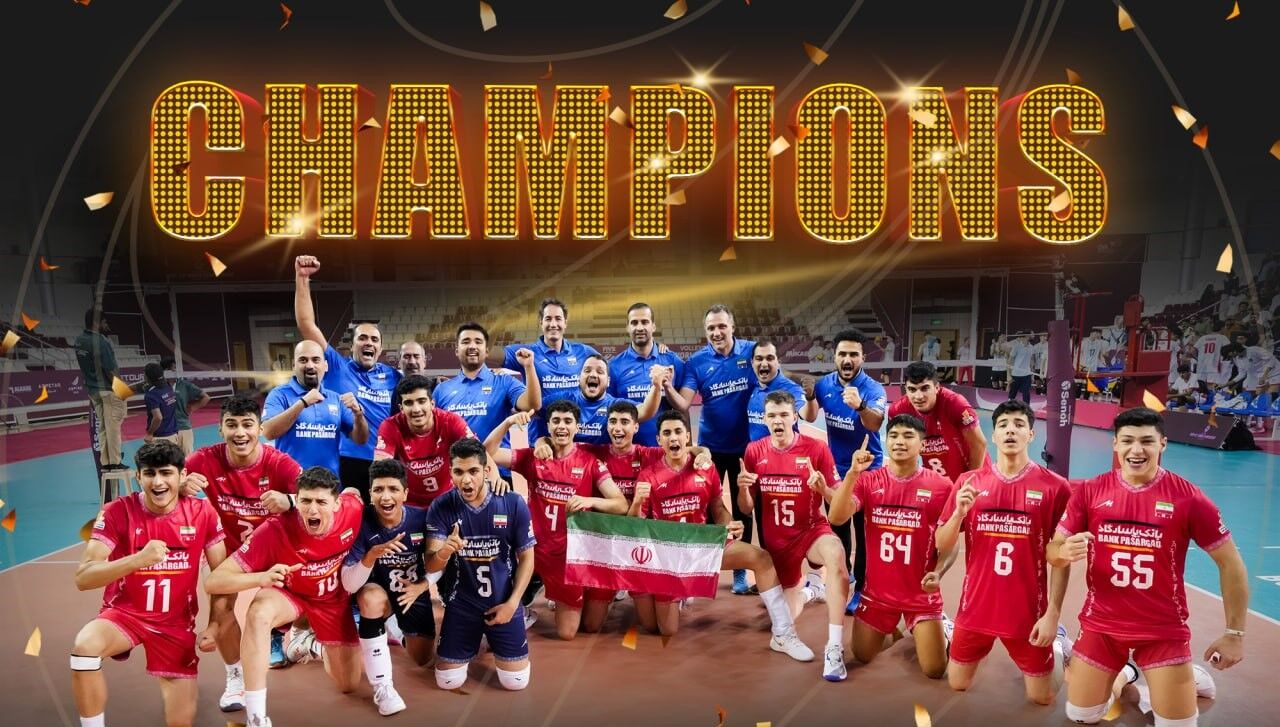
On Saturday, Iran’s U17 volleyball team clinched the world title in Doha, defeating their French counterparts to complete a remarkable sweep of age‑group world championships. This latest achievement adds yet another glittering accolade to Iran’s volleyball legacy—and reaffirms the sport’s status as the country’s most successful athletic federation since the 1979 Revolution.
Once considered a respectable but mid‑to‑lower‑ranked volleyball nation in Asia, Iran has now firmly established itself among the global elite. Its senior team has competed in the prestigious Nations League for a decade, consistently holding its own against the world’s best. This trajectory from regional obscurity to world‑class standing is a testament to strategic vision, sound management, and relentless grassroots development.
Yet, against this backdrop of triumph, one cannot help but ask a troubling question: Why has this extraordinary success—at all levels, in management, infrastructure, and on‑court performance—not been replicated by other federations, especially those enjoying far greater government financial support?
The glaring example is the Iranian football federation. Since the revolution, it has been mired in a cycle of disappointment and underachievement. Led largely by individuals who have lacked the acumen, drive, and strategic foresight to elevate Iran’s football, the federation has repeatedly fallen short on both domestic and international stages. While a comprehensive analysis of the volleyball federation’s decades‑long work is beyond the scope of this article, a simple comparison of outcomes speaks volumes: the Iran Volleyball Federation (IRIVF) has delivered world‑class results on a fraction of the budget allocated to its football counterpart (FFIRI).
To understand this disparity, one must look at the bigger picture—and it starts at the top. Volleyball has consistently been steered by competent, skilled managers who have devised and adhered to long‑term strategies since the mid‑1980s. Today, those plans are bearing fruit, but the foundation was laid years ago through patience, discipline, and a clear sense of purpose.
The Financial Factor
Football in Iran generates enormous revenue. Clubs are heavily subsidised by the state, yet financial oversight is weak and auditing is often superficial. Money flows freely, but it is frequently wasted—or worse, embezzled. This is the result of an unspoken pact between negligent club officials and complacent government bodies, each profiting from opaque transactions while the sport itself stagnates.
Volleyball, in contrast, has never been a magnet for quick‑money schemes. Until recently, the sport operated on modest budgets; only with the arrival of corporate backing—notably from telecommunications companies—has the federation’s financial position improved. Agents and intermediaries have little influence over policy or selection, and there are few opportunities for unscrupulous individuals to exploit the system for personal gain. This is not to suggest that volleyball is entirely free of misconduct, but the federation’s consistent record of regional, continental, and world success insulates it from the chaotic and corrupt practices that plague football.
Coaching Excellence
One of volleyball’s greatest strengths is its ability to produce a steady stream of accomplished Iranian coaches. This is no accident. It is the outcome of a deliberate, phased process: top‑quality players, upon retirement, enter coaching programmes that emphasise proper training, certification, and incremental experience—starting with junior club sides and progressing through various levels before taking charge of the national team.
Compare this with football, where a player can hang up his boots one day and take over a league club the next. There is a pervasive belief that expensive European coaching courses are unnecessary for managing in Iran’s top flight. This “fast‑lane” mentality explains why volleyball has cultivated a superb grassroots foundation while football languishes as a third‑tier nation in Asia at youth levels.
The Media’s Double‑Edged Sword
Despite modest media coverage overall, volleyball has managed to double or even triple its popular support in Iran through consistent planning, grassroots engagement, international exposure, and prudent spending. Yet, the country’s sporting media remains overwhelmingly fixated on the two Tehran giants, Persepolis and Esteghlal. Almost every news report references these clubs, creating a bipolar media landscape that leaves little room for other sports.
For volleyball, however, this relative neglect has been a blessing in disguise. Without the intense rivalries and controversies that fuel football’s headlines, the sport enjoys an immunity from the venomous media battles that often distract and destabilise. There is no “Esteghlal versus Persepolis” equivalent in volleyball—and that absence of constant conflict allows the sport to focus on what truly matters: performance and development.
Rising Popularity Among the Youth
Iran’s volleyball success has had a profound impact on the younger generation. Increasingly, young athletes are choosing volleyball over football when it comes to team sports. The sight of so many Iranian volleyball players securing contracts in Europe and other leading leagues serves as powerful inspiration. More regional clubs are embracing volleyball, and they are consistently producing high‑quality players across all age groups—especially at the grassroots level. This virtuous cycle reinforces the sport’s growth and ensures a bright future.
Conclusion
One can only hope that the football federation will learn from volleyball’s exemplary model of sustained achievement. The lessons are there: visionary leadership, financial discipline, rigorous coaching development, and insulation from counterproductive media sensationalism. Realistically, however, such hope may be wishful thinking. Volleyball’s success is no accident—it is the product of decades of hard work, integrity, and intelligent planning. Whether football can summon the will to follow suit remains to be seen, but the blueprint is clear for all to examine.