
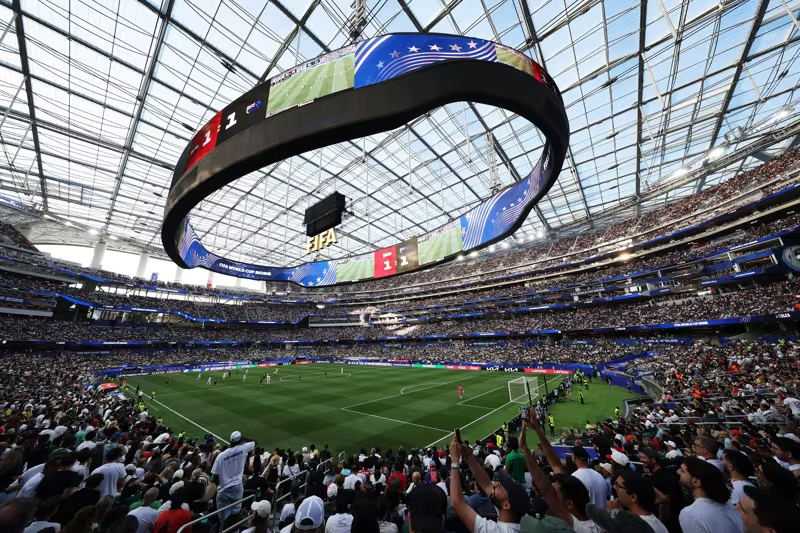
Team Melli's 2-2 draw against New Zealand—a match widely perceived as the most winnable of the three group fixtures—has drawn fierce criticism toward head coach Amir Ghalenoei and a host of underperforming players. With the toughest test of the group stage arriving tomorrow against Belgium, Ghalenoei finds himself with no room for error. He must not only mitigate the expected damage but also salvage Iran's fading hopes of advancing to the knockout rounds.
Limited Options, Limited Vision
Frankly, Ghalenoei does not have a wealth of options at his disposal. The squad lacks strength in depth, and there is no clearly defined, coherent game plan that the coach can confidently deploy. Nevertheless, it is imperative that the technical staff rise to the occasion and devise a strategy capable of neutralizing a completely different threat in the form of Belgium's golden generation.
Defensive Crisis – The Achilles' Heel
The most critical area of concern remains the backline. Alireza Beiranvand is the only viable option in goal, despite a performance against New Zealand that did little to inspire confidence. His shot-stopping was suspect, and his distribution remains a persistent liability.
In central defense, the options are available but far from reassuring. Shoja Khalilzadeh is slow, error-prone, and was directly at fault for both goals conceded against the Kiwis. Ali Nemati offered little alongside him, displaying minimal understanding or coordination with his partner. It is becoming increasingly apparent that Nemati is uncomfortable in the heart of Iran's defense at this level.
The alternative is Mohammad Hossein Kanaanizadegan, Khalilzadeh's usual partner, who has inexplicably found himself on the bench. Also available is Danial Eiri, but selecting him would require a level of courage that Ghalenoei has conspicuously failed to demonstrate throughout his tenure. The odds strongly favor Kanaanizadegan's return to the starting lineup alongside Khalilzadeh, tasked with the unenviable job of neutralizing Romelu Lukaku, who is expected to lead Belgium's attack.
Flank Warfare – Containing the Doku Threat
On the flanks, Ghalenoei has a potential solution in the form of Saleh Hardani—a tenacious, hard-tackling defender who can be deployed specifically to contain the explosive Jérémy Doku. However, Hardani alone may not be sufficient to neutralize a player of Doku's caliber.
This is where Ramin Rezaeian becomes pivotal. By utilizing Rezaeian in a dual role—operating as both a pseudo-right-back and an attacking right winger—Ghalenoei could kill two birds with one stone. Rezaeian possesses the experience, skill, and quality to execute such a demanding role, and history has shown that the closer he gets to the opponent's goal, the more influential he becomes. Deploying both Hardani and Rezaeian simultaneously would create a defensive-offensive partnership while ensuring there is no empty space behind Rezaeian for Doku to exploit on the counter.
Midfield Malaise – Time for Change
The midfield was arguably the weakest link against New Zealand, with Saeed Ezzatollahi and Saman Ghoddos delivering performances that ranged from anonymous to outright detrimental. Introducing Mohammad Ghorbani could provide much-needed defensive solidity and energy in the middle of the park. Ghoddos, for his part, faces no serious challenger for his position—but that is more a reflection of the squad's lack of depth than his own form. The hope is that he will finally wake up and deliver a performance worthy of his reputation against Belgium.
Frontline Adjustments – Time for Ghaedi
In attack, starting Mehdi Ghaedi could give Iran the creative spark and dribbling threat that was sorely missing against New Zealand. Keeping Mohammad Mohebi and Mehdi Taremi in their respective positions remains the best available solution, but Ghalenoei must ensure that the forward line operates with greater cohesion and understanding than it showed in the opener.
The Mental Battle – Composure Is Key
Beyond tactics and personnel, Ghalenoei and his coaching staff must address the emotional fragility that plagued the team against New Zealand. Haste, confusion, and a lack of composure were evident in nearly every area of the pitch. Experienced Iranian players repeatedly failed to execute simple moves or complete basic passes—a damning indictment of their mental state. With only hours remaining before the Belgium clash, this psychological deficiency must be urgently addressed. Whether it can be fixed in such a short time remains highly doubtful.