
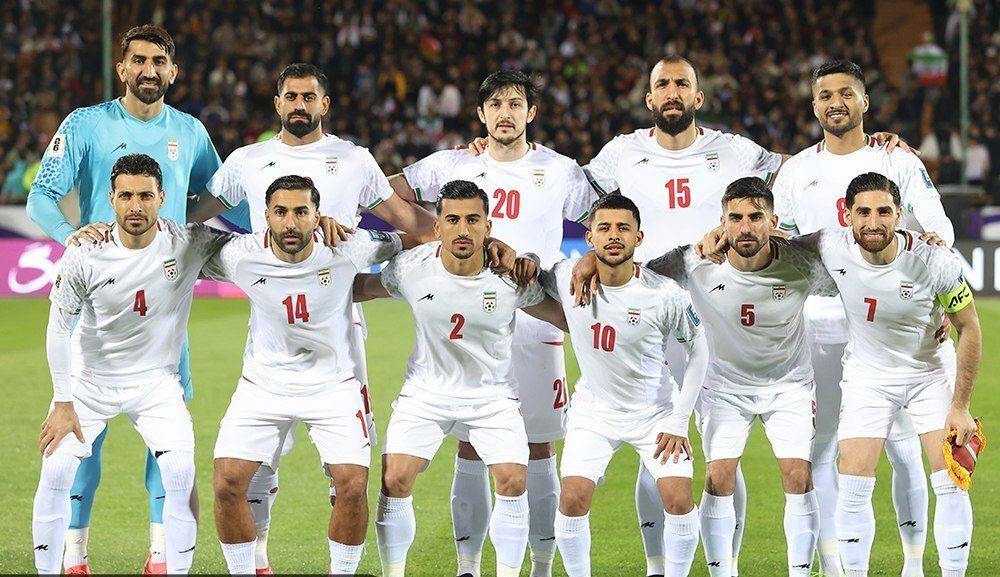
Team Melli is set to play against Russia this evening in Volgograd, in another attempt by head coach Amir Ghalenoei to restore the waning confidence of the Iranian fans.
For Ghalenoei, the approach remains largely unchanged, with only minor squad rotations. The one bright spot is the inclusion of Kasra Taheri, the promising U23 star, though whether he will see any playing time remains to be seen.
This match against Russia—a nation banned from the international arena by what many see as a hypocritical FIFA—presents an opportunity for Iran to test itself against tough opposition. Unlike the weak standard of Iran's domestic league, the Russian Premier League remains strong and competitive despite its European ban, which has sidelined clubs like Zenit and Spartak. In stark contrast, Iranian clubs are arguably at their lowest level in decades. Esteghlal's recent 7-0 defeat to Al Wasl of the UAE in a secondary Asian competition highlights how far Iran's best clubs have fallen.
This domestic decline is directly reflected in the quality of players and the game plans of Team Melli. For years, the national team could depend on its legionnaires (players based abroad) to cover for these shortcomings, but that is no longer the case. With Sardar Azmoun sidelined for an extended period following surgery, the forward line is overly dependent on Mehdi Taremi. While Taremi started brilliantly at Olympiacos after his move, he now struggles to secure a starting spot for the Greek club.
The situation is even more concerning for Team Captain Alireza Jahanbakhsh, who currently does not have a club to train with, let alone play competitive matches—a basic requirement for international duty. In Ghalenoei's book, however, this does not seem to matter.
Other legionnaires are not in better shape. Allahyar Sayyadmanesh, a player of great promise, has been underperforming in the Belgian league with KVC Westerlo. Since his transfer, he has played six matches, scoring no goals and providing only a single assist. Ghalenoei's selection criteria remain a point of contention.

Adding to the controversy is the recall of 37-year-old Shoja'a Khalilzadeh to the defense—a unit in dire need of fresh energy after consistently conceding goals. The central midfield is another area of concern, as a chronic lack of service to the forwards has hampered the team's attacking potential. Saman Ghoddos, the team's creative maestro, is suffering a dip in form and has been uninspiring lately, requiring courage from Ghalenoei to revitalize this critical line.
The goalkeeping position also raises questions. None of the options have been shining for their clubs. Payam Niazmand, who replaced the suspended Alireza Beiranvand, was far from solid and has not proven himself a capable replacement. Beiranvand is most likely to start, but his form is not at its peak either.
Historically, Iran and Russia have met three times, with Team Melli winning once and drawing the other two. Russia comes into the match undefeated in its last five outings, including an impressive 4-1 win against Qatar in September, though they have largely faced Asian and African opposition rather than European teams.
Team Melli is playing its first match since a narrow defeat to Uzbekistan, prior to which it had three wins and a draw. The match in Volgograd should be a balanced affair, with current form and home-ground advantage favoring the Russians under coach Valery Karpin. Kickoff is at 20:00 local time at the sold-out Volgograd Arena.